
A diversified conglomerate in Baghdad, Basra, and Erbil uncovered hidden workforce health issues. Chronic disease claims were climbing, mental health absences were rising, and nearly a third of employees missed over five days of work annually. After introducing an Arabic-language EAP and chronic condition management, absenteeism fell 17% in six months.
Iraq’s workforce is under a significant health burden. A nationwide study (July 2024–Feb 2025) found severe depression in 20.4% and anxiety in 12% of adults, with higher rates in middle and southern Iraq. Among employees, 43.5% reported anxiety and 28.7% depression. These issues affect workers across Baghdad, Basra, Mosul, Erbil, Sulaymaniyah, Kirkuk, and Najaf.
Non-communicable diseases add another layer. Between 2003 and 2021, diabetes and kidney disease increased by 42.9%, while cardiovascular disease remains the leading cause of NCD deaths. Over 20% of NCD deaths occur in young workers, directly impacting productivity, turnover, and healthcare costs.
Iraq’s digital health market is growing, projected at USD 228.18 million in 2025. Smartphone and internet penetration enable scalable app-based wellness delivery across the country. Employers now treat wellness as a measurable business investment. This guide identifies credible corporate wellness providers in Iraq, shows what they deliver, and helps decision-makers choose the right partner for a workforce under real pressure.
Curious about wellness trends in neighboring Middle Eastern countries? Discover corporate wellness in Saudi Arabia, the UAE, and Qatar to see regional best practices.
What Is a Corporate Wellness Provider?
A corporate wellness provider partners with employers to design and deliver structured health and wellbeing programs. It goes beyond a basic health check or insurance card, creating a measurable system that addresses the full range of employee health challenges.
Wellness in Iraq in 2026 is holistic, covering mental, physical, financial, and social health. Employees often face multiple pressures simultaneously – workplace stress, chronic conditions, financial anxiety, and societal instability. Programs must be culturally adapted and available in Arabic.
Providers generally operate across three service levels:
- Preventive health: health risk assessments, biometric screenings, ergonomic evaluations, and workforce audits to catch issues early.
- Clinical and curative support: telehealth, GP access, specialist referrals, physiotherapy, chronic disease management, and rehabilitation to keep employees functional.
- Lifestyle and mental wellness: EAPs, counseling, stress management, fitness, nutrition, smoking cessation, and financial coaching, shaping engagement and culture.
Employer obligations in Iraq are defined by Labor Law No. 37 of 2015 and Kurdish Labor Law No. 71 of 1987. Employers must maintain safe workplaces, provide risk assessments, training, equipment, and register employees for social security. Private health insurance is optional but expected in competitive sectors. Leading wellness providers either ensure full legal compliance or embed occupational health management into their core programs.
The Growing Need for Corporate Wellness in Iraq
Iraq’s workforce faces a compounding health crisis shaped by decades of conflict, economic instability, and a strained healthcare system. The cost of inaction is rising.
1. Mental health challenges are severe.
Studies show 43.5% of employees experience anxiety and nearly 30% experience depression, with business owners and managers particularly affected. Structured employer-led mental health support remains rare, leaving most workers without workplace access to professional care.
2. Chronic disease is widespread.
Diabetes and kidney disease increased by 43% between 2003 and 2021. Cardiovascular disease remains the leading cause of mortality. Over 20% of deaths occur among working-age adults, driving absenteeism, higher healthcare claims, and premature workforce exits. Early intervention through wellness programs can manage these risks effectively.
3. Digital infrastructure enables scalable delivery.
Smartphone penetration and digital health platforms now allow employers to reach employees in Baghdad, Basra, Mosul, Erbil, Kirkuk, and Sulaymaniyah without physical clinics. This is critical for geographically distributed workforces, particularly in energy and infrastructure sectors.
4. Wellness programs deliver measurable ROI.
Evidence-based mental health and wellness initiatives return $3–$6 per $1 invested through lower absenteeism, reduced turnover, improved productivity, and decreased healthcare claims. For Iraqi employers, structured wellness is both a financial and human imperative.
Top Corporate Wellness Providers in Iraq in 2026
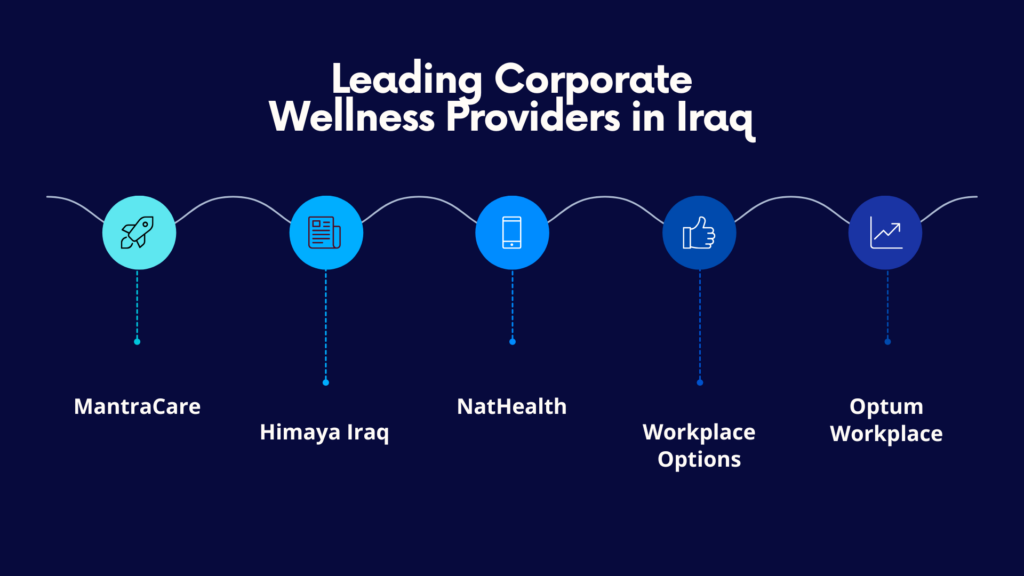
Iraq’s corporate wellness landscape spans globally proven digital platforms to regionally embedded insurance brokers, specialized health claims administrators, and broad-spectrum EAP providers with Middle East operations. The providers below represent the leading corporate wellness companies serving Iraq – covering EAPs, digital health, insurance-linked benefits, health administration, and behavioral care.
| Corporate Wellness Provider | Best For | Unique Strength |
| MantraCare | All Business Sizes | AI-powered multilingual wellness platform with Arabic-language support, one of the highest EAP engagement rates in the market, and a full-spectrum service ecosystem |
| Himaya Iraq | Oil, Gas, and High-Risk Sectors | Iraq-licensed insurance brokerage specializing in employee benefits design, group medical insurance, and risk-tailored coverage for energy and industrial sector workforces |
| NatHealth | Health Insurance Administration | Regional TPA pioneer with 26+ years of experience managing health insurance policies and corporate self-funded health plans across the Middle East |
| Workplace Options (WPO) | Global EAP for Multinational Workforces | Global employee wellbeing platform serving 88 million people across 200+ countries, with Middle East service infrastructure and 24/7 multilingual support |
| Optum Workplace | Data-Driven Enterprise Wellness | Global integrated health management platform combining EAP, biometric screening, chronic disease management, and population health analytics |
1. MantraCare
- Headquarters: Global (with Middle East and Arabic-language operations)
- Core Focus: AI-powered holistic digital wellness platform
MantraCare is one of the most established corporate wellness platforms serving employers across the Middle East. The platform consistently delivers five to seven times higher EAP sign-up rates compared to traditional programs – an engagement advantage driven by a comprehensive service ecosystem that spans mental health counseling, meditation, yoga, physiotherapy, gamified wellness challenges, and chronic condition management, all accessible from a single platform.
MantraCare combines global reach with advanced AI to deliver personalized, affordable care across mental health, EAP, physiotherapy, diabetes, hypertension, weight management, nutrition, and more. The MantraCare HR dashboard gives people teams live reporting on employee health metrics, program engagement, therapy utilization, and ROI across departments and locations. With support across 20+ languages – including Arabic – and 1,500+ health experts on the network, employees access care when and how they need it.
Key services: EAP, psychological counseling, chronic condition management for diabetes and hypertension, corporate yoga and fitness, nutrition coaching, physiotherapy, women’s health programs, virtual care and telehealth, steps challenges, legal and financial assistance, biometric health checks, and real-time HR analytics dashboards.
2. Himaya Iraq
- Headquarters: Baghdad, Iraq (licensed by the Insurance Commission of Iraq since 2012; License No. 6)
- Core Focus: Insurance brokerage specializing in employee benefits, group medical insurance, and risk coverage for the oil, gas, and industrial sectors
Himaya Iraq is the most specialized locally licensed insurance broker for employee benefits in Iraq. Established in Baghdad and holding Insurance Commission License No. 6, Himaya Iraq operates at the intersection of employee protection and risk management – two priorities that are inseparable in Iraq’s operating environment. The firm is an active player in placing insurance for oil and gas companies across the upstream-to-downstream value chain, and brings deep technical knowledge to the design and placement of employee benefits programs for both Iraqi nationals and expatriates.
Himaya Iraq’s approach to employee benefits is advisory-first. The firm works with clients to design benefits programs tailored to their specific risk profile and workforce composition – before going to the insurance market to negotiate cost-effective solutions. Group medical insurance, personal accident coverage including passive war risks, group travel insurance, and kidnapping and ransom coverage are all part of the portfolio. Himaya’s direct billing network approach protects employees from out-of-pocket costs at the point of care – a significant operational advantage in Iraq’s fragmented healthcare market.
Key services: Group medical insurance design and placement, personal accident insurance including war and terrorism risk, kidnapping and ransom coverage, cash in transit and fidelity insurance, professional indemnity, workmen’s compensation, benefits program design and tendering, and insurance market advisory.
3. NatHealth
- Headquarters: Amman, Jordan (with Middle East-wide operations including Iraq)
- Core Focus: Third-party administration of health insurance policies and corporate self-funded health plans
NatHealth was established in 1997 as a third-party administration company, pioneering the frontier of electronic medical health claims in the Middle East. With over 26 years of operation, NatHealth is a full-service TPA delivering claims administration, hospital admissions management, utilization review, healthcare data analysis, benefit design consultation, and reinsurance support to insurance companies and self-insured corporate clients.
NatHealth’s proprietary e-Claim system and E-Health Gate platform represent some of the most advanced health insurance technology in the region. The E-Health Gate system enables paperless, near-field communication-based approvals at the point of care – allowing employees to receive medical services with a card swipe, without calls, delays, or out-of-pocket payments. For Iraqi employers running self-funded or insured health plans, NatHealth’s combination of administrative efficiency, clinical cost containment, and data analytics translates directly into lower claims costs and a better experience for covered employees.
Key services: Health insurance claims adjudication and administration, hospital admissions management, utilization review, healthcare data analysis, benefit design consultation, reinsurance and underwriting assistance, e-Claim processing, E-Health Gate NFC-based approvals, and self-funded corporate health plan management.
4. Workplace Options (WPO)
- Headquarters: Raleigh, USA (UAE-based Middle East service center)
- Core Focus: Global EAP and employee wellbeing platform
Workplace Options delivers high-quality wellbeing care to more than 88 million people from 113,000 organizations across more than 200 countries and territories. Its philosophy is built on three principles: reach, relevance, and results. WPO’s services are available 24 hours a day, 7 days a week, 365 days a year – delivered from service centers around the world, including a dedicated UAE hub serving the Middle East region.
WPO helps employees and their families when they need emotional, practical, and physical wellbeing support. Services cover counseling and critical incident response, personalized health coaching on topics including weight management and stress management, work-life consultation, manager training, and interactive wellbeing reporting. The platform’s Wellbeing Ambassador Programme gives employers a structured way to embed wellness advocacy inside their organizations – building an internal culture of support rather than relying solely on external access.
Key services: Global EAP, counseling and crisis response, personalized health coaching, stress and weight management programs, work-life consultation, manager and leadership support training, Wellbeing Ambassador Programme, interactive live reporting, and 24/7 multilingual support.
5. Optum Workplace
- Headquarters: Eden Prairie, USA (global operations)
- Core Focus: Integrated enterprise health management combining EAP, biometric screening, chronic disease programs, and population health analytics
Optum is one of the world’s most established integrated health management platforms, serving large employers and payer organizations globally. Its 8th annual Wellbeing in the Workplace study – drawing on insights from 430+ health benefits decision-makers at global employers – has made Optum a recognized authority on workforce health strategy. Optum’s EAP is a free service model offering covered employees confidential access to licensed therapists, clinical social workers, and professional counselors – available by phone or online around the clock.
For Iraqi employers – particularly large enterprises, IOCs, and organizations with internationally mobile workforces – Optum’s combination of EAP, biometric screening programs, and chronic condition support addresses the full clinical spectrum. A majority of employees report that Optum’s EAP helped them take control of their wellbeing, and employers offering biometric screenings through Optum’s programs have reported significant per-member per-month savings through early health risk identification.
Key services: Global EAP with 24/7 counseling access, Emotional Wellbeing Solutions (premium EAP), biometric screenings, chronic condition management, fitness and wellness network access via One Pass Select, behavioral health navigation, population health analytics, financial and legal assistance, and integrated wellbeing reporting.
Extended Provider List Worth Evaluating
| Corporate Wellness Provider | Headquartered | Core Focus | Best For |
| Mercer | Global (New York; Middle East operations) | Global human capital and employee benefits consulting with deep regional expertise across benefits design, health strategy, and workforce analytics | Multinationals operating in Iraq needing end-to-end benefits benchmarking, insurance brokerage, and data-driven workforce health strategy |
| ComPsych | Chicago, USA | World’s largest EAP provider delivering GuidanceResources to millions of employees globally, with multilingual support and comprehensive work-life services | Large employers needing a high-volume, clinically proven EAP with fast access, broad clinical coverage, and 24/7 crisis support |
| AXA Gulf / GIG Gulf | Dubai, UAE | Regional insurance and employee benefits provider delivering health insurance, life coverage, and wellness solutions across the GCC and broader Middle East | Iraqi employers seeking a regionally grounded health insurance partner with established claims infrastructure and corporate wellness program integration |
See how multinational corporations tackle employee health. Check corporate wellness trends in Canada, Australia, and Singapore.
How to Choose the Right Corporate Wellness Provider in Iraq
Selecting the right wellness partner requires balancing legal compliance, workforce demographics, sector risks, budget, and measurable outcomes.
Step 1 – Assess workforce risks.
Use anonymous surveys or structured health assessments to identify which departments, sites, or roles carry the highest burden of stress, absenteeism, or health claims. Platforms like MantraCare include built-in risk assessment tools. For field-based or site operations, Himaya Iraq can support benefits program needs assessments.
Step 2 – Verify compliance with Iraqi Labor Law.
Ensure your chosen provider supports alignment with Labor Law No. 37 of 2015 – including workplace safety obligations, social security registration, and the right of employees to refuse unsafe work. In the Kurdistan Region, additional provisions under Labor Law No. 71 of 1987 apply.
Step 3 – Evaluate Arabic-language mental health access.
Look for structured pathways with licensed Arabic-speaking psychologists or multilingual counselors. Iraq’s public mental health system is deeply under-resourced relative to the documented scale of need. Providers like MantraCare, Workplace Options, and ComPsych offer clinical care access at a meaningful scale with multilingual delivery.
Step 4 – Review physical and chronic disease coverage.
Given the documented rise in diabetes, cardiovascular disease, and kidney disease across Iraq’s working-age population, programs covering chronic condition management, physiotherapy, and preventive health screening deliver outsized value.
Step 5 – Ask for measurable outcomes.
Request absenteeism reduction data, EAP utilization rates, employee satisfaction benchmarks, and ROI metrics from comparable organizations. Engagement is the primary signal. The best-designed program delivers nothing if employees don’t use it.
Step 6 – Pilot across key locations.
Start with a three-to-six-month pilot across Baghdad operations and one provincial site – such as Basra or Erbil. Test Arabic-language access, sector-specific support, and demographic coverage before scaling company-wide.
Conclusion
Iraq’s corporate wellness market is at a critical inflection point. Employers are addressing a documented mental and physical health burden, evolving awareness of Labor Law obligations, and a workforce that increasingly expects meaningful wellbeing support – especially in sectors like energy, banking, and professional services.
MantraCare provides an AI-powered, Arabic-language wellness platform with EAP, telehealth, chronic care, and physical wellness, achieving high engagement and real-time HR analytics across multi-city workforces. Himaya Iraq delivers locally licensed, sector-specific expertise, tailored for oil, gas, and industrial operations. NatHealth contributes 26 years of health insurance administration and technology-driven claims management to control costs in a fragmented healthcare environment. Workplace Options offers a globally consistent, multilingual EAP with Middle East service support. Optum Workplace equips large enterprises with population health analytics and integrated care management to shift from reactive to proactive wellness strategies.
The right provider isn’t the one with the most features – it’s the one employees actually use, with Arabic-language support, verified outcomes, and solutions built for Iraqi working realities in 2026.
Looking for diverse perspectives on workforce wellbeing? Explore corporate wellness in Belgium, Poland, Spain, Greece, and Switzerland for innovative ideas.
Frequently Asked Questions
Costs vary by provider and scope. Digital EAPs start at $3–$5 per employee per month. Comprehensive programs with health insurance, clinical support, and chronic disease management are priced per headcount and service tier. MantraCare offers a cost-effective entry point, with average EAP costs around $100 per employee per year.
No. An EAP provides confidential counseling and referrals. A full wellness program also includes preventive health, physiotherapy, chronic disease management, fitness, nutrition, financial wellbeing, and legal support – addressing workforce health comprehensively.
Mental health programs typically return $3–$6 for every $1 invested. Benefits include reduced absenteeism, lower turnover, improved productivity, and lower healthcare claims. Providers tracking engagement and outcomes help optimize ROI.
expectedPartially. Iraqi Labor Law No. 37 of 2015 mandates safe working conditions, equipment, training, and social security registration. Private health insurance is not required but widely expected. Broader wellness programs remain voluntary but are essential for talent retention.
MantraCare, Workplace Options, and ComPsych offer scalable, cost-effective EAP solutions. Himaya Iraq supports smaller employers with tailored group medical plans.