

Canada’s corporate wellness program business is more than just a side benefit; it is a bottom-line concern. The market valued USD 1.69 billion in 2024, and is expected to reach USD 2.1 billion by 2030 with a 3.7% CAGR. That trajectory is not driven by trend-chasing. It’s fueled by a workforce that’s now under measurable stress, and an employer who is just connecting the dots between employee health and bottom-line performance.
It’s an urgent need. Every week, at least 500,000 Canadians suffer job loss because of mental illness, resulting in an estimated $51 billion in costs to the economy each year. 39% of all Canadian workers experience burnout, compared to 35% in 2023, which costs employers between $5,500 and $28,500 per worker on an annual basis. Meanwhile, nearly half of employees see financial problems as the biggest source of stress, and nearly 4 in 10 people regularly or constantly feel worried about their financial future, which does not magically disappear once you clock in for work.
As HR leaders, business owners, and decision-makers assess employers in 2026, this primer cuts the clutter on the playing field: which companies are credible, what they have to offer, and how to determine which partner would be best suited to the Canadian workforce reality.
Workforce wellbeing programs are rapidly expanding across Germany and the Netherlands. Assess the leading corporate wellness companies globally.
What is a Corporate Wellness Provider?
A corporate wellness provider collaborates with an employer to create and implement a planned health and wellness program for employees. In practice, corporate wellness goes beyond gym memberships or annual health checks. It creates a sustainable and measurable system that supports employee health across multiple areas.
In 2026, employee wellness in Canada takes an integrated approach that connects mental, physical, financial, and social wellbeing rather than treating them separately. In the financial sense, a mentally stressed employee with undiagnosed hypertension is neither mentally ill nor physically ill. They are both, and they need to be treated as both.
There are usually three levels of services offered by most providers.
- Preventive health encompasses health risk assessments, biometric screenings, annual medical wellness check-ups, wellness days, and occupational health audits.
- Clinical and Curative include the following support: Telemedicine, GP Referrals, Specialist Consultation, Chronic disease Management, and Pharmacy benefits.
- Lifestyle and mental wellness services include EAPs, counselling, fitness programs, nutrition coaching, financial guidance, stress management, and legal support.
In Canada, many corporate wellness programs now use mental health and virtual primary care as the first point of employee support. Leading providers also manage bilingual English and French delivery across the workforce.
Why Corporate Wellness Is Now Emerging in Canada
It is important to take the time to understand what the data is telling you before making a shortlist for providers.
- Mental health is a measurable business issue. In Canada, around 500,000 people experience mental health challenges every week, costing the economy an estimated $51 billion annually. In 2025, many Canadian workers also reported declining mental health, poorer sleep, and reduced physical activity – all of which contribute to absenteeism, disability claims, and productivity loss for employers.
- Financial stress is compounding the mental health burden. Financial stress is a significant factor contributing to stress, as 49% of employees report that money is their main source of stress, with 40% often or always worrying about their finances. There is a reinforcing effect between financial stress and mental stress – a mentally stressed workforce is financially stressed and vice versa.
- Burnout is the invisible multiplier. According to the 2025 national Mental Health Research Canada survey, burnout is affecting 39% of workers in Canada, rising from 35% in 2023. The annual cost of burnout to employers is estimated to range from $5,500 to $28,500 per employee. However, only 36 per cent of staff report that their workplace has genuine employee burnout prevention programs, and the distinction says a lot about the true impact of prevention programs on businesses in Canada.
Top Corporate Wellness Providers in Canada in 2026
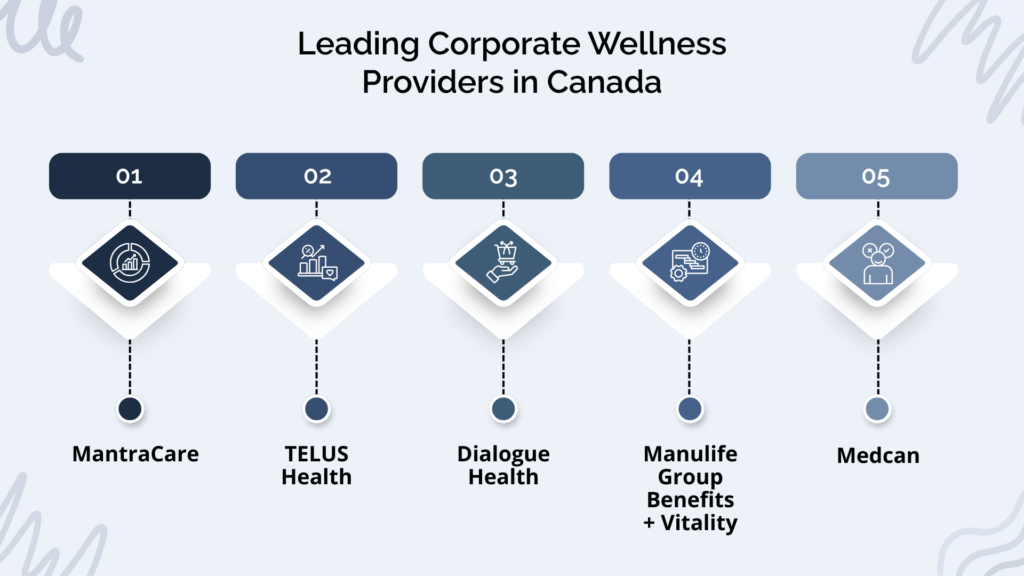
Canada’s corporate wellness landscape is evolving rapidly as organizations increasingly prioritize employee mental health, preventive healthcare, and workplace productivity. The providers listed below are among Canada’s leading corporate wellness companies, offering EAPs, health screenings, fitness programs, telemedicine, and holistic employee wellbeing services.
| Corporate Wellness Provider | Best For | Unique Strength |
| MantraCare | All Business Sizes | AI-powered holistic wellness platform with multilingual reach |
| TELUS Health | Large Enterprises & MNCs | Canada’s most comprehensive integrated EFAP and virtual health platform |
| Dialogue Health | Mid-Size to Large Enterprises | Canada’s only accredited virtual care provider with bilingual delivery |
| Manulife Group Benefits + Vitality | Large Enterprises | Behaviour-based wellness rewards uniquely tied to insurance outcomes |
| Medcan | Executive & Leadership Teams | Medical-grade preventive health assessments for corporate accounts |
1. MantraCare
- Headquarters: New Delhi (global, with Canadian operations)
- Core Focus: AI-powered holistic employee wellness platform
From startups to multinationals, MantraCare offers a unified digital wellness platform, making it easier to manage what numerous providers disperse through several contracts. It houses more than 15 programs – from EAP, fitness, to mental health, chronic care, diabetes management, and women’s health—in one turn-key app, and its AI features link employees to the appropriate care at the appropriate time.
The platform supports 50+ languages, maintains PIPEDA and SOC 2 compliance, uses bank-level encryption, and keeps all employee data confidential from employers. In large multicultural, multilingual cities like Toronto, Vancouver, Calgary and across Canada, language is important for the country’s workforce. An employee who cannot access wellness support in a language they are comfortable with is an employee who will not use it.
When accountability is key, HR teams can leverage MantraCare’s analytics dashboard to get on-the-spot reporting on signups, usage, therapy sessions, and engagement rates by location and department, putting the return on investment right in front of leadership.
Key services: EAP, psychological counselling, chronic condition reversal (diabetes and hypertension), corporate fitness and yoga, nutrition coaching, physical therapy, women’s health programs, health risk assessments, telemedicine, and HR analytics dashboards.
2. TELUS Health
- Headquarters: Vancouver, BC (nationwide)
- Core Focus: Integrated digital health, EFAP, and total workforce wellbeing
TELUS Health supports 157 million people across 200+ countries through integrated primary care, preventive health, EFAP, virtual care, mental health, and benefits management services. It also offers one of Canada’s most comprehensive all-in-one employee wellbeing platforms.
The 2025 acquisition of Workplace Options strengthened its global employee wellbeing capabilities. The platform now offers personalised mental health support, access to a broad counselling network, and preventive care through clinics across Canada.
With more than 40 years of serving the same health management solutions to the top employers across Canada, TELUS Health has solutions that fit the needs and budget of any company, small or large.
Key services: EFAP, Total Mental Health program, virtual primary care, preventive health assessments, chronic disease management, benefits management, retirement solutions, mental health coaching, and digital health platforms.
3. Dialogue Health
- Headquarters: Montreal, QC (nationwide)
- Core Focus: Accredited virtual care and integrated health platform for Canadian employers
Dialogue is the first and only credible virtual care provider in Canada dedicated to providing members with safe & timely care and white-glove customer success results employing its industry-leading Integrated Health Platform. It brings together Primary Care, Mental Health+, EAP, and Wellness into one continuous experience; one sign-in, one medical record, consistent reporting for HR teams — connecting over 50,000 organizations across Canada.
Dialogue announced the winners of its second annual Healthiest Workplace Awards at the beginning of March 2026, praising organizations across Canada that take action to foster wellness, measure it, and create cultures where people continue to thrive.
Dialogue’s bilingual delivery in English and French addresses the specific operational reality of employers with Quebec-based or francophone workforces – a non-negotiable for any national Canadian program. For mental health specifically, its stepped-care model moves employees from self-help tools through to professional counselling and psychiatric referrals without forcing navigation across multiple systems.
Key services: EAP, Primary Care virtual clinic, Mental Health+ (including internet-based CBT), Wellness program, organizational health analytics, team challenges, wearable device integration, and bilingual delivery.
4. Manulife Group Benefits with Vitality
- Headquarters: Toronto, ON (nationwide)
- Core Focus: Group insurance-integrated employee health benefits with behavioural wellness activation
Manulife is one of the largest financial and group benefits providers in Canada. Its group benefits platform combines health, dental, disability, life, and Employee and Family Assistance coverage in one system. Members can also access primary care, mental health, and wellbeing practitioners anytime through Manulife’s digital Healthcare Online platform.
Manulife Vitality helps members build healthier habits through a behaviour science-based wellness platform. In 2025, the program expanded with new prevention partners, broader activity tracking, and more flexible rewards.
Participating members have measurable outcomes. Vitality data indicates that since launch, 71% of members with out-of-range results now have their cholesterol in a healthy range, while 47% had improved their blood pressure, and 31% improved their BMI. Manulife’s model is unique, as there is no equivalent that directly ties employee health engagement to insurance results in Canada.
Key services: Group health, dental, life, and disability insurance; EFAP; Manulife Vitality wellness activation; Healthcare Online virtual care; chronic disease management; and preventive screening incentives.
5. Medcan
- Headquarters: Toronto, ON (with virtual and select regional services)
- Core Focus: Medical-grade preventive health assessments and executive corporate wellness
Medcan has supported over 1,500 businesses in bridging the gap between traditional benefits plans and the health and wellness needs of their employees, providing value through easy access to medical experts, specialists, and comprehensive wellness services that drive better health outcomes. The crux of its Annual Health Assessment is a physician-led evaluation that includes a detailed assessment of cardiovascular health, bloodwork, hearing evaluations, vision screenings, nutrition, fitness and more, all conducted in one day, and with referral to specialists and long-term care plans incorporated into the model.
Medcan has earned Canada’s Best Managed designation for 15 consecutive years, including Platinum Club recognition in 2025, for its innovation, client care, and workplace culture. In 2025, it also expanded its footprint by signing an agreement with the newly launched Manulife Vitality, providing GRAIL’s Galleri multi-cancer early detection test at preferred pricing to eligible members above 50 years old.
Key services: Annual Health Assessment (physician-led), year-round virtual and in-person care, chronic disease monitoring, mental health support, weight management, women’s health programs, nutrition and fitness coaching, and cancer screening partnerships.
Extended Provider List Worth Evaluating
| Corporate Wellness Provider | Headquartered | Core Focus | Best For |
| Canada Life Group Benefits | Winnipeg | MBGroup insurance with EAP, mental health, and disability support | Employers seeking a legacy insurer with integrated wellness |
| EAPMedcor | Canada | Occupational health and onsite/virtual mental health advocacy | Manufacturing, construction, and resource sector employers |
| Sun Life Financial | Toronto | ONVirtual care depth and all-in-one digital health benefits | Organizations prioritizing seamless clinical access |
Companies across the USA and Singapore are integrating mental health and preventive care into employee benefits. Explore the providers shaping this shift.
How to Choose the Right Corporate Wellness Provider in Canada
Choosing the right corporate wellness provider is one of the most consequential decisions an HR leader will make in 2026 – and the Canadian market is crowded enough that getting it wrong is easy. Here is how to cut through the noise.
Step 1 – Map your workforce before briefing any provider
Financial services staff on Bay Street in Toronto and mining industry employees in northern Ontario don’t have much in common when it comes to their wellness needs. Before approaching a vendor, map: Age distribution, Geographic spread, Language demographics, Health risk profile, Work structure. The problem definition drives the provider selection, not the other way around.
Step 2 – Be specific in your goal
Reduce absenteeism? Lower disability claims? Tackle a department’s mental health issue? Boost Gen Z and millennial turnover? Providers are set up in different ways for different results. Focus attention on the strengths of the providers among the list of their top priorities, and not on their longest track record.
Step 3 – Demand real bilingual capability, not just a translation layer
For Canadian employers whose workforces are in Quebec or with a francophone background, bilingual delivery is not an option. Not only a translated app interface, but also ask providers to show French-language content, francophone counsellors and French-language crisis lines. That’s important when a worker at the workplace in Montréal must reach out to a mental health service when under pressure.
Step 4 – Evaluate the mental health infrastructure properly
Canada’s mental health problems require a stepped-care delivery system: self-help tools at the lowest level, confidential help lines, help from trained counsellors, psychiatric referral pathways, and crisis intervention at the highest end. Inquire from all providers about how they would handle a staff member encountering a crisis, and how rapidly. The things that exist in that path – empty elements – are not small, but the most dangerous point of failure in any wellness program.
Step 5 – Run a structured pilot before committing long-term
A 3-month pilot period based on agreed-upon and established success indicators safeguards against the “sales pitch—to-real” disconnect. Outline success beforehand: employee participation by department, early utilisation data, manager feedback scores and employee satisfaction with the program. Pilot is the most dependable tool of due diligence.
Conclusion
Canada’s corporate wellness industry is on the maturing path. With the mental health crisis on the rise, the burnout epidemic, which nets employers billions of dollars per year, and a generation of professionals who see wellness benefits as key to their employment decision, inaction has become the most costly option on the market.
TELUS Health offers the most comprehensive digital health and EFAP ecosystem in the Canadian market. Dialogue provides Canada’s top accredited virtual care experience, with real bilingual skills. Manulife Group Benefits with Vitality is the industry’s 1st insurance-integrated behavioural wellness activation program in Canada. Unlike digital-only, Medcan brings the clinical expertise of a preventive evaluation to executive cohorts. MantraCare offers a technology-forward, multilingual platform for organizations seeking measurable wellness ROI across a diverse workforce.
The provider that has the most flashy brochure is not the right choice. It’s the one that your employees will use, in their native tongue, and in the channels they can access, and results they can independently verify. That bar is even higher in 2026 (as is the reward for getting it right).
Nordic countries such as Norway, Sweden, and Denmark continue to lead workplace wellbeing innovation. Discover the top workplace wellness providers available today.
Frequently Asked Questions
The cost of this service depends on the range and service provider. There are digital-first multiple plans that begin at a few dollars per employee per month, and comprehensive plans that cover clinical and preventive screenings, which begin with headcount and what services are offered.
No. An EAP is one of the areas that specialise, usually in psychological, legal, and financial counselling. A corporate wellness program is more comprehensive and encompasses all aspects of health, including physical, mental, and emotional health. The best corporate wellness programs have a strong EAP as part of a broader wellness framework.
A company with 500 employees can lose more than $3.4 million each year from productivity losses and salary costs due to burnout. However, if two organizations of the same size implement the same-sized PWR initiatives focused on burnout prevention, you can expect to save about $1.7 million per year. Greater holistic investment also cuts disability claims & enhances retention.
Not in their modern comprehensive form. Federal and provincial occupational health and safety laws establish minimum standards with regard to workplace safety. While not required by the law, there is a significant legal and reputational concern to provide employee care, especially psychological, but the focus is definitely shifting to doing so as employee expectations and psychological safety benchmarks continue to rise.
Many per-employee pricing options exist, including MantraCare, GroupHEALTH Benefit Solutions and Canada Life’s Freedom at Work program – all of which have no minimum employment thresholds.