
The debate over employee benefits in Singapore has taken a drastic turn. It used to be sufficient to have a group hospitalization agreement and an annual health screening. This is not enough in 2026 – it can expose your organization to legal liability, put you at a commercial disadvantage in recruiting and hiring, and cost you productivity in a way that no one knows.
In Singapore, USD 530.6 million was generated through the corporate wellness market in 2024 and is estimated to reach USD 645.9 million by 2030, increasing at a CAGR of 3.3%. However, what should matter much more to HR leaders is not the market expectations, but the workforce statistics. In a study jointly conducted by Duke-NUS Medical School and Singapore’s Institute of Mental Health, researchers determined that the cost of anxiety and depression symptoms in Singapore was an estimated SGD 15.7 billion each year in terms of absenteeism, healthcare expenses, and lost productivity. The amount, about 2.9 per cent of Singapore’s GDP, is a problem on the balance sheet, not a wellness program problem.
This guide is for HR leaders, business owners, and people managers who want to identify and select the best corporate wellness provider for their organization in Singapore in 2026.
Organizations across Hong Kong and Japan are redesigning workplace wellbeing programs around burnout prevention and resilience. Explore the top providers leading this change.
What Is a Corporate Wellness Provider?
A corporate wellness provider is defined as an organization that collaborates with employers to create and offer health and wellbeing initiative programs beyond what is prescribed by law in Singapore. To rephrase, it is a move from the realm of mandatory CPF contributions, MediShield Life, group hospitalisation and surgical (GHS) insurance to the new perimeter of preventive care, mental health, chronic disease management, health insurance work, and digital health engagement.
There are three tiers of the most serious providers.
- Preventative health includes personal health reporting, biometric assessment, health risk assessments (HRAs) and annual health screenings.
- Curative and clinical support includes monitoring of chronic diseases, GP and specialist teleconsultations and telemedicine.
- Mental health and lifestyle support includes EAP counselling, fitness and nutrition coaching, mindfulness programs and financial wellbeing services.
The best ones combine all three in the same system, providing HR with one complete picture of workforce health – and one statement of ROI for finance directors to showcase as a success.
Why Corporate Wellness Matters in Singapore in 2026
The unique trend of Singapore’s emphasis on preventing burnout, mental well-being, and employee engagement has turned corporate wellness into a key business objective for all sectors.
1. The mental health crisis is measurable and expensive
Singapore’s 2024 Wellness at Work Report, which surveyed 1,018 employees, found that 61% of Singaporean employees reported feeling burnt out – one of the highest rates globally – with minimal improvement from 62% recorded in 2022. This is not a post-pandemic lapse. It is structural.
2. Chronic disease is a persistent and growing workforce burden
Singapore’s National Population Health Survey 2024 found that about 1 in 3 Singapore residents continues to have hyperlipidaemia and hypertension – marking an area of continued concern – while the prevalence of obesity (BMI ≥30.0 kg/m²) increased significantly from 10.5% in 2019-2020 to 12.7% in 2023–2024. The percentage of diabetes and hypertension in working-age adults is relatively stable but high. When left untreated at the employer level, using preventive care and monitoring programs, these conditions are a growing problem, increasing healthcare claims and long-term absences that escalate over time.
3. The regulatory and legal landscape is raising the bar
Singapore’s Workplace Safety and Health (WSH) Act requires employers to take proactive steps to ensure the safety and wellbeing of their employees, including conducting regular risk assessments across all workplace settings. The Tripartite Advisory on Mental Well-Being at Workplaces, released by MOM, NTUC and SNEF, suggests that employers offer confidential counselling services, designate mental wellness champions, train supervisors on mental health, and incorporate mental wellbeing into their organization’s formal risk assessment process.
4. Data privacy obligations apply to every wellness provider you engage
The Personal Data Protection Act (PDPA) 2024–2025 is the law that regulates the way personal data (including employees’ health information) is collected, processed, and retained in Singapore. It covers all wellness providers who process health information on behalf of a Singapore employer. Before implementation, the employer is required to obtain explicit consent, set up a lawful purpose for processing, appoint a Data Protection Officer and enter into a Data Processing Agreement with any third party with whom data is shared. This is not procurement due diligence – it is a legal obligation.
Top Corporate Wellness Providers in Singapore in 2026
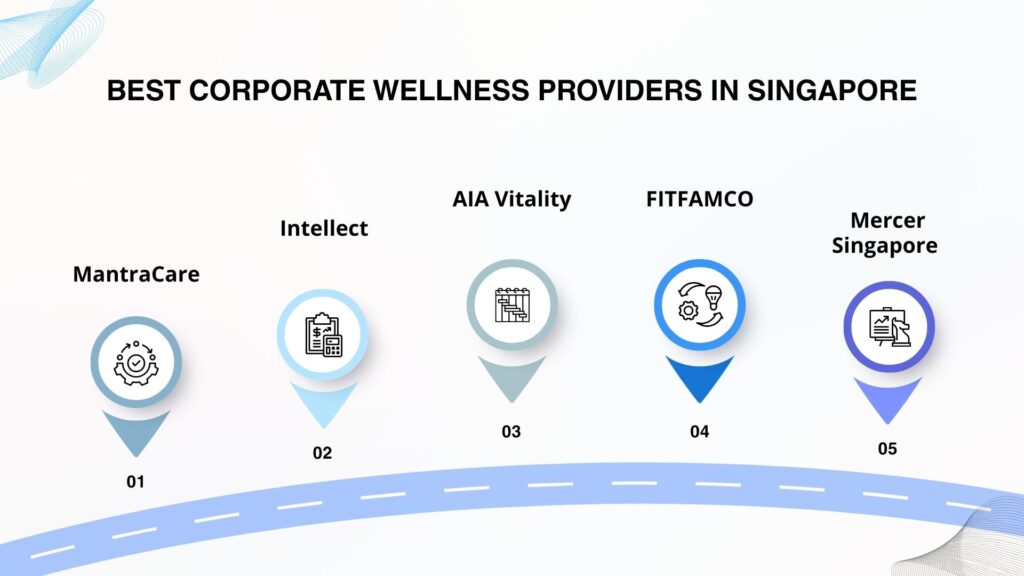
Mental health is crucial for the workforce. Choosing a provider wisely is important. The comparison among the top corporate wellness providers in Singapore is listed below –
| Corporate Wellness Providers | Best For | Unique Strength |
| MantraCare | Mid-Size to Large Enterprises | AI-driven holistic platform across mental, physical and preventive care |
| Intellect | Enterprises Prioritizing Clinical Mental Health Depth | Asia’s largest mental health tech company, Singapore-headquartered, with 4 million users |
| AIA Vitality | Enterprises Seeking Insurance-Integrated Wellness | Behavioural science-backed program tied to real insurance benefits |
| FITFAMCO | Employers building a visible, participatory wellness culture alongside a digital mental health platform | Largest onsite and hybrid fitness delivery network — 30+ classes, 50+ wellness workshops, 200+ trainers across the city-state. |
| Mercer Singapore (Mercer Marsh Benefits) | Large enterprises and multinationals seeking a strategic benefits partner, not just a wellness vendor | The only strategic benefit an architect on this list provides is that they benchmark, design, and optimizes your entire wellness investment using global data from 18,384 employees across 17 markets. |
1. MantraCare
- Headquarters: Global, with Singapore operations
- Core focus: Holistic, AI-driven employee wellbeing
Over 1,000 global companies and enterprise clients in Singapore trust MantraCare as one of the most widely adopted integrated corporate wellness platforms in Singapore. It is what mental health counselling meets physiotherapy, chronic disease management, nutrition coaching, yoga, meditation and women’s health programs on the same platform – all driven by AI-personalization across 80 plus languages! For Singapore employers managing multicultural, multi-generational, and geographically dispersed teams, this multilingual AI infrastructure is operationally significant.
Key services: EAP counselling, AI-powered chronic disease management (diabetes, hypertension, PCOS), physiotherapy, fitness and nutrition coaching, manager training, HR analytics dashboard with ROI reporting, HIPAA- and SOC 2-compliant data architecture.
2. Intellect
- Headquarters: Singapore
- Core focus: Clinically rigorous, hyperlocalised mental health for enterprise workforces
Founded in Singapore, Intellect provides hyperlocalised mental healthcare across 100+ countries and 50+ languages, supporting over 4 million users. Backed by major investors, it has become one of Asia-Pacific’s fastest-growing mental health technology companies.
Key services: Self-guided mental health programmes, access to licensed psychologists and behavioural health coaches, 24/7 crisis support, clinical EAP, in-person clinic access, Mental Health First Aid™ training, wellbeing analytics, and organizational consulting.
3. AIA Vitality (WorkWell)
- Headquarters: Singapore
- Core focus: Insurance-integrated corporate wellness with behavioural science foundations
AIA Singapore holds the distinction of being the first in the Singapore market to offer an end-to-end mental healthcare solution covering mental wellbeing through to mental health therapy and synchronous text-based coaching. It has been voted Employee Insurance Vendor (Gold) for 19 consecutive years since 2006, and AIA Vitality is the world’s largest wellness program with over 5 million members worldwide.
Key services: AIA Vitality behavioural wellness program, corporate wellness days, onsite health screenings, fitness and nutrition classes, mental wellbeing support through WhiteCoat partnership, digital health tools, and insurance benefits integration.
4. FITFAMCO
- Headquarters: Singapore
- Core focus: Physical fitness, wellness engagement, and holistic corporate health activities
FITFAMCO was established in 2016 as SgFitFam to address the need for a sustainable approach to personal and corporate wellness programs in Singapore. It’s a network of qualified fitness trainers, nutritionists, counsellors and wellbeing professionals. It is the only provider in the Singapore market with 100% in-person and hybrid implementation — it is the obvious choice for employers looking to build a palpable, engaged environment for wellness over a digital subscription that most workers never open.
Key services: Group fitness classes (HIIT, yoga, pilates, and more), health and wellness talks, nutrition coaching, chronic disease management workshops, stress management sessions, mental wellness talks, gym management services, and virtual and onsite delivery options.
5. Mercer Singapore (Mercer Marsh Benefits)
- Headquarters: Global – Singapore operations via Mercer Marsh Benefits
- Core focus: Strategic employee benefits design, wellness programme consulting, and data-driven health benefits optimisation
Mercer Singapore lounges in a different category from the other providers on this list – it is not primarily a wellness delivery platform, but a global consultancy and benefits representative that designs, structures, and optimises the entire employee benefits architecture for its clients. This is significant for employers in Singapore, especially for large employers and multinationals. Mercer helps organizations deliver wellness programmes while also identifying investments that are cost-effective, competitive, and strategically aligned with market standards.
Key services: Employee benefits design and strategy, health and wellbeing program consulting, mental wellness program design, benefits analytics and benchmarking, onsite clinic health management, benefits communication strategy.
Extended List of Providers Worth Evaluating
| Corporate Wellness Providers | Headquartered | Core Focus | Best For |
| Safe Space | Singapore | Regional B2B2C digital mental health platform, 500+ multilingual professionals | Companies prioritizing broad clinical network coverage across the Asia-Pacific |
| Naluri | Kuala Lumpur | Mental health integrated with chronic disease management | Singapore employers with a high NCD burden are seeking dual-track care |
| Meditopia for Work | WorkGlobal, APAC operations | Digital-first mental health coaching in multiple languages | Remote-first and multilingual workforces |
| Optum | Global, Singapore operations | EAP and integrated health management | Large multinationals require a global benefit infrastructure |
From India to the UAE and the USA, employers are adopting integrated wellness programs to support healthier workplaces. Assess the providers shaping this trend.
How to Choose the Right Provider in Singapore
When selecting a corporate wellness provider in Singapore, it is not a business procurement process; it is a people strategy decision impacting the law.
Step 1 – Understand your statutory and advisory obligations
Singapore employers must comply with the WSH Act, including assessing psychosocial risks. The Tripartite Advisory on Mental Well-Being also provides practical workplace mental health guidelines. The Workplace Fairness Bill, which will be enforced in 2026 or 2027, grants mental health a protected attribute. Any provider you assess must champion compliance with these frameworks and not consider them optional.
STEP 2 – Validate PDPA Compliance
In Singapore, employee health data is personal data. Before signing a contract, confirm that the provider complies with PDPA, supports Data Processing Agreements, and has proper data protection and breach notification processes in place. International certifications like ISO 27001, SOC 2, and HIPAA are added to the list of protections.
Step 3 – Statement of Local Language and Cultural Competency
Singapore has a truly multicultural workforce. Providers that offer English-only content will perform poorly at employee segments that are Mandarin-speaking or dominant. Request particular data rather than average data from around the world. Mental health uptake is related to language and cultural proximity.
Step 4 – Match the provider to your current benefits gaps
The most effective provider fills the gaps in your existing structure without duplication. For those who have complete GHS insurance coverage, you probably require depth in mental health and EAP over another curative layer. Whereas, if benefits are sparse, a single platform, such as MantraCare, that includes both preventive, curative, and mental health benefits could be more effective than several point solutions.
Step 5 – Validate mental health infrastructure depth
The most credible minimum that the Singapore employer will have to offer in 2026 is a ‘stepped care’ approach: digital self-help, access to licensed counsellors, referral pathways to registered psychologists and a working crisis protocol. Ensure counsellors possess valid Singapore or international licences, rather than simply an appealing website. Request clinical governance information and case information about the experience of crisis pathways from providers.
Conclusion
Singapore’s corporate wellness landscape is evolving rapidly as employers move beyond traditional insurance benefits toward integrated mental health, preventive care, and workforce wellbeing strategies. Rising burnout, chronic disease risks, and stronger regulatory expectations are pushing organizations to invest in wellness programs that improve productivity, retention, and employee resilience.
The best corporate wellness providers in Singapore help organizations strengthen workforce wellbeing through EAPs, preventive healthcare, digital mental health support, fitness programs, and chronic disease management. Companies that invest in structured wellness strategies are better positioned to reduce burnout, improve employee experience, support compliance, and build healthier, more resilient workplaces for long-term growth.
Organizations in France and Austria are investing in structured wellness strategies to improve retention and productivity. Assess the providers leading this transition.
Frequently Asked Questions
No single law mandates a standalone wellness program, but employers must manage workplace health and psychosocial risks under the WSH Act. The upcoming Workplace Fairness Bill and Tripartite Advisory also encourage structured EAP and mental health support across organizations.
Under Singapore’s PDPA, employers must obtain informed consent before collecting or processing employee health data and implement appropriate security measures. Wellness providers handling health information must comply with PDPA requirements, including signing a Data Processing Agreement before implementation.
MantraCare provides scalable, multilingual solutions that can be used with 50 to enterprise-level employees. ThoughtFull is robust enough for SMEs looking after mental health culture; certified with ISO 27001, PDPA compliant, and formatted as text, which yields a higher engagement rate among smaller teams. Meditopia for Work offers low-cost mental health coaching for work digitally for SMEs without enterprise commitments.
Research always demonstrates a return ranging from SGD 3 to SGD 6 per SGD spent on structured mental health support. These metrics, provided by any respectable company, will emerge with respect to employer dashboards following the PDPA consent status reporting policies.
High-pressure sectors need 24/7 crisis support, confidential counselling, financial wellbeing resources, and strong data governance. TELUS Health, Intellect, and MantraCare are well-suited for these workforce needs.