

Employee health benefits were once hidden and confined to the HR policy folder. By 2026, they are on every serious Australian organization’s agenda – because the price of engaging an unhealthy, disengaged workforce is becoming too much to ignore on the balance sheet.
This is what is driving the growth of Australia’s corporate wellness market. The Asia-Pacific workplace wellness market has been expanding since 2020, and Australia stands out not only as a mature health and wellbeing market but as one of the quickest growing in the region, according to the Global Wellness Institute. The total economic cost of work-related injury and illness in Australia is estimated at AUD 28.6 billion per year, including lost productivity, health expenses and compensation claims (Safe Work Australia). That number alone has changed the conversation from whether to invest in workforce health to how quickly and how strategically.
It’s not about one thing – it’s all about a combination of factors: A persistent mental health crisis, driven by the pandemic and not abated, a public health system that’s been put under a lot of pressure and now has shifted its focus toward employers as a key gateway to health and wellbeing services, chronic disease prevalence among workers, and a workforce that is focused on wellbeing and health before taking up or retaining a job.
Whether you are an HR manager, founder, or a business decision-maker looking to address a fundamental question for your organization: If there’s a choice between the most reliable corporate wellness providers in Australia, which one is the right one for your organization?
Compare the leading corporate wellness providers in New Zealand for EAPs, wellness platforms, and employee wellbeing.
What is a Corporate Wellness Provider?
A corporate wellness provider is an organization that collaborates with the employer to create and execute formal corporate health and wellness programs for their employees. It extends well beyond a subsidised gym membership or a mental health app that sits unopened on most employees’ phones.
In reality, most suppliers work at three levels:
- Preventive Health – biometric screenings, health risk assessments (HRAs), annual health checks, and personalised health reports.
- Curative / Clinical Support – telehealth, virtual GP consultations, occupational health, specialist referrals.
- Lifestyle and Mental Wellness – fitness programs, nutrition coaching, mindfulness, employee assistance programs (EAPs), and financial wellbeing support.
However, health risk assessment continues to be essential to the strategic backbone of the market, allowing organisations to uncover health risks among the workforce before they even make it to claims, absences or attrition.
What is the significance of Corporate Wellness Providers to Australia in 2026?
The question now isn’t whether investing in workforce health makes sense for Australian employers; it is which investments will lead to the biggest measurable return on their workforce.
1. Work illness and injury costs AUD 28.6 billion each year
Based on national data from Safe Work Australia, the economic cost of work-related injury and illness is AUD 28.6 billion annually. Mental health conditions now account for the longest and most expensive workers’ compensation claims, with the median time lost for a mental health claim more than four times that of a physical injury claim. For employers, this is no longer a compliance issue – it is a cost structure issue.
2. Mental health at work is Australia’s most urgent and expensive workforce challenge
According to Beyond Blue, depression and anxiety cost Australian workplaces around $12.8 billion a year, as a result of absenteeism, presenteeism and staff turnover. A mental health problem strikes one Australian every five years, and the workplace is a significant trigger and point of intervention. The average return for Australian employers in investing in effective workplace mental health action, as articulated by PricewaterhouseCoopers, is AUD 2.30 for every AUD 1.
3. Chronic disease is reshaping the Australian working population
AIHW data indicate that almost half of all Australians aged 15 years and over have at least one chronic condition. The main causes of long-term absence and increasing costs to employers for treatment of health conditions are cardiovascular disease, Type 2 diabetes, musculoskeletal disorders, and obesity. If these conditions are not addressed in a systematic manner, they can only get worse over time: investment in wellness programs is all the more essential!
4. Remote and hybrid working has generated new and permanent health risks
The COVID-19 transition to a hybrid and remote workforce has created unique and ongoing health impacts on Australian workers, including increased sedentary behaviour, digital fatigue, social isolation and a measurable increase in anxiety and burnout. In its 2024 Workforce survey, the Australian HR Institute (AHRI) findings also confirmed that companies lacking a formal remote wellness program see much higher than average voluntary turnover and engagement scores compared to those that do have a wellness initiative for staff working from home. Reaching employees where they are – not where the office is – has become a core function of modern corporate wellness providers.
5. Wellness is now a top consideration in talent decisions
Health and wellbeing features in the top five priorities of Australian workers when assessing a job offer, and this was consistently the case in a SEEK survey of job seekers published each year. Leaders in industries where the job market remains tight, like healthcare, construction, technology and professional services, cannot afford not to have a credible wellness program.
Top Corporate Wellness Providers in Australia in 2026
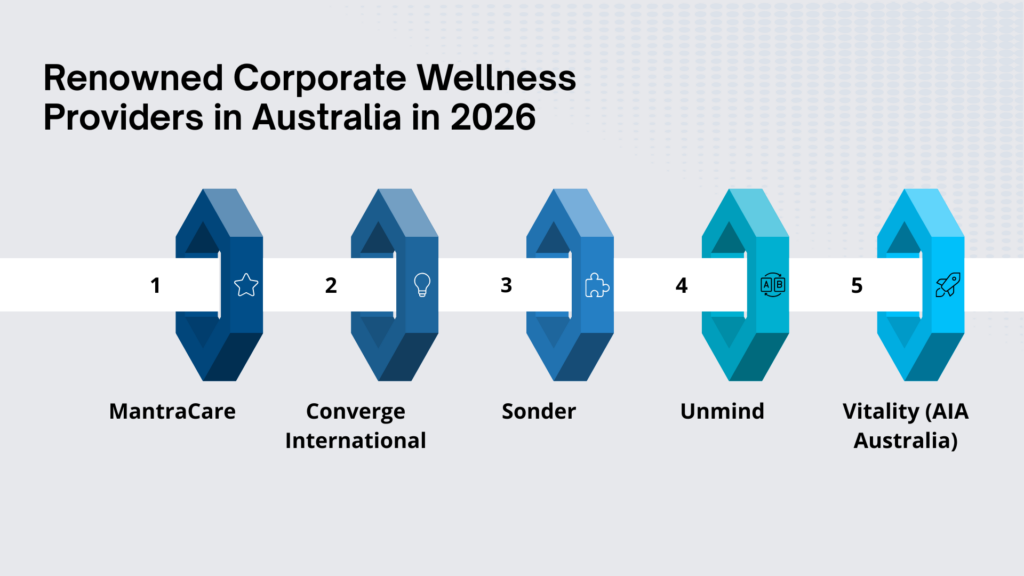
The comparison table below provides an at-a-glance summary. Detailed profiles follow.
| Corporate Wellness Provider | Best For | Unique Strength |
| MantraCare | Mid-Size to Large Enterprises | Holistic AI-Driven Platform Across Mental, Physical & Preventive Care |
| Converge International | Large Enterprises & ASX-Listed Companies | Australia’s Most Established EAP with Deepest Clinical Network |
| Sonder | Frontline & Distributed Workforces | Real-Time Safety, Medical & Mental Health Support in One App |
| Unmind | Enterprises Prioritising Mental Health | Preventive Whole-Organisation Mental Health with Clinical Depth |
| Vitality (AIA Australia) | Insurance-Integrated Corporates | Behaviour Change Rewards Linked Directly to Health Insurance Premiums |
1. MantraCare
- Headquarters: Global, with Australian operations
- Core Focus: Holistic, AI-driven employee wellbeing
MantraCare is one of the most comprehensive global corporate wellness providers in Australia, available for employers, offering integrated health solutions in mental, physical and preventive care. It offers organizations access to structured wellness programs with AI-powered technology, allowing them to deliver tailored employee care paths, enhance engagement, and monitor the results through the central platform.
MantraCare is designed to be a single-resource wellness platform that brings together disjointed wellness studies into one ecosystem, including therapy, fitness, chronic health management, and prevention components. It is also scalable, making it ideal for Australian businesses with geographically dispersed staff across metropolises and regions.
Key services: Employee Assistance Programs (EAP), 24/7 counselling service, fitness & wellness program, chronic disease management, preventive health check-ups, nutrition coaching, teleconsultation, analytics and reporting dashboard.
2. Converge International
- Headquarters: Melbourne, Victoria
- Core Focus: Australia’s most established EAP and organisational wellbeing provider
Converge International has been in the Australian market for more than 30 years and is widely known as the most clinically knowledgeable and experienced EAP provider in Australia. It supports more than one million employees across Australia and New Zealand, and its network of psychologists, social workers and allied health professionals operates nationally – reaching areas popular with Australians, including remote and regional, as many digital-only providers do not.
Converge’s offering is more than just reactive counselling. Providers without strong coverage across regional Australia, including Queensland, Western Australia, and the Northern Territory, may not suit many employers.
Key services: EAP counselling, manager support line, critical incident response, organisational consulting, leadership coaching, career transition support, financial and legal advisory, digital wellbeing tools.
3. Sonder
- Headquarters: Sydney, New South Wales
- Core Focus: Real-time safety, medical, and mental health support for distributed workforces
Sonder is one of Australia’s most distinctive corporate wellness platforms, built for frontline, shift-based, and distributed workforces. It combines safety, medical, and mental health support in a single app with 24/7 access to trained responders.
The key difference with Sonder is response times and human-first design. Staff in distress reach a real human in minutes, not a time-delayed phone tree or a chatbot. The platform is rolled out to a wide range of industries such as construction, resources, retail, logistics, and the healthcare sector, where workforces are often at great risk and where traditional, desk-based wellness tools have not historically managed to penetrate.
Key services include: 24/7 real-time safety and medical assistance, mental health counsellor support, check-ins/safety monitoring, critical incident response, peer support services, and employer utilization analytics.
4. Unmind
- Headquarters: London, with Australian enterprise clients
- Core Focus: Preventive, whole-organisation mental health platform
Unmind takes a distinctively preventive approach to workplace mental health – building mental fitness across an entire workforce before issues become clinical or generate costly absenteeism. It offers clear, evidence-based content on sleep, stress, resilience and relationships, with a global network of therapists in over 50 languages and over 20 therapy modalities, such as CBT.
Unmind’s depth and cultural breadth make it an excellent fit for Australian businesses with diverse and multilingual teams, especially in professions like professional services, financial services, and technology. The platform supports HR engagement analytics at the company level, enabling people leaders (and individuals) to keep track of mental health trends amongst employees without sacrificing their privacy.
Key services: Evidence-based mental health programs, access to therapists, tools designed to help you sleep, recognize stress, build resilience, support managers and HR engagement analytics.
5. Vitality (AIA Australia)
- Headquarters: Sydney, New South Wales
- Core Focus: Behaviour change wellness linked to health insurance
AIA Australia’s Vitality program is the only major corporate wellness initiative available in the Australian market that provides direct links between health behaviours and insurance outcomes, offering employee discounts, rewards and reduced premium perks for completing health checks, being active and responding to health monitoring platforms.
It is a financial mechanism to encourage healthy behaviours that can’t be easily replicated on a stand-alone wellness platform: the incentive creates an engagement loop that is internal to the insurance product itself (as opposed to being a side-benefit of a rewards program). If you already have group life or health insurance through AIA, Vitality integrates without the need for a new vendor relationship.
Key services: Behaviour-linked wellness rewards, Health checks, Fitness tracking integration, Group life and health insurance, AIA Vitality app, Mental health pathways, Cancer & chronic condition support.
Extended List of Corporate Wellness Providers in Australia in 2026
| Corporate Wellness Provider | Headquartered | Core Focus | Best For |
| Benestar | Sydney, NSW | EAP, mental health coaching, and organisational wellbeing | Large Enterprises & ASX-Listed Companies |
| Medibank Health Solutions | Melbourne, VIC | Preventive health, chronic disease management, and telehealth | Employers Seeking Insurance-Integrated Wellness |
| Workplace Health Group | Brisbane, QLD | Occupational health, injury prevention, and on-site wellness | Industries with High Physical Health Risk |
| Calm for Business | Global, Australian operations | Sleep, stress, and mental resilience | Remote & Hybrid Workforces |
| Headspace for Work | Global, Australian operations | Clinically validated mindfulness and stress management | Remote & Hybrid Workforces |
Learn how corporate wellness providers in the United Kingdom, the United States and India are approaching mental health and preventive healthcare.
How to Choose the Best Corporate Wellness Provider in Australia
“Choosing the right corporate wellness provider is not about who offers the most features. It is about who understands your workforce, delivers measurable outcomes, and builds a healthier organisation beyond the HR department.”
Step 1 – Map your workforce health profile
Before evaluating any provider, understand your organisation’s health risk profile through existing workers’ compensation data, absenteeism records, or a health risk assessment. Include the risk of your industry, age of workers, geographical dispersion and the proportion of desk-based to front-line roles.
Step 2 – Define your priority outcome
Providers are tailored to get different outcomes. For the depth of clinical EAP services, Converge International is a leader. Sonder has a lead in front-line support as real-time knowledge. MantraCare is a leader in holistic AI-powered wellbeing. Unmind is a pioneering organization in the field of preventive mental health at scale. Vitality leads in sustained behaviour change in relation to insurance. Pair the strongest provider with your greatest problem.
Step 3 – Verify geographic reach
Australia’s geographical size is a true criterion of selection. A provider that has the capacity to provide a wide range of regional and metropolitan coverage but doesn’t offer services in Queensland regions, Western Australia, and the Northern Territory is not yet the right fit for many employers in Australia. Before committing, always check the clinical network reach.
Step 4 – Confirm mental health infrastructure
The current standard is a stepped-care model: digital self-help resources, a 24/7 confidential helpline, escalation to registered psychologists, and clear crisis pathways. Ensure the counsellors are registered members of the Psychology Board of Australia or the Australian Counselling Association. Providers that cannot demonstrate this layered model are operationally incomplete.
Step 5 – Pilot before committing
Let the provider know you want a three-month contract before you commit to a multi-year contract. Set metrics before launch – absenteeism rates, existing EAP utilisation, and employee wellbeing scores. A trusted service provider will not be offended by this structure; they will embrace it.
Conclusion
Australia’s corporate wellness market in 2026 is defined by a workforce that is more informed, more mobile, and more health-conscious than any previous generation of employees – and by employers who have learned, often at high cost, that reactive approaches to workforce health are consistently more expensive than preventive ones.
The corporate wellness providers in Australia profiled in this guide are credible, established operators with distinct strengths for different workforce profiles, industries, and organisational sizes. The right provider is not the one with the longest feature list. It is the one your employees will actually engage with, whose clinical infrastructure is genuinely robust, and whose model addresses the specific health challenges your workforce faces in 2026 and beyond.
Discover the top corporate wellness providers in France, Mexico and South Africa for EAPs, preventive care, and occupational wellbeing.
Frequently Asked Questions
The cost of employee wellbeing programs varies based on the services included, organisation size, and level of support provided. Basic programs are generally more affordable, while comprehensive solutions offering mental health, wellbeing, and healthcare services require a greater investment.
An EAP addresses employees already in distress. A full wellness program addresses the broader workforce before problems become clinical. For organisations with fewer than 100 employees, a well-structured EAP is a strong starting point. For larger organisations, an EAP alone will consistently underperform against the scale of need.
Yes. Providers delivering psychological services must employ practitioners registered with the Psychology Board of Australia or the Australian Counselling Association. All employee health data must be handled in accordance with the Privacy Act 1988 and the Australian Privacy Principles. Employers should request documented compliance confirmation from any provider before signing.
Track four metrics over twelve months: reduction in absenteeism, change in workers’ compensation claims frequency, program utilisation rates, and employee wellbeing scores from pulse surveys. Credible providers supply employer dashboards that surface these metrics without compromising individual employee confidentiality.
Converge International and Sonder both have demonstrated reach beyond major metropolitan areas. MantraCare’s digital-first model also serves geographically dispersed workforces effectively. For any organisation with significant regional or remote headcount, always verify specific coverage before committing to a provider.