
Employee health benefits used to be a line item in the HR budget. In 2026, it sits in the boardroom – because for American employers, the cost of ignoring it has definitively exceeded the cost of fixing it.
The U.S. corporate wellness market is among the fastest-growing segments of employer benefits spending, driven by rising healthcare costs, a deepening mental health crisis, and a workforce that increasingly treats health benefits as a dealbreaker.
According to the Global Wellness Institute, the workplace wellness market globally was valued at USD 51 billion in 2020 and has grown consistently since, with the United States representing the single largest national market.
This trend is quite clear. Employers in America are now paying much more attention to the health and wellbeing of their employees, and this action is gaining steam.
This guide is intended for HR leaders, founders, and business decision-makers asking the same core question: among the most reliable corporate wellness providers in the USA, which one is actually right for your organization?
Want to see the impact of corporate wellness on employee engagement in major USA hubs? Check out wellness programs in Mexico and Brazil.
What is a Corporate Wellness Provider?
A corporate wellness provider is an organization which collaborates with employers to design and implement formal health and wellbeing programs for their employees.
In practice, most providers operate across three levels:
- Preventative Health – biometric screening, health risk assessment (HRA), annual health check, and individual health reports.
- Curative / Clinical Support – telemedicine, virtual primary care, occupational health, and specialist referral.
- Lifestyle and Mental Wellness – fitness programs, nutrition coaching, meditation, employee assistance programs (EAPs), and financial counselling.
Health risk assessment is now the market anchor of the basis of preventive strategy, as it allows organizations to assess employee vulnerability and provide targeted, measurable interventions.
Why Corporate Wellness Providers in the USA Matter Today
“Employers are in a unique position to serve as the front door to health. The organizations that invest in prevention today will carry a fundamentally different cost structure – and culture – than those that wait.”
1. Chronic disease is the defining workforce health challenge
Six in ten American adults live with at least one chronic condition; four in ten have two or more. The CDC approximates that the productivity losses and chronic illnesses cost U.S. employers more than USD 1 trillion every year. The leading causes of spending on healthcare, as well as long-term absenteeism, are conditions such as obesity, Type 2 diabetes, hypertension, and musculoskeletal disorders.
2. Mental health has become a quantifiable business cost
In the United States, mental health conditions have become the most important cause of absenteeism and presenteeism in the workplace. The American Institute of Stress estimates that U.S. employers spend USD 300 billion annually through absenteeism, reduced productivity, and healthcare due to workplace stress alone. More than 200 million lost working days per year can be attributed to depression and anxiety disorders. Research published in the Journal of Occupational and Environmental Medicine found that across 44 studies of employer-provided early mental health intervention, USD 4 is the average payback every USD 1 expended.
3. Employer-sponsored healthcare costs are at an inflexion point
In 2024, the average healthcare expense per employee is USD 13,823 per employee, increasing at a rate of 6.5 per cent, year-on-year, according to Mercer. Firms that have designed wellness programs have shown to incur fewer per-employee healthcare claims, less absenteeism, and greater retention – transforming the value of wellness investment into a benefit, rather than a financial lever.
4. Remote and hybrid work has posed new health risks to the workforce
The normalization of both remote and hybrid work since 2020 has resulted in a unique set of health outcomes: reduced physical activity, loneliness, work-life boundaries, and objectively greater anxiety about work and burnout among home-based workers. The American Psychological Association’s 2024 Work and Well-Being Survey found that remote employees report significantly higher rates of loneliness and emotional exhaustion than their in-office counterparts. Corporate wellness providers in the USA now play a critical role in reaching employees where they are – not where the office is.
Top Corporate Wellness Providers in the USA in 2026
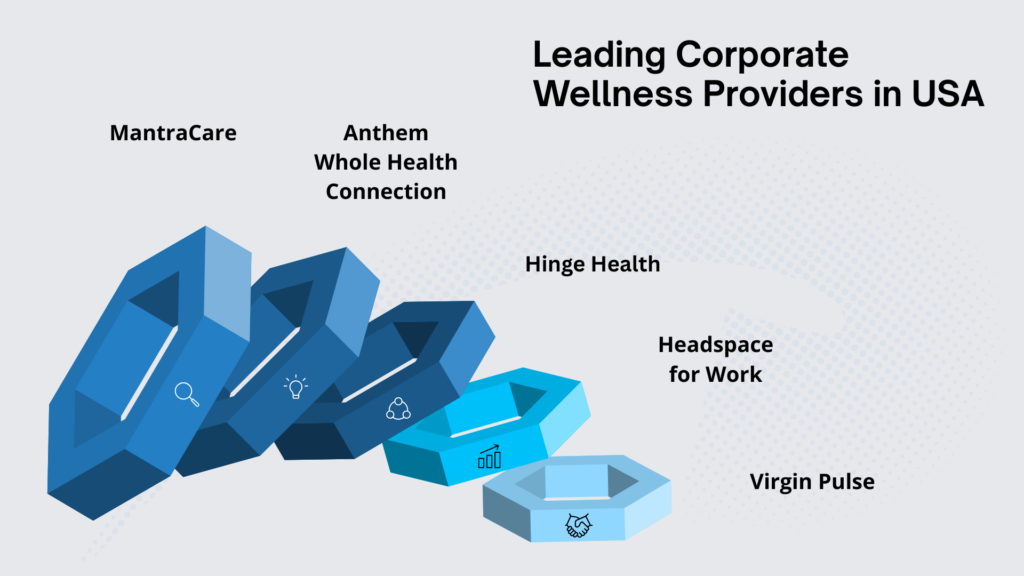
The comparison table below provides an at-a-glance summary. Detailed profiles follow.
| Corporate Wellness Provider | Best For | Unique Strength |
| MantraCare | Mid-Size to Large Enterprises | Holistic AI-Driven Platform Across Mental, Physical & Preventive Care |
| Anthem Whole Health Connection | Large Enterprises & Insurers | Integrated Medical + Wellness with Nationwide Network Depth |
| Hinge Health | Employers with High MSK Burden | Digital-First Musculoskeletal Care with Clinical Outcomes Data |
| Headspace for Work | Remote & Hybrid Workforces | Clinically Validated Mindfulness with Enterprise-Grade Engagement |
| Virgin Pulse | Large & Multinational Employers | Behaviour Change Platform with Global Reach and HRMS Integration |
1. MantraCare
- Headquarters: New York, USA
- Core Focus: Holistic, AI-driven employee wellbeing
MantraCare is among the most comprehensive global corporate wellness providers in the USA, delivering integrated health solutions across mental, physical, and preventive care. The platform provides structured wellness programs backed by AI technology, enabling organizations to offer personalized care journeys, improve employee engagement, and track outcomes through centralized dashboards.
Key services: Employee Assistance Programs (EAP), 24/7 counselling support, fitness and wellness programs, chronic disease management, preventive health checkups, nutrition coaching, teleconsultations, analytics and reporting dashboards.
2. Anthem Whole Health Connection
- Headquarters: Indianapolis, Indiana
- Core Focus: Integrated medical and wellness benefits at enterprise scale
Anthem’s Whole Health Connection brings together physical health insurance, mental health services, and workplace wellness into a unified member experience for large employers. As one of the largest health insurers in the United States – covering over 40 million members – Anthem’s corporate wellness proposition is uniquely backed by claims data, clinical networks, and population health infrastructure that standalone wellness platforms cannot replicate.
Key services: Group medical insurance, mental health integration, biometric screenings, chronic disease management, nurse care navigation, EAP, digital health tools, population health analytics.
3. Hinge Health
- Headquarters: San Francisco, California
- Core Focus: Digital musculoskeletal (MSK) care and physical therapy
Hinge Health is a leading digital MSK platform helping U.S. employers address back pain, joint disorders, and other musculoskeletal conditions – one of the largest drivers of employer healthcare costs. The platform pairs wearable motion sensors with app-based exercise therapy and one-on-one coaching from licensed physical therapists and health coaches.
Key services: Digital physical therapy, wearable motion feedback, licensed health coaches, surgical avoidance pathways, mental health integration for chronic pain, employer analytics and ROI reporting.
4. Headspace for Work
- Headquarters: Los Angeles, California
- Core Focus: Clinically validated mindfulness and mental wellbeing for enterprise
Headspace for Work is the enterprise wellness platform from Headspace, backed by 65+ peer-reviewed studies. It helps organisations reduce burnout, improve sleep, and support workforce mental wellbeing through structured mindfulness and stress-management programs.
Key services: Guided mindfulness and meditation, stress and sleep program, burnout prevention content, manager training, Focus music, HR admin dashboard, HRIS integrations, multilingual content library.
5. Virgin Pulse
- Headquarters: Providence, Rhode Island
- Core Focus: Behaviour change and global workforce wellbeing platform
Virgin Pulse is one of the most widely deployed corporate wellness platforms in the United States, serving over 3,000 clients and more than 14 million members across 190 countries. The platform’s core proposition is sustained behaviour change – moving beyond point-in-time wellness incentives toward long-term habit formation through personalized journeys, social challenges, and rewards architecture.
Key services: Personalized wellness journeys, health challenges and incentives, mental health support, financial wellbeing tools, benefits navigation, HRMS integrations, global multilingual support, and employer analytics.
Extended List of Corporate Wellness Providers in the USA in 2026
| Corporate Wellness Provider | Headquartered | Core Focus | Best For |
| Calm for Business | San Francisco, CA | Sleep, Stress, And Mental Resilience | Remote & Hybrid Workforces |
| Lyra Health | Burlingame, CA | High-Quality Mental Health Care With Therapist Matching | Enterprises Prioritising Clinical Mental Health |
| Spring Health | New York, NY | Precision Mental Healthcare With Fast Therapist Access | Mid-Size to Large Enterprises |
Global organisations are increasingly investing in employee wellbeing, mental health, and preventive healthcare. Explore how businesses across India, the UK, Canada, and Singapore are approaching corporate wellness in 2026.
How to Choose the Best Corporate Wellness Provider
To make a good decision among the top corporate wellness service providers in the United States would mean finding an option that is both consistent with the actual health needs of your employees and capable of producing measurable results – not simply the most feature-rich platform to which your workforce will never interact.
Step 1 – Map your workforce health profile
Before assessing any provider, determine your organizations health risk profile using available claims information or a health risk assessment. Consider age distribution, work organization, geography, and industry-related health risks. The needs of a 300-person technology company with a fully remote workforce are fundamentally different from those of a 6,000-person logistics employer operating across multiple states.
Step 2 – Clarify your priority outcome
Are you primarily aiming to reduce absenteeism? Reducing healthcare claims expenses? Enhance mental health results? Increase retention? Providers are tuned to various results. MantraCare is at the forefront of achieving holistic, AI-powered wellbeing in both mental and physical health. Hinge Health is a leader in reducing the costs of MSK. Headspace for Work is a leader in the prevention of stress and burnout. Virgin Pulse is the leader with regard to long-term behaviour change and engagement. Match the provider’s core strength to the challenge your organization faces most urgently.
Step 3 – Demand mobile-first and inclusive technology
By 2026, mobile-first experience is a baseline expectation, not a differentiator. Make sure that the platform equally serves office-based, remote, frontline, and hybrid employees. Verify real-time HR dashboards, HRMS integration capability, and HIPAA-compliant data architecture. For any employer operating across state lines or internationally, data privacy and compliance infrastructure are non-negotiable.
Step 4 – Verify the mental health infrastructure
A stepped-care model, including self-directed digital resources and a confidential 24/7 helpline, and an escalated approach to licensed counsellors and psychologists, as well as clear crisis support pathways, has become the current standard expectation. Verify that counsellors are licensed in the relevant states and credentialled through recognized bodies such as the APA or NASW. Any of the providers that fail to show this layered model is an operationally incomplete provider.
Step 5 – Test the depth and reach of clinical networks
To access preventive health and occupational health services, make sure the provider has a clinical network that stretches to the locations where your employees actually live and work, rather than just large metropolitan areas. In the case of mental health, specifically, request the average time-to-first-session. The economic value of an EAP or mental health benefit is lost when a worker who has sought assistance waits weeks to utilize the benefit.
Step 6 – Try it on a small scale before you roll it out
Ask to pilot a structured three-month program before signing a multi-year contract. Set up pre-launch baseline: rate of absenteeism, present-day use of benefits, and overall wellbeing rate. Measure participation rates, employee NPS towards the program and any early signs of improvement in health outcomes at the end of the pilot. The credible provider will not accept this structure only; he will embrace it.
Conclusion
The U.S. corporate wellness market in 2026 is being shaped by several converging forces: employer healthcare costs rising at rates that demand structural intervention, a mental health crisis that has fundamentally repositioned employers as primary access points for psychological care, the normalisation of hybrid and remote work models, and a workforce generation that evaluates health benefits as a decisive factor in where they choose to work and whether they stay.
The corporate wellness providers in the USA profiled in this guide are reputable, established operators – each with distinct advantages for different company sizes, sectors, and health priorities. The most comprehensive provider is not automatically the right one. The right provider is the one your employees will genuinely engage with, whose outcomes are measurable against your specific workforce challenges, and whose model is built for where your organization is going – not where it has been.
Discover the best corporate wellness providers in Belgium, Kuwait and Turkey for EAPs, engagement, and occupational wellbeing.
Frequently Asked Questions
Entry-level EAPs typically cost USD 12 to USD 40 per employee per year. Mid-range digital platforms range from USD 100 to USD 300, while a comprehensive program covering EAP, telemedicine, and chronic condition management runs USD 400 to USD 800 per employee annually. Most providers offer tiered and custom enterprise pricing.
An EAP is a focused benefit covering mental health, legal, and financial support for employees in crisis. A corporate wellness program is broader – encompassing preventive health, fitness, and chronic disease management. Most modern wellness platforms include an EAP as one component within a wider ecosystem.
Frontline workers are consistently underserved by programs built for desk-based employees. The best providers for this segment offer mobile-first access without a corporate email requirement, multilingual content, and flexible access outside standard working hours. Always verify engagement rates among non-desk employees before committing to a provider.
Yes. Providers such as MantraCare, Headspace for Work, and Spring Health offer scalable plans from 50 employees upward at per-employee pricing that does not require enterprise headcount to be cost-effective. Many platforms also offer modular structures, allowing smaller employers to start lean and expand coverage as the business grows.
Employer contributions to group health plans are generally tax-deductible and excluded from employee taxable income. EAP benefits are typically tax-exempt under a qualified plan, while cash wellness incentives may be taxable depending on structure – organizations should confirm program design with a benefits counsel or tax adviser.