
“The health of the people is really the foundation upon which all their happiness and all their powers as a state depend.” – Benjamin Disraeli
Denmark is widely regarded as one of the world’s most progressive labour markets – yet beneath that reputation, a workforce under measurable and growing strain is pushing corporate wellness from a discretionary benefit to a genuine business imperative. Stress levels across the Nordic countries are rising, and among those countries, Denmark is recording the steepest rate of increase. The increase in long-term negative stress was steepest in Denmark, climbing 58% in a single year, even as the country’s baseline stress levels remained comparatively lower than neighbouring Finland and Sweden. For employers, that trajectory is a warning signal – not a reassurance.
The European corporate wellness market reached USD 16.54 billion in 2025 and is forecast to hit USD 22.45 billion by 2035, growing at a CAGR of 3.10%, driven by rising focus on employee health, productivity, and workplace well-being initiatives. Denmark sits at the heart of this shift. For HR leaders, business owners, and decision-makers evaluating their options in 2026, this guide cuts through the noise: who the credible providers are, what they actually deliver, and how to choose the right partner for the real complexity of the Danish workforce.
Building a Nordic wellbeing strategy? Compare employee wellness providers in France and Sweden.
What Is a Corporate Wellness Provider?
A corporate wellness provider works collaboratively with an employer to design and deliver a structured health and wellness program for their workforce. In practice, this means going well beyond a one-off wellness day or an annual fitness challenge – it means building a sustained, measurable system that supports employees across every dimension of their health.
Most providers operate across three service levels.
- Preventive health includes health risk assessments, biometric screenings, ergonomic evaluations, wellness days, and occupational health audits. This is the diagnostic foundation – understanding what the workforce is actually dealing with before problems translate into prolonged absences.
- Clinical and curative support includes telemedicine, physiotherapy, specialist referrals, chronic condition management, and rehabilitation services. This tier keeps employees with existing health conditions functioning and supported within the workplace.
- Lifestyle and mental wellness include Employee Assistance programs (EAPs), psychological counselling, fitness programs, nutrition coaching, stress management workshops, and financial advisory. This is the layer employees feel in their daily experience and the one that most directly shapes engagement, retention, and culture.
In Denmark, the Working Environment Act emphasises that individual workplaces should be designed to prevent employees from being forced to leave the labour market due to attrition and stress, and requires that factors that may lead to physical or mental health risks be addressed. Since 2020, this has been reinforced by a dedicated Executive Order on Psychosocial Working Environment.
Why Corporate Wellness Has Become Urgent in Denmark
Before building a provider shortlist, it is worth understanding what the data actually says.
1. Stress levels are rising at an alarming pace.
A 2024 survey of over 4,000 people across the Nordic countries found that 88% of respondents experience negative stress at least occasionally, with more than half of those experiencing long-term stress having been stressed for more than six months – a 30% increase from the prior year. Critically, stress levels in Denmark, while comparatively lower than in Finland, are growing faster than in any other Nordic country.
2. Demeaning treatment at work is disproportionately common in Denmark.
One in four Nordic employees reports having experienced demeaning treatment at work, and Denmark records a higher degree of such treatment than the other Nordic countries, with women and young people most affected. This type of psychosocial harm sits upstream of burnout, disengagement, and long-term sick leave, and it demands structured intervention rather than reactive management.
Danish research found the prevalence of perceived stress among Danish working adults increased from 21% to 25% between 2010 and 2017 and was particularly high among workers aged 18–44, with prevalence rates of 35% among women and 24% among men. Stress is simultaneously one of the most commonly stated causes of sick leave in Denmark and one of the least consistently addressed.
4. The ROI case is established.
For every dollar spent on corporate wellness programs, companies can expect an average return of $3.27 in lower healthcare costs, while companies with wellness programs report a 20% increase in employee productivity. In 2026, the question for Danish employers is not whether to invest – it is which partner to trust with that investment.
Top Corporate Wellness Providers in Denmark in 2026
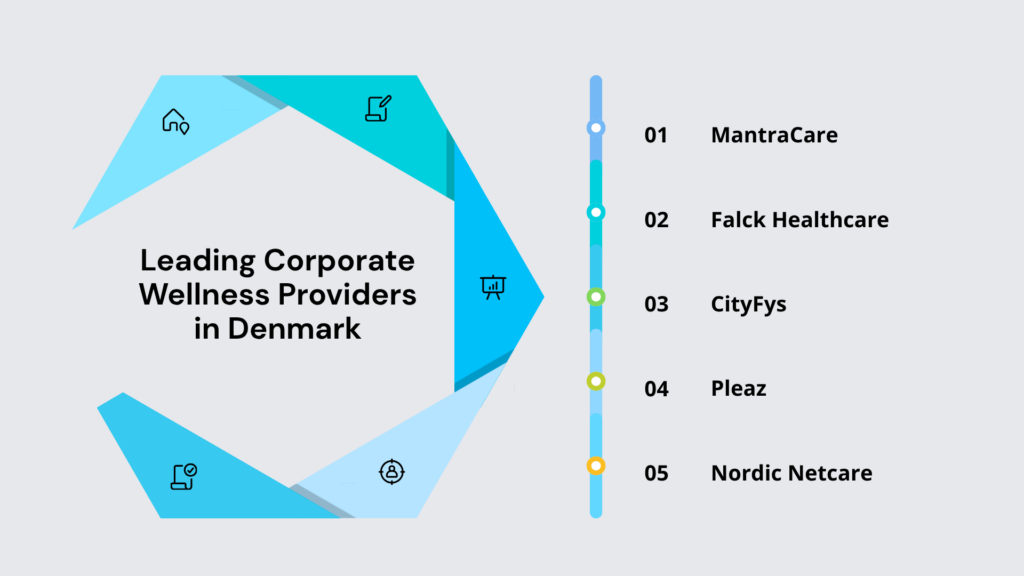
Denmark’s corporate wellness landscape is evolving rapidly as organizations increasingly prioritize employee mental health, preventive healthcare, and workplace productivity. The providers listed below represent the leading corporate wellness companies in Denmark, offering services ranging from EAPs and occupational health to digital wellbeing platforms, physiotherapy networks, and musculoskeletal care.
| Corporate Wellness Provider | Best For | Unique Strength |
| MantraCare | All Business Sizes | AI-powered multilingual digital wellness platform with the highest EAP engagement rates |
| Falck Healthcare | All Business Sizes | Denmark’s largest provider of health schemes with 120+ clinics nationwide |
| CityFys | SMEs & Copenhagen-based employers | 25+ years of physiotherapy and workcare expertise with onsite and clinic-based delivery |
| Pleaz | Hybrid & Remote Workforces | Microsoft Teams-native wellbeing platform driving daily engagement through micro-activities |
| Nordic Netcare | Insurers, Pension Funds & Corporates | Blended digital health network for MSK care covering 100,000+ patients annually |
1. MantraCare Denmark
- Headquarters: Global (with Danish operations and GDPR-compliant data infrastructure)
- Core Focus: AI-powered holistic digital wellness platform
MantraCare Denmark offers a comprehensive workplace wellness platform covering mental health (EAP), telehealth, musculoskeletal care, chronic condition management, diabetes, obesity, and fitness – all under one roof, with AI-driven guidance connecting employees to the right care at the right time. Having served 80,000 employees in Denmark and over 30 countries across more than 10 years, MantraCare delivers 5 to 7 times higher signup rates compared to other EAPs in Denmark, driven by additional offerings such as meditation, yoga, and physiotherapy, with 95% of users reporting satisfaction with the program.
For Denmark’s international workforce – concentrated in Copenhagen, Aarhus, and Odense and spanning a wide range of languages and cultural backgrounds – MantraCare’s 50-plus language delivery determines whether a meaningful share of employees ever engage with the program. An employee who cannot access psychological counselling or health coaching in their preferred language is an employee who will not use it, regardless of how comprehensive the underlying platform is.
Key services: EAP, psychological counselling, chronic condition reversal (diabetes and hypertension), corporate yoga and fitness, nutrition coaching, physiotherapy, women’s health programs, health risk assessments, telemedicine, multilingual delivery, and HR analytics dashboards.
2. Falck Healthcare
- Headquarters: Copenhagen, Denmark (120+ clinics nationwide)
- Core Focus: Prevention, treatment, and rehabilitation for Danish workplaces
Falck Healthcare is Denmark’s largest provider of health schemes within prevention, treatment, and rehabilitation, covering more than 2 million Danes yearly through Employee Assistance programs in more than 120 health clinics. With a heritage stretching back to 1906, Falck operates across healthcare, assistance, safety services, and emergency response – and its healthcare division brings the same depth of operational infrastructure to corporate clients.
Falck Healthcare runs more than 120 clinics with around 700 physical therapists carrying out approximately 650,000 treatments a year, while its “Hurtig Diagnose” (Fast Diagnosis) concept helps more than 310,000 Danes reduce waiting times for appointments with specialist doctors. For employers managing a workforce spread across multiple Danish cities or sectors with significant physical demands – construction, logistics, manufacturing, healthcare – that national clinic footprint translates directly into access and utilization.
Key services: EAP, physiotherapy, occupational rehabilitation, return-to-work support, mental health support, “Hurtig Diagnose” specialist access, health screenings, chronic condition management, absence management, and nationwide clinic network.
3. CityFys
- Headquarters: Copenhagen (clinics in Copenhagen, Herning, and Randers)
- Core Focus: Physiotherapy, massage, and workcare for Danish employers
CityFys is Denmark’s largest massage provider. It has specialised in physiotherapy and massage for more than 20 years, based in Copenhagen. Beyond the clinic, its corporate health arm works directly with Danish employers. Services cover ergonomics, physical and mental wellbeing, and strategic workplace health.
CityFys A/S operates across three health areas – CityFys Wellness, CityFys Healthcare, and CityFys Workcare. Its team of health professionals – including physiotherapists, nurses, and dietitians – is working on improving ergonomics, physical and mental wellbeing, and the overall strategic health of Danish workplaces. With more than two decades of experience, CityFys is one of Denmark’s most experienced corporate healthcare players.
Key services: Corporate physiotherapy, workplace massage schemes, ergonomic assessments and coaching, workcare consultancy, dietitian services, musculoskeletal treatment and prevention, health lectures and courses, and company treatment schemes.
4. Pleaz
- Headquarters: Copenhagen, Denmark (operating in 74+ countries)
- Core Focus: Digital micro-wellbeing platform for hybrid and remote workforces
Pleaz is a Danish-founded wellbeing company on a mission to make daily healthy habits a natural part of working life. It operates as an online video platform offering science-backed exercises and tools covering muscle pain, stress management, focus, and energy. The platform is designed to strengthen social bonds and build lasting healthy habits – particularly relevant in an era when the boundary between office and home has permanently shifted. It is active in 74-plus countries and available in six languages.
The provider stands out through its native integration into Microsoft Teams, allowing employees to participate in wellbeing activities without leaving their existing workflow. This reflects a broader understanding that wellbeing works best when embedded into daily work rather than treated as something separate. For Danish employers managing hybrid teams – where inconsistent access to in-person wellness resources is an ongoing challenge – that integration removes the single largest barrier to consistent utilization.
Key services: Microsoft Teams-integrated wellbeing activities, science-backed micro-exercise sessions, breathwork and mindfulness modules, stress management tools, energy and focus recovery, social connection features for hybrid teams, and multilingual content delivery.
5. Nordic Netcare
- Headquarters: Copenhagen, Denmark (network spanning the Nordics)
- Core Focus: Blended digital health for musculoskeletal conditions and evidence-based therapy
Nordic Netcare was founded in 2003 in Copenhagen as a private health service focusing on physiotherapy and exercise. Since then, it has grown into one of the leading health service providers in the Nordics. The organization operates with a passion for empowering people to take control of their own health – a philosophy it describes as “Digital Health With a Human Touch.
It is a health network for blended healthcare, specializing in musculoskeletal conditions and evidence-based therapy support. It combines digital solutions with human interaction, guaranteeing proven support for MSK conditions. The network handles over half a million health enquiries annually. It brings together more than 18,000 practices and 22,000 therapists across its provider network.
Key services: Online physiotherapy, personalised health plans, health coaching, MSK case management, evidence-based therapy referrals, Physiocoach blended rehabilitation, insurance-integrated health case handling, and a pan-Nordic clinic network.
Extended Provider List Worth Evaluating
| Corporate Wellness Provider | Headquartered | Core Focus | Best For |
| PrimaCare | Denmark | Occupational health and preventive care | SMEs and Danish public sector organizations |
| Howdy (by LifeGuard Health) | Denmark | Digital health and wellbeing platform | Tech companies and hybrid workforces |
| Aleris Denmark | Denmark | Private healthcare and specialist access | Employers seeking premium clinical benefits |
Expanding your employee wellbeing strategy internationally? Compare wellness providers in the UAE, Australia, and Singapore.
How to Choose the Right Corporate Wellness Provider in Denmark
Choosing the right wellness provider in Denmark requires balancing regulatory obligations, workforce characteristics, and measurable outcomes.
Step 1 – Assess your workforce.
Different sectors and team structures carry different health risk profiles. Evaluate your workforce by location, sector, work model (office, hybrid, remote, field-based), and key health risks before beginning a provider selection process.
Step 2 – Confirm compliance with Danish working environment law.
The Danish Working Environment Act requires employers to conduct regular risk assessments, provide employees with necessary training and equipment, and ensure a safe and healthy working environment that is both physically and psychosocially sound. Ensure the provider you select either operates within this regulatory framework or formally supports your compliance obligations.
Step 3 – Evaluate mental health support depth.
With stress levels rising faster in Denmark than anywhere else in the Nordics, surface-level mental health provision is not sufficient in 2026. Strong providers offer structured pathways including self-help tools, counselling, crisis support, and psychiatric referral capacity for employees experiencing burnout or psychological distress.
Step 4 – Prioritize integration and daily accessibility.
The most robust program on paper is worth nothing if employees do not use it. Evaluate whether the provider’s delivery model – clinic network, digital platform, or both – fits how your workforce actually operates day to day. For hybrid teams, digital-first or Teams-integrated platforms tend to outperform purely clinic-based models on utilization.
Step 5 – Demand measurable outcomes, not activity reports.
Ask providers to present data on absenteeism reduction, EAP utilization rates, health risk improvements, and employee satisfaction scores from comparable Danish clients. Aggregate reporting and anonymised HR analytics dashboards should be standard, not premium add-ons.
Step 6 – Run a structured pilot.
A defined pilot period – typically three to six months – allows you to measure actual engagement, gather employee feedback, and validate utilization before committing to a long-term contract. Providers confident in their platform should welcome a pilot structure.
Conclusion
Denmark’s corporate wellness market is moving with both urgency and sophistication. With 88% of Nordic workers experiencing negative stress and the steepest acceleration in long-term stress recorded in Denmark, and with more than a third of the working population worried about the prospect of long-term sick leave, the cost of inaction for Danish employers in 2026 is substantially higher than it has ever been.
Falck Healthcare is Denmark’s largest provider of health schemes within prevention, treatment, and rehabilitation, covering more than 2 million Danes yearly through EAPs and more than 120 health clinics. MantraCare Denmark delivers an AI-powered, multilingual wellness platform designed for hybrid and diverse workforces, with strong EAP engagement and real-time ROI reporting across 80,000+ Danish employees served. CityFys A/S brings together physiotherapy, workcare, and nutritional expertise across its wellness, healthcare, and workcare divisions, working with employers on improving ergonomics, physical and mental wellbeing, and strategic health at Danish workplaces.
Further, Pleaz provides a Microsoft Teams-native wellbeing platform that embeds healthy habits into the flow of daily work, making it especially well-suited to hybrid and remote-first teams. And Nordic Netcare – now part of Howden Danmark – serves over 100,000 patients annually through its pan-Nordic network of more than 4,000 clinics, focusing on blended digital and human health support for MSK conditions and evidence-based rehabilitation.
The right provider is not the one with the most impressive feature list. It is the one your employees will actually use – in the language they speak, through channels that fit how they work, within a legal framework that protects both them and your organization, with outcomes that are independently verifiable. In 2026, that bar is higher than it has ever been. So is the return for getting it right.
Compare employee wellness trends across Hong Kong, Israel, and Turkey.
Frequently Asked Questions
Costs vary by provider and workforce size. Digital wellness platforms can start at a few euros per employee per month, while comprehensive programs combining clinical access and digital platforms are priced based on services and headcount. Most Danish employers report meaningful ROI through reduced absenteeism and healthcare costs.
No. An EAP primarily provides confidential counselling and referral support. A full wellness program additionally includes preventive care, physiotherapy, fitness, nutrition, financial wellbeing, and mental health support – addressing the workforce holistically rather than reactively.
Effective wellness programs return an average of $3.27 for every $1 spent in reduced healthcare costs alone, while companies with active programs report a 20% increase in employee productivity. Absenteeism reduction, lower turnover, and improved engagement compound those returns over time
Partially. Danish law requires employers to plan, organize, and carry out work in a way that ensures a safe and healthy psychosocial working environment, but broader wellness programs beyond that legal baseline remain voluntary. Regulatory pressure is nonetheless tightening, and the costs of non-compliance – both legal and reputational – are rising.
MantraCare and Pleaz offer cost-effective digital wellness and mental health solutions that scale well for smaller organizations. Falck Healthcare and CityFys provide accessible clinic-based schemes suitable for companies of most sizes, while Nordic Netcare’s insurance-integrated model suits employers already managing group health insurance arrangements.