

Employee wellbeing used to live in the HR benefits brochure. In 2026, it sits on the CFO’s desk – because the cost of ignoring it now exceeds the cost of fixing it. IMARC Group estimates that the UK corporate wellness market is worth USD 3.0 billion in 2025 and will reach USD 4.6 billion by 2034, with a CAGR of 4.64%. A more approximate estimate from Grand View Research puts the picture in clearer focus: the UK corporate wellness market will generate USD 3,458.6 million in revenue in 2024 alone, with the largest revenue-generating service segment being health risk assessment and the fastest growth registered by stress management.
The direction is clear regardless of the lens you are applying. British employers are spending significantly more on the health and wellbeing of their people, and that investment is accelerating.
What is causing this growth is not a single factor but rather a combination of forces: a crisis in sickness absence rates, reaching an unprecedented high in more than ten years, an NHS under sustained pressure, which has pushed employers to cover the gap in healthcare, leading employers to consider wellness benefits as a genuine dealbreaker in considering employers.
The guide is intended for HR leaders and founders as well as business decision-makers – what questions should be answered to choose the right one among the most reliable corporate wellness providers in the United Kingdom?
Asian workplaces are redefining employee wellbeing. Compare how corporate wellness providers in Spain and Norway are supporting healthier, more productive workforces.
What is a Corporate Wellness Provider?
A corporate wellness is an organisation that works in liaison with employers to plan and execute formal health and well-being programmes for their staff. It is much more than a gym subsidy or a box of fruit in the break room.
Practically, most of the providers exist at three levels:
- Preventive Health – biometrics screening, health risk assessment (HRA), annual health check-up, and personalised health report.
- Curative / Clinical Support – telemedicine, online GP visits, occupational health, and specialist referrals.
- Lifestyle and Mental Wellness – workout programmes, dietary counselling, meditation, employee assistance programmes (EAPs), and financial counselling.
Health risk assessment is prevalent in the market, as it has established itself as the basis for preventive healthcare strategies, enabling organisations to identify employee health vulnerabilities and design targeted wellness interventions.
Why Corporate Wellness Providers Matter in 2026
“Employers are uniquely positioned to take a preventative approach to health and remove barriers to healthcare access. Investing in wellbeing is not just the right thing to do – it delivers clear organisational benefits.”
1. The UK is facing a workforce health crisis
The average level of employee absences is currently at 9.4 days per year, compared to 7.8 in 2023 and 5.8 in 2022. The CIPD cautions that the numbers are an indicator of a looming workforce health crisis, with much of the growth being fueled by mental health problems, stress, and musculoskeletal diseases.
2. Mental health at work is a quantifiable business challenge
Mental health illness is now the leading cause of long-term absence, accounting for 41% of cases. In liaison with Mental health – problems associated with employment cost the UK economy £57.4 billion per year. Deloitte places the cost to employers at £51 billion annually, with a £4.70 return for every £1 invested in early intervention. 63% of UK employees show at least one characteristic of burnout – up from 51% in 2021.
3. NHS waiting times are creating a corporate healthcare imperative
Long delays are caused by NHS mental health services, and therefore, offering internal EAP counselling providers available 24/7 can help reduce absenteeism and offer quicker assistance. This dynamic has also resituated the employer as a major point of access to mental health care. The UK EAPs are currently accessible to over 24 million workers, although the actual utilisation is only 3 to 10 per cent; the gap between provision and real need is the defining problem of HR leaders in 2026.
Top Corporate Wellness Providers in the United Kingdom in 2026
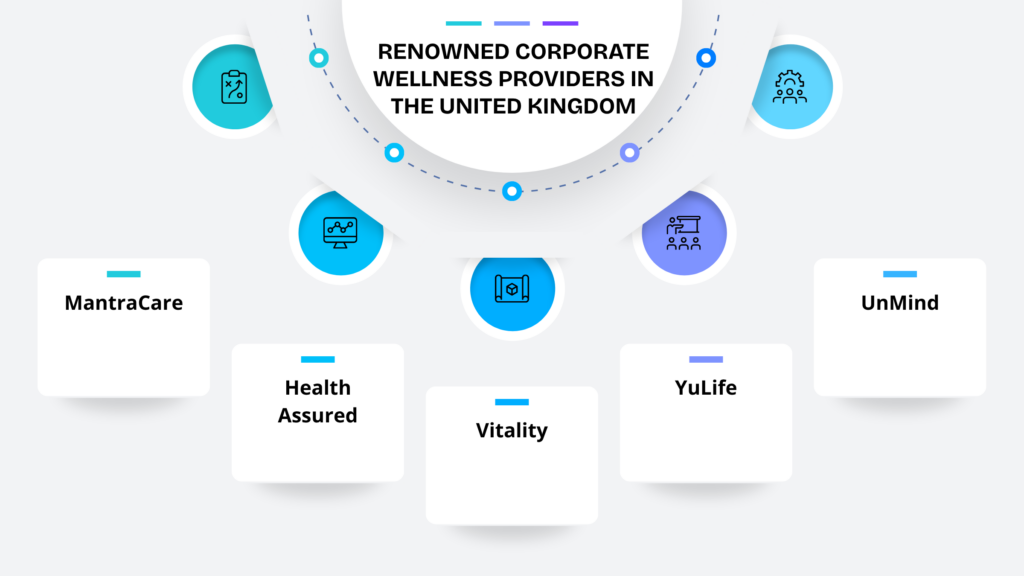
The comparison table below provides an at-a-glance summary. Detailed profiles follow.
| Corporate Wellness Provider | Best for | Unique Strength |
| MantraCare | Mid-Size To Large Indian Companies | Physical + Mental Health In One Platform |
| Health Assured | Large Enterprises And Mncs | World’s Largest EAP, 24/7 Counselling Support |
| Vitality at Work | Insurance-Driven Corporates | Healthy Behaviour = Lower Insurance Premiums |
| YuLife | Startups And Tech Companies | Gamified App With 70%+ Engagement Rates |
| Unmind | Enterprises Prioritising Mental Health | Clinical Tools That Measure Workforce Mental Health Outcomes |
1. MantraCare
- Headquarters: Birmingham, UK
- Core Focus: Holistic, AI-driven employee wellbeing
MantraCare is amongst the global corporate wellness providers in the United Kingdom that deliver integrated health solutions across mental, physical, and preventive care. It provides structured wellness programs backed by technology, enabling organisations to offer personalised care journeys, improve employee engagement, and track outcomes through centralised dashboards.
The platform is built to simplify fragmented wellness offerings by combining therapy, fitness, chronic care management, and preventive health into a single ecosystem. With a strong emphasis on accessibility and scalability, MantraCare supports organisations in creating consistent wellness experiences across distributed and diverse workforces.
Key services: Employee Assistance Programmes (EAP), 24/7 counselling support, fitness and wellness programmes, chronic disease management, preventive health checkups, nutrition coaching, teleconsultations, analytics and reporting dashboards.
2. Health Assured (HA | Wisdom Wellbeing)
- Headquarters: Manchester, UK
- Core Focus: The largest EAP and employee wellbeing platform in the UK and Ireland
Health Assured is trusted by over 88,000+ organisations and 13.5 million people across the UK and Ireland. The platform is designed to decrease mental health-related absences, safeguard staff, and maximise ROI – providing expert care 24/7, 365 days a year.
Health Assured is the only UK EAP provider to have both clinical accreditation of this type against the standards set by the National Counselling and Psychotherapy Society (NCPS) and the British Association for Counselling and Psychotherapy (BACP). It also has a 98% client retention rate.
Key services: 24 / 7 confidential counselling, legal and financial advice, virtual GP, critical incident support, and manager consultancy. mental health first aid training, HR analytics, My Healthy Advantage app.
3. Vitality at Work
- Headquarters: London, UK
- Core Focus: Wellness-based on insurance with a behaviour-change rewards model
Vitality is the only major platform concerning the corporate wellness providers in the United Kingdom that has built its entire model around behaviour change – linking private medical insurance with a proactive rewards programme that incentivises employees to adopt healthier habits long-term.
The Vitality Programme gives rewards to employees who complete health checks, exercise consistently, and use health monitoring tools. Some examples of rewards are gym discounts, cinema tickets, and coffee benefits. The model makes employee engagement and behavioural change a long-term investment by directly correlating proactive health management to tangible benefits.
Key services: Private medical insurance, rewards-based wellness programme, Vitality Health app, GP services, cancer and mental health clinical pathways, Britain’s Healthiest Workplace study, and occupational health.
4. YuLife
- Headquarters: London, UK
- Core Focus: Gamified wellness platform and insurance benefits
Founded in 2016, YuLife has become one of the most distinctive wellness propositions in the UK market by combining gamified daily wellbeing with substantive insurance products in a single employee-facing experience.
YuLife has launched a partnership with Bupa, making its reward and wellbeing app and benefits available to small and medium enterprises, using the Bupa Select product available for organisations of between two and 500 employees. It features access to 600 hospitals within the Bupa network, pathways to cancer, mental health and MSK conditions, and unrestricted digital GP appointments.
Key services: Game-based wellbeing application, group health insurance (via Bupa), group life insurance (via AIG), group critical illness, income protection, YuCoin rewards, access to digital GP, mental health support.
5. Unmind
- Headquarters: London, UK
- Core Focus: Preventative, whole-organisation mental health platform
Unmind is a UK-based workplace mental health platform focused on preventive and organisation-wide wellbeing. It helps employers build mental fitness proactively before issues lead to burnout, absenteeism, or clinical intervention.
Unmind Talk provides coaching and one-on-one support through a global therapist network covering 50+ languages and multiple therapy models, including CBT. The platform also offers evidence-based programmes for sleep, stress, resilience, and relationships, and is currently available free to all NHS staff until June 2026.
Key services: Evidence-based mental health programmes, therapist access (50+ languages, CBT and 20+ modalities), sleep and stress tools, resilience training, HR engagement analytics.
Extended List of Corporate Wellness Providers in the United Kingdom in 2026
| Corporate Wellness Provider | Headquartered | Core Focus | Best For |
| AXA Health | London | Private health insurance, digital GP, mental health support | Mid-Size to Large Enterprises |
| Personify Health | London | Integrated benefits, health navigation, wellness challenges | Large & Multinational Enterprises |
| Headspace | London | Mindfulness, meditation, stress & sleep support | Remote & Hybrid Workforces |
| Aviva | London | Health insurance, mental health, fitness rewards | Mid-Size to Large Enterprises |
Looking beyond the United Kingdom? Global markets like India and the United States are increasingly investing in employee wellbeing programmes.
How to Choose the Best Corporate Wellness Provider
Choosing the right corporate wellness provider in the United Kingdom means finding a solution that genuinely fits your workforce’s needs. The best providers deliver measurable impact on employee health, engagement, and productivity – not just features.
Step 1 – Map your workforce
Understand your organisation’s health risks, age demographics, work structure, and geographic spread before choosing a provider. A remote fintech team and a large manufacturing workforce will require very different wellness solutions.
Step 2- Evaluate your priority outcome.
Do you mainly aim to minimise absence rates? Lower voluntary attrition? Enhance mental health outcomes? Providers are good at various functions. MantraCare stands out for AI-enabled wellbeing, Health Assured for EAP support, Vitality for behaviour change, YuLife for gamified engagement, and Unmind for preventive mental health. The best provider is the one that aligns most closely with your organisation’s biggest workforce challenge.
Step 3 – Demand mobile-first and inclusive technology
By 2026, the mobile-first experience will become the baseline, rather than a differentiator. Ensure that the platform serves office-based, hybrid, and fully remote employees equally well and does not exclude shift workers or the frontline team. Verify real-time HR dashboards, the capability to integrate with HRMS, and a data architecture that is compliant with GDPR. Employers in the UK and EU should not compromise on compliance with the GDPR.
Step 4 – Verify the mental health infrastructure
In 2026, the standard expectation is a stepped-care model: starting with self-help digital resources, providing a 24/7 confidential helpline, escalating to professional counsellors and psychologists where needed, and including crisis support pathways. Enquire about BACP or NCPS accreditation of counsellors – not only is this important in terms of clinical quality assurance, but also because of the HMRC requirements of counselling benefits being tax-exempt. Any provider that fails to prove this layered model is never complete.
Step 5 – Test the depth of clinical networks
Under preventative health examination and occupational health, ensure that the protective network of the provider reaches where your employees actually reside and not just in London and major cities. In a mental case, verify average time-to-first-session: the value of an EAP decays quickly when an employee who has requested assistance waits weeks to see someone.
Step 6 – Pilot, then commit
Demand a staged three-month trial before negotiations of a lengthy agreement. Set benchmark measures before launch: absence rates, utilisation of current benefits and employee wellbeing score. Measure participation rates and employee NPS for the wellness programme at the end of the pilot period. A credible provider will embrace the acceptable structure.
Conclusion
The corporate wellness market is being shaped by several converging forces: an absence crisis that has reached its highest point in over a decade, an NHS under pressure that has repositioned employers as frontline access points for mental health support, the maturation of hybrid and remote work models, and a new generation of employees who evaluate wellness benefits as a primary factor in where they choose to work and stay.
The corporate wellness providers in the United Kingdom profiled in this guide are reputable, established operators – each with distinct advantages for different company sizes, sectors, and objectives. The most feature-rich provider is not automatically the right one. The right provider is the one your employees will actually use consistently, whose outcomes are measurable, and whose model genuinely aligns with the health challenges your workforce faces in 2026.
Workplace wellness programs are expanding across Europe. Discover how organisations in Nigeria, Kuwait, and the Philippines are building healthier work environments.
Frequently Asked Questions
Corporate wellness programme costs in the UK vary based on company size, services offered, and customisation needs. Basic EAP platforms are more affordable, while comprehensive wellness programmes are typically priced per employee.
Implementation timelines vary by provider and programme scope. Digital-first platforms can usually be deployed within 2–6 weeks, while programmes with onsite services may take longer.
ROI is typically measured through reduced absenteeism, lower healthcare costs, improved employee engagement, and productivity gains. Companies also track participation rates, employee satisfaction (NPS), and health outcomes over time to evaluate effectiveness.
A strong programme usually includes mental health support, preventive healthcare, fitness and nutrition, and financial wellbeing. The best programmes combine digital tools with human support to drive consistent employee engagement.
Scalable options include MantraCare, YuLife, and Unmind, which offer flexible wellness solutions that grow with workforce needs.