
Indonesian workplaces are entering a new era in employee health benefits. The former “tick in the box” element (registration to BPJS and annual check-up) has turned into a strategic issue that is important to HR leaders and CEOs. In 2026, the risk of workforce mental health, chronic disease and absenteeism is present enough on the balance sheet that the minimum is not defensible in a serious organization.
Indonesia’s corporate wellness market reflects this shift and is projected to exceed USD 1.2 billion as demand continues to grow rapidly. A younger and more stressed workforce, rising NCD prevalence, changing employee expectations, and supportive government policies are all driving market growth.
This guide is for organizations that are posing this core question: Which are the best corporate wellness providers in Indonesia for your organization?
Assess leading workplace wellness companies in Malaysia and Japan offering preventive healthcare and EAP programs.
What is a Corporate Wellness Provider?
A corporate wellness provider is an organization that works with an employer to develop and implement a health and wellbeing program that goes above and beyond what the statutory health system is offering. In Indonesia, this translates to moving beyond BPJS Kesehatan’s bottom line and the duty of occupational safety and health, K3, to preventive care, mental health, lifestyle support, and digital health engagement.
Most providers work at three levels in practice:
- Preventive Health – annual medical check-ups (MCU), biometric screening, health risk assessments (HRAs), and personalised health reporting.
- Curative and Clinical Support – telemedicine and teleconsultations with GPs, specialists and chronic disease management.
- Lifestyle and Mental Wellness – mental health counselling, employee assistance programs (EAPs), fitness and nutrition coaching, mindfulness, and financial wellbeing support.
In Indonesia, the statutory baseline includes basic health at work and BPJS-sponsored services. However, this isn’t the entire value of a corporate wellness provider – it’s a bar that the added value of a corporate wellness provider is above.
Why Corporate Wellness Providers Matter in Indonesia in 2026
Corporate wellness in Indonesia is rapidly becoming a strategic business priority. Rising mental health concerns, chronic disease, and changing employee expectations are driving employers to invest beyond basic statutory healthcare.
1. Mental health in the workplace is a measurable and growing problem.
Indonesia’s Ministry of Health, citing WHO data, estimates that mental health conditions such as depression and anxiety cost the global economy USD 1 trillion annually in lost productivity. The productive-age population in Indonesia has taken up some 70 per cent of the population from 2020 to 2035, which constitutes a demographic bonus, and the mental health of these workforce members is a direct national economic concern. EAP providers working in Indonesia have said that most employees believe that poor mental well-being has a significant impact on their productivity. Despite persistent stigma, awareness is increasing, and employers who actively address mental health are seeing measurable improvements in retention and workforce performance.
2. Non-communicable diseases are dramatically increasing among the working-age population.
Based on the data from the National Health Research (Riskesdas), the prevalence of diabetes among adults increased from 6.9 per cent in 2013 to 10.9 per cent in 2018, while hypertension rose from 0.265 per cent to 0.341 per cent. In Indonesia, the top three causes of disability adjusted life years (DALYs) are heart disease, cerebrovascular disease, and Type 2 diabetes. Unless the chronic disease burden in the workforce is addressed at the employer level, costs will continue to rise in health care, and long-term absences will accumulate.
3. The regulatory landscape is pushing significantly towards structured wellness.
The Indonesian Occupational Health framework, based on Permenaker No. 5/2018, Occupational Health and Workplace Safety (K3), is no exception, as it also dictates that the employer shall identify and manage the risk of psychological factors along with physical factors. In 2023, the government mandated health and wellness programs for companies with more than 100 employees. In addition, Law No. 17 of 2023 concerning Health deepened the legal framework of mental health services and digital health in the workplace. Workplaces that return on their investment with a structured wellness program are better able to meet regulatory expectations and lessen compliance risk.
4. Remote and hybrid work has generated a new and ongoing health risk profile.
The knowledge economy, now centred in Jakarta, Surabaya, Bandung and Bali, embraced remote and hybrid working at a mass scale during and since the pandemic. The health effects are comparable globally, and include higher sedentary time, digital fatigue, social isolation and greater anxiety and burn-out. Indosat Ooredoo Hutchison is Indonesia’s biggest telecom service provider and documented that re-framing mental health support as a tool for performance resilience acceptance rates at least tripled, compared to those using it as a deficit service. The challenge of framing is real and is recognised by the right provider!
Top Corporate Wellness Providers in Indonesia in 2026
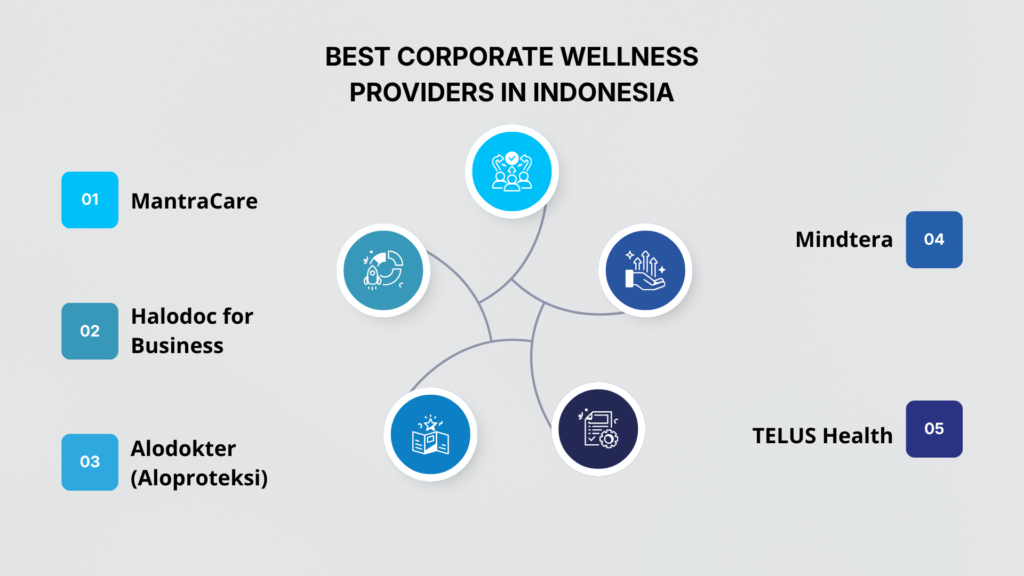
Indonesia’s workforce is one of the largest in Southeast Asia – and in 2026, corporate wellness has moved from a fringe benefit to a boardroom priority, driven by rising burnout rates, post-pandemic mental health awareness, and a competitive talent market. From multinational enterprises in Jakarta to fast-scaling tech startups across the archipelago, HR leaders are actively seeking wellness providers that combine mental health support, physical wellbeing, and culturally relevant care for a uniquely diverse workforce.
| Corporate Wellness Provider | Best For | Unique Strength |
| MantraCare | Mid-Size to Large Enterprises | Holistic AI-Driven Platform Across Mental, Physical and Preventive Care |
| Halodoc for Business | Enterprises Prioritising Telemedicine and Preventive Health | Indonesia’s Largest Digital Health Network with Corporate MCU Bundles |
| Alodokter (Aloproteksi) | Insurers and Large Employers Seeking Integrated Health Cover | Insurance-Embedded Wellness with Digital Health and Chronic Disease Management |
| Mindtera | Indonesian Companies Prioritising Mental Health and Culture | Indonesia-Built Employee Mental Wellbeing Platform with Bahasa-Native Support |
| TELUS Health | Multinational Employers Requiring Global EAP Infrastructure | Integrated EAP and Mental Health Platform with Multilingual Global Reach |
1. MantraCare
- Headquarters: Global, with Southeast Asian operations including Indonesia
- Core Focus: Holistic, AI-driven employee wellbeing
One of the most noticeable and widely used integrated corporate wellness platforms in Indonesia is MantraCare, which provides a combined model that includes mental health, fitness, nutrition coaching, chronic disease management and preventive care services. The platform is AI-driven, multilingual and includes support in 80+ languages, ideal for Indonesian employers handling global teams in different islands and offices.
Key services: Employee Assistance Programs (EAP), 24/7 counselling support, mental health coaching, fitness and wellness programs, chronic disease management, preventive health check-ups, nutrition coaching, teleconsultations, analytics and reporting dashboards.
2. Halodoc for Business
- Headquarters: Jakarta, Indonesia
- Core Focus: Telemedicine, preventive health, and corporate MCU programs
Halodoc is the most recognized digital health platform and one of the largest corporate wellness providers in Indonesia. The business segment (based on telemedicine bundles and annual medical check-up programs) is a strong opportunity for enterprise adoption, especially in procuring low-cost, scalable, proactive medical care for the larger employers. Used by employees, Halodoc allows them to chat, call, or video-talk with more than 20,000 licensed physicians, and integrates with delivery businesses in the pharmaceutical field and laboratory services through a single app.
Key services: 24/7 teleconsultations with licensed doctors, annual MCU programs, pharmacy delivery, laboratory referrals, health screening, chronic disease monitoring, and corporate health dashboards.
3. Alodokter (Aloproteksi)
- Headquarters: Jakarta, Indonesia
- Core Focus: Insurance-embedded wellness with digital health integration
Alodokter is one of Indonesia’s largest health platforms, connecting over 40 million monthly users with 45,000 doctors. Aloproteksi’s corporate wing is marketed as an insurance-embedded wellness solution, selling employers packages of health insurance, mental health support and chronic disease management packaged with access to digital health features. It has gained momentum among large employers seeking a single health benefit package instead of a separate wellness program and health insurance.
Key services: Digital health consultations, insurance-embedded wellness bundles, mental health support, chronic disease management, health content and education, corporate health analytics.
4. Mindtera
- Headquarters: Jakarta, Indonesia
- Core Focus: Employee mental wellbeing and organizational culture
Mindtera focuses specifically on Indonesian employees’ mental health and organizational wellbeing through a platform built in Bahasa Indonesia and designed for local workplace culture. Many employers prefer Mindtera because its locally developed approach improves cultural relevance, accessibility, and employee engagement.
Key services: Mental health programs, wellbeing assessments, manager training, organizational culture analytics, Bahasa-native content and counselling, employee pulse surveys.
5. TELUS Health
- Headquarters: Global, with Indonesian and Southeast Asian operations
- Core Focus: Integrated EAP and mental health platform for multinational employers
TELUS Health, formerly known as LifeWorks, supports more than 50 million people across 160+ countries through its global EAP and employee wellbeing platform. It is a trusted regional provider that provides geographic consistency, multilingual clinical infrastructure, and reporting capabilities to support Indonesian-based multinationals and large enterprises.
Key services: 24/7 EAP counselling, legal and financial advisory, digital mental health tools, physical wellbeing programs, manager support line, critical incident response, UU PDP-aligned data architecture, multilingual support including Bahasa Indonesia.
Extended List of Corporate Wellness Providers in Indonesia in 2026
| Corporate Wellness Provider | Headquartered | Core Focus | Best For |
| IMPROVE | Jakarta, Indonesia | Crisis intervention and employee resilience training | Indonesian companies prioritising clinical EAP depth |
| Good Doctor | Jakarta, Indonesia | Tech-driven preventive care and digital consultations | Employers seeking affordable remote wellness at scale |
| Meditopia for Work | Global, APAC operations | Digital-first mental health coaching in multiple languages | Remote-first and multilingual workforces |
| Prodia OHI | Jakarta, Indonesia | Occupational health and laboratory-based wellness | Manufacturing and industrial employers with K3 obligations |
Learn how multinational employers like those in the United States, the United Kingdom and India are integrating EAPs, preventive care, and digital health into workforce strategy.
How to Choose the Best Corporate Wellness Provider in Indonesia
When selecting an Indonesian corporate wellness provider, it begins with compliance, and then, capability.
Step 1 – Understand your statutory obligations first
Indonesian employers are required by law to register employees with BPJS Kesehatan and BPJS Ketenagakerjaan. Companies with more than 100 employees are additionally required to provide health and wellness programs. As per Permenaker No.5/2018 and requirements of K3, employers must carry out psychological risk assessment together with the management of the K3 framework, as a requirement in the field of occupational safety. A legitimate wellness supplier will support rather than supplant this statutory framework.
Step 2 – Verify compliance with Indonesia’s Personal Data Protection Law (UU PDP)
The Personal Data Protection Law (No. 27/2022 regarding Personal Data Protection) is enacted and passed completely in October 2024, which regulates the collection, processing, and storage of employee health data. All health care providers that manage personal health information are required to prove compliance. Before signing contracts, verify data processing agreements, data residency, and consent processes.
Step 3 – Assess the Bahasa Indonesia capability
Any global platform that is not localized into Bahasa Indonesia will not perform well. Look for providers that have engaging local content, Indonesian-speaking counsellors and psychologists, and local customer care. This is particularly important for mental health services, where language and cultural closeness go straight to uptake.
Step 4 – Assess the complementarity of BPJS
The best corporate wellness providers in Indonesia aim to complement, rather than redundantly overlap, BPJS Kesehatan. Evaluate the needs and depth of preventive services, mental health access, specialist referral availability, and digital engagement offered by the provider, noting areas that may either be met or unmet and require changes. Providers are able to provide better commercial justification to internal stakeholders with evidence of how their contribution builds on the BPJS base offering rather than repetition.
Step 5 – Confirm mental health infrastructure depth
Supported by the magnitude of mental health problems in the workplace in Indonesia, the general expectation for 2026 is a stepped care system: digital self-help, confidential counselling, referral to a licensed psychologist, and a clear pathway to crisis. Ensure that counsellors and psychologists possess valid licenses for their practice and that there are implemented – not theoretical pathways – for referring to crisis.
Conclusion
Indonesia’s corporate wellness landscape is evolving rapidly as employers move beyond basic statutory healthcare toward preventive health, mental wellbeing, and digital-first employee support. With rising workforce stress, increasing chronic disease risk, and stronger regulatory expectations, organizations are now treating wellness as a strategic investment rather than a compliance exercise.
MantraCare provides AI-driven holistic wellbeing, while Halodoc specializes in telemedicine and preventive care. Alodokter, Mindtera, and TELUS Health focus on insurance-integrated wellness, mental health support, and global EAP services, respectively. The right provider ultimately depends on workforce needs, compliance requirements, and the organization’s long-term wellbeing strategy.
Assess leading workplace wellness companies in the United Arab Emirates, Finland and Egypt focused on employee engagement and mental health.
Frequently Asked Questions
Corporate wellness costs in Indonesia vary based on company size and services offered.Basic EAP platforms offer more affordable support, while providers customise comprehensive wellness programs around workforce needs.
A baseline is required. All employers must register employees with BPJS Kesehatan and BPJS Ketenagakerjaan. Permenaker No. 5/2018 encourages employers to implement EAPs and actively assess and manage psychological risks in the workplace.
The laws on personal data protection (Undang-Undang Republik Indonesia No. 27 tahun 2022) mandate that the employer obtain informed consent from employees before collecting or processing personal health data, set valid reasons for processing, and take reasonable precautions to keep the data secure. The law went fully into effect in October 2024.
MantraCare offers scalable multilingual wellness solutions for growing SMEs, while Mindtera stands out for culturally relevant mental health support in Bahasa Indonesia. For budget-friendly preventive care and telemedicine, Good Doctor and Halodoc for Business are strong options.
Monitor four indicators on an annual basis over 12 months: absenteeism rate; decrease in mental health-related long-term absences; program use rate; employee wellbeing scores based on pulse surveys. Providers with a strong reputation will display these metrics on their employer dashboards as required to satisfy the data privacy requirements of UU PDP.