
Employee health benefits used to be an administrative formality in German workplaces – a statutory obligation managed quietly by HR. In 2026, they have moved firmly into strategic territory, because the cost of workforce mental health in Germany is now a large enough concept to appear on every serious organization’s financial risk register.
Germany’s corporate wellness market is expanding at a pace that reflects this shift. The German statutory health insurance system – while among the most comprehensive in the world – is under sustained pressure from an ageing workforce, rising chronic disease prevalence, and record levels of mental health-related sick leave. Employers are increasingly stepping in to fill the gap between what the public system provides and what a productive, engaged workforce actually needs.
According to the Bundesanstalt für Arbeitsschutz und Arbeitsmedizin (BAuA), mental health-related strain and psychological workload continue to be major contributors to long-term sick leave and workplace stress in Germany.
The direction is unambiguous. German employers – from Mittelstand companies to DAX-listed multinationals – are investing significantly more in the health and wellbeing of their people, and that investment is accelerating.
This guide is intended for organizations asking the same core question: among the most reliable corporate wellness providers in Germany, which one is actually right for your organization?
Compare leading workplace wellness companies in Switzerland and Poland offering preventive care and an EAP program.
What is a Corporate Wellness Provider?
A corporate wellness provider is an organization that collaborates with employers to develop and deliver corporate wellness. In Germany, this is not just the mandatory compliance with Arbeitsschutz or the carrying out of work health examinations – it is a structured intervention for the improvement of employee health in advance.
In reality, most providers work at three levels:
- Preventive Health – biometric screening, annual health checks, personalised health reports, and health risk assessment (HRAs).
- Curative / Clinical Support – telehealth, virtual GP consultations, occupational health and specialist referrals.
- Lifestyle and Mental Wellness – fitness programs, nutrition coaching, mindfulness, employee assistance programs (EAPs) and financial wellbeing support.
The point to note here is that there are already minimum standards for occupational health provision as part of its statutory framework. The added value that corporate wellness providers in Germany offer is found at an elevated level beyond this baseline that the statutory system cannot provide – in preventive care, mental health depth, access to and usability of digital resources, and personalised employee engagement.
Why Corporate Wellness Providers in Germany Matter Today
“Arbeitsschutz is not just a legal obligation for employers but a strategic advantage for the workforce – 2026 has helped drive that point home.”
1. The rate of mental health sick leave is at an all-time high.
The DAK-Gesundheit Psychreport 2024 recorded 323 absence days per 100 insured employees due to mental disorders in 2023 – a 52 per cent increase over the previous decade and the highest level the report has documented. Mental disorders are among the leading causes of long-term absences in Germany, and the average mental health-related absence is significantly longer than absences due to other causes, averaging around 33 days per case according to DAK data. For German employers, this is the defining workforce health challenge of the decade.
2. The economic cost of absenteeism to the German economy is measurable and increasing.
According to economic analyses referenced by IW Köln, workplace absenteeism and labour shortages create substantial productivity losses for the German economy. Data from German statutory health insurers, including AOK and TK, showed elevated sickness absence rates in 2023, reaching some of the highest levels recorded in recent decades. The vast majority of days lost are due to mental health conditions, respiratory illness, and musculoskeletal disorders.
3. The prevalence of chronic disease is rising due to an ageing workforce.
Germany has one of the oldest working populations in the European Union. According to the Robert Koch Institut (RKI), chronic diseases such as cardiovascular conditions, Type 2 diabetes, and musculoskeletal disorders represent a growing health burden in Germany’s ageing workforce. If preventive health interventions are not structured at the employer level, chronic disease burden will continue to be ramped up as the workforce ages and will increase both healthcare costs and long-term absence rates.
4. Remote and hybrid work has generated new and ongoing health risks.
With the acceptance of remote and hybrid working since 2020 across all German knowledge-economy sectors, a specific profile of health side effects has emerged; these include increased sedentary time, digital fatigue, social isolation and measurable increases in work-related anxiety and burnout. BAuA has again, in its current report on working conditions in 2024, reported that remote employees in Germany rate their psychological strain much higher, especially when they have to communicate a lot via digital means.
5. Regarding health, employers offer growing incentives for new hires.
The Institut für Arbeitsmarkt- und Berufsforschung (IAB) continues to report significant structural labour shortages across multiple sectors in Germany. In this context, the quality and presence of wellbeing benefits have become a key factor in the employer’s branding – especially for younger employees. Employers increasingly use wellbeing initiatives as part of their talent attraction and retention strategies in competitive labour markets.
Top Corporate Wellness Providers in Germany in 2026
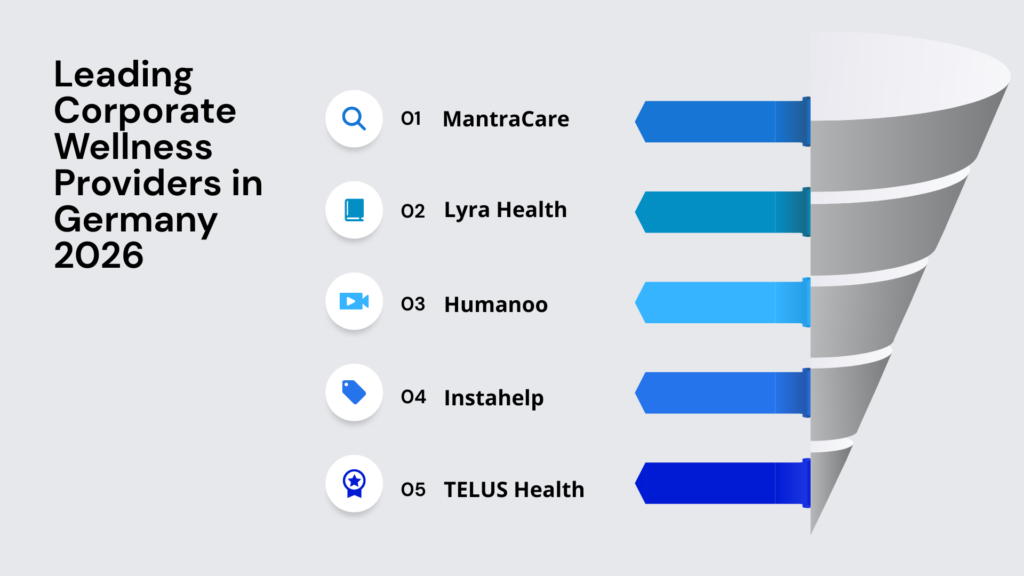
The comparison table below provides an at-a-glance summary. Detailed profiles follow.
| Corporate Wellness Provider | Best For | Unique Strength |
| MantraCare | Mid-Size to Large Enterprises | Holistic AI-Driven Platform Across Mental, Physical & Preventive Care |
| Lyra Health | Enterprises Prioritising Clinical Mental Health | Fast Therapist Access with Proven Workforce Mental Health Outcomes |
| Humanoo | German Mittelstand & SMEs | German-Built Gamified Wellness App with High Engagement Rates |
| Instahelp | Remote & Hybrid Workforces | Digital-First Psychological Counselling in the German Language |
| TELUS Health | Large & Multinational Enterprises | Integrated EAP and Mental Health Platform with Global Reach |
1. MantraCare
- Headquarters: Global, with European operations
- Core Focus: Holistic, AI-driven employee wellbeing
MantraCare is one of the world’s leading corporate wellness partners, offering comprehensive health programs to German companies in the three key areas: mental health, physical health, and preventive care. Organizations can access a range of structured wellness programs powered by AI, with the option to create personalised care journeys and track results from a central platform that provides visibility and engagement.
Key services: Employee Assistance Programs (EAP), 24/7 counselling support, fitness and wellness programs, chronic disease management, preventive health checkups, nutrition coaching, teleconsultations, analytics and reporting dashboards.
2. Lyra Health
- Headquarters: Global, with European operations
- Core Focus: Precision mental healthcare with fast, high-quality therapist access
Since joining the European market, Lyra Health has firmly positioned itself as one of the most clinically vetted mental health platforms for enterprise employers worldwide, and its growth in Europe has brought it an increasing relevance to the German market for organisations that are looking to focus on mental health outcomes as opposed to any expansive wellness component. The matching algorithm on the platform assigns an employee to a therapist who is most appropriate to them, and has an average time to first session much faster than the traditional EAP referral process.
Key services: Therapist matching, individual and couples therapy, mental health coaching, medication management, crisis support, manager training, and workforce mental health analytics.
3. Humanoo
- Headquarters: Berlin, Germany
- Core Focus: Gamified digital wellness platform built for the German market
Humanoo is one of the few corporate wellness platforms tailored to the German market and is therefore a special offering among the corporate wellness companies in Germany that domestic employers have to offer. Founded in Berlin, the platform is fully German-language native, DSGVO-compliant by design, and structured around the specific preventive health incentives available under German statutory health insurance – including the §20 SGB V framework, which allows statutory health insurers to co-fund certified workplace wellness measures.
Key services: Gamified wellness challenges, fitness and nutrition programs, mindfulness and sleep tools, §20 SGB V certified content, DSGVO-compliant data architecture, HR engagement analytics, German-language support.
4. Instahelp
- Headquarters: Graz, Austria – serving Germany and the DACH region
- Core Focus: Digital psychological counselling in the German language
Instahelp is a digital psychological counselling service that offers direct, confidential, completely in German communication with licensed psychologists for employees across the DACH region (Germany, Austria, Switzerland) by video, phone, or text. If you are a German employer looking for a mental health platform that doesn’t have the language barrier and cultural distance that many international platforms do, Instahelp is highly pertinent.
Key services: Video and text-based psychological counselling, licensed German-speaking psychologists, flexible scheduling, DSGVO-compliant data handling, employer utilization reporting, and crisis referral pathways.
5. TELUS Health
- Headquarters: Global, with German and European operations
- Core Focus: Integrated EAP and mental health platform for multinational employers
TELUS Health, previously known as LifeWorks, is one of the world’s most used EAP and employee wellbeing platforms, supporting more than 50 million lives in more than 160 countries. It provides a degree of geographic consistency and multilingual clinical infrastructure to attract fewer competitors for German-based multinationals and large enterprises with multi-country workforces across multiple European markets.
Key services: 24/7 EAP counselling, legal and financial advisory, digital mental health tools, physical wellbeing programs, manager support line, critical incident response, GDPR-compliant data architecture, multilingual support.
Extended List of Corporate Wellness Providers in Germany in 2026
| Corporate Wellness Provider | Headquartered | Core Focus | Best For |
| Wellhub (formerly Gympass) | Global, German operations | Fitness network access and wellness app aggregation | Employers Prioritising Physical Activity & Gym Access |
| OpenUp | Amsterdam, Netherlands – DACH operations | Digital mental health coaching in German | SMEs & Remote |
| Evermood | Berlin, Germany | Digital mental health and peer support platform | German Mittelstand & Tech Companies |
Assess how global companies across the USA, UK, Canada, and Singapore are reshaping wellness strategies in 2026.
How to Choose the Best Corporate Wellness Provider in Germany
Choosing the right corporate wellness provider in Germany starts with compliance, then capability.
Step 1 – Understand your statutory obligations first
The Arbeitsschutzgesetz and the Betriebsverfassungsgesetz contain a statutory minimum standard for the employer’s obligation to provide health protection. You should first identify the existing statutory obligations your organization has concerning wellbeing – e.g. an occupational health assessment, Gefährdungsbeurteilung psychischer Belastungen or rights of members of the works council. A credible provider will complement and not redefine this framework.
Step 2 – Verify DSGVO compliance and data architecture
In Germany, data privacy is not a procurement requirement, but a customary and legal requirement. Every company that processes employee health information must use the Datenschutz-Grundverordnung (DSGVO). Confirm data retention, processing, and any written data processing agreements. If providers cannot demonstrate unequivocal DSGVO compliance, they should not until further evaluation.
Step 3 – Assess German-language capability
Any international website using a language other than German or translated but not localized will always deliver lower performance to a German workforce. Focus on providers that have their content in German, German-speaking counsellors, and German-speaking customer service hours.
Step 4 – Evaluate §20 SGB V certification eligibility
For German employers, co-funding for certified measures to foster employee wellbeing in the workplace is possible under §20 SGB V, and Humanoo’s programs are certified. Seek certification status as part of the evaluation process.
Step 5 – Confirm mental health infrastructure depth
In 2026, the standard expectation is a stepped-care model: digital self-help resources, confidential counselling service phone (available 24/7), referral to licensed psychologists and clear pathways to crisis. In Germany, make sure that the psychologists are licensed and registered with the corresponding Landespsychotherapeutenkammer. Proponents with less clinical equipment are not fully functional for the German market.
Step 6 – Pilot before committing
Engage in a three-month pilot program before agreeing to a multi-year contract. Set up baseline values before the start: Krankheitsquote, current use of EAP, and employee wellbeing scores. A credible provider will embrace such a structure and set up the reporting on how to do it meaningfully.
Conclusion
Germany’s workplace wellbeing landscape is increasingly shaped by rising mental health-related absences, chronic disease prevalence, demographic ageing, and pressure on the statutory healthcare system.
The corporate wellness providers in Germany profiled in this handbook are legitimate, longstanding operations – each with its own distinct attractions for various group dimensions, sectors, and employee profiles. A 2,000-person American technology firm in Berlin is as different from a 5,000-person Mittelstand factory in Bavaria as the Oktoberfest is from Silicon Valley. The best option is the one that has the proper infrastructure in place to support clinical activities, a compliance position you can validate, and the employee experience you will have in the first month, and then every month going forward.
Understand how businesses in Ireland, Qatar and Hong Kong are improving employee wellbeing and workplace productivity.
Frequently Asked Questions
Depending on the depth and scale of services, the integrated program of EAP, telehealth, health risk assessments and management of chronic conditions can cost EUR 400-EUR 800 per employee per year.
Yes, to a certain extent. Employers are allowed to pay up to EUR 600 towards health promotion costs per employee per year, tax-free, if the support is defined as follows under German tax law, §3 Nr. 34 EStG. This includes certified fitness, nutrition, stress management and addiction prevention programs. Income over this amount is taxed as income and is liable to social insurance taxes.
Yes, in most cases. As per the Betriebsverfassungsgesetz, the workplace council possesses co-determination rights concerning actions relating to employee welfare and working conditions. The early involvement of the Betriebsrat in the evaluation process is legally strategically sound and relevant for program adoption.
Monitor 4 measurement indicators for a period of one year, including: Krankheitsquote, reduction in mental health-related long-term absences, program utilization-rate and employee wellbeing scores (pulse survey). Reliable providers offer employers dashboards “mirroring” such statistics without violating DSGVO data privacy.
MantraCare suits Mittelstand companies with international workforce components that require multilingual capability alongside German-language support. Humanoo is purpose-built for the German Mittelstand – DSGVO-compliant, §20 SGB V certified, and priced for organizations that cannot justify enterprise wellness contract values. Instahelp and OpenUp are strong options for mental health, specifically.