
Japan’s workplace culture is globally recognized for its discipline, efficiency, and commitment to excellence. However, behind this strong work ethic lies a growing and often understated concern – employee mental health. Employees are experiencing long-term stress due to increasing workloads, long working hours, and increased performance expectations, necessitating mental health support to become a strategic priority and not a secondary initiative.
In recent years, concerns such as burnout, stress-related absenteeism, and emotional fatigue have become more visible across industries. Although mental health awareness is slowly rising, just a few employees are ready to seek assistance because of cultural beliefs that discourage discussing individual issues. This gap between awareness and action makes structured workplace support systems more important than ever.
Employee Assistance Programs (EAPs) are emerging as a practical and effective solution to address this challenge. By offering confidential, accessible, and structured support, EAPs enable employees to manage stress, navigate personal issues, and maintain productivity—without compromising privacy or professional standing.
In order to comprehend the changing landscape of mental health support in the workplace around the world, it is a good idea to compare Japanese practice with some other countries, like South Africa, Singapore, and Australia.
We shall start with some basics and understand how EAP providers in Japan pave their way out with regard to employee mental health.
What is the Employee Assistance Program (EAP)?
An Employee Assistance Program (EAP) is a work-related support service that is professionally administered to assist workers in solving personal problems that can influence their mental state, emotional well-being, and work performance.
It acts as an interface between the workforce and qualified specialists, offering access to advice in a timely manner, counseling, and useful resources. The aim is not only to solve the immediate issues but to support the long-term health and strength.
EAP services usually comprise:
- Professional stress, anxiety, and emotional support
- Organized burnout and work-related stress management programs
- Financial and legal counseling to combat external pressures
- Emergency response or critical care emergency help
In Japan, EAPs have evolved significantly in recent years. Traditional face-to-face counseling is now complemented by digital platforms, mobile applications, virtual consultations, and self-guided resources. Most providers also undergo data-driven insights and preventive programs, whereby support will be proactive, ongoing, and consistent with recent workplace requirements.
The Importance of EAPs in Japan
Japan’s workforce operates within a high-performance environment that emphasizes consistency, responsibility, and long-term commitment. Although this leads to organizational success, it is also a scenario that creates circumstances that can adversely affect mental well-being unless handled effectively.
Several factors contribute to the growing need for EAPs:
- Long working hours and short rest intervals
- Performance-oriented organizational culture and high expectations
- Reluctance to openly discuss mental health concerns
- Growing dependence on online devices causes mental exhaustion
Despite having a well-developed healthcare system, Japan frequently fails to adequately address occupation-related mental health issues. Employees may also avoid seeking external help due to concerns about stigma or confidentiality. EAPs overcome these obstacles through employer-sponsored, structured solutions that are private and available.
For organizations, the benefits are equally significant. EAPs help:
- Reduce absenteeism and prevent burnout through early intervention
- Enhance employee concentration, performance, and engagement
- Strengthen workplace culture by promoting well-being and support
However, even more importantly, EAPs can help organizations shift their strategy toward a proactive process that pays greater attention to the long-term employee well-being instead of responding to issues.
Top EAP Providers in Japan (2026)
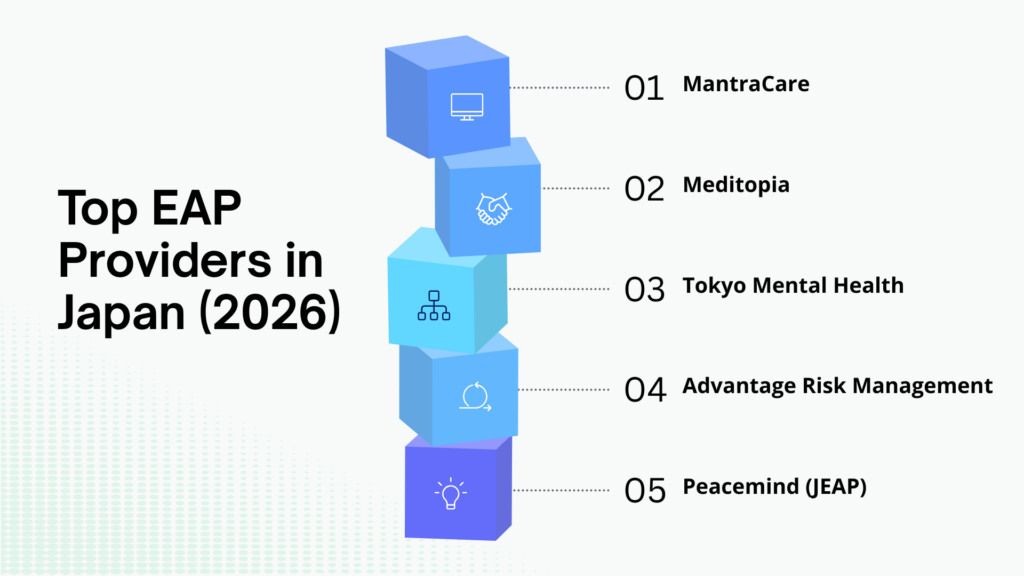
Japan’s EAP ecosystem reflects a combination of global expertise, local understanding, and technological innovation. Organizations can choose from providers offering scalable, flexible, and culturally relevant solutions tailored to modern workforce needs.
1. MantraCare – Integrated Employee Well-Being Platform
MantraCare offers a comprehensive and integrated approach to employee well-being, combining mental health support with coaching, lifestyle services, and financial wellness programs.
Its main strength is that it generates a proactive well-being ecosystem and not a reactive support system. Employees are encouraged to engage regularly with wellness programs, therapy sessions, and guided resources, leading to sustained improvements in mental health and productivity.
The digital-first architecture of the platform makes accessing it across devices seamless, and it is especially valuable in a hybrid and remote work setting.
| Focus | Best For | Key Strength |
| Holistic well-being | All company sizes | Preventive & high engagement |
Testimonial
“The platform’s ease of access and continuous engagement tools have significantly improved employee participation in well-being programs.”
2. Meditopia for Work – Engagement-Focused Digital Platform
Meditopia Work provides a progressive content-focused employee mental health solution. It combines guided meditation, self-help content, and professional counseling to create a holistic and engaging experience.
The platform aims to make mental health stigma less stigmatizing and more accessible and approachable by making the process of support more deeply embedded in everyday life. This fact is supported by its intense user-centered orientation, which promotes engagement instead of single-use.
| Focus | Best For | Key Strength |
| App-based + Digital EAP | Remote & global teams | Tech-driven personalization |
Testimonial
“The content-driven approach of Meditopia fits perfectly with our digital workforce, encouraging daily well-being habits.”
3. Tokyo Mental Health – Specialized Local Support
Tokyo Mental Health is a professional counseling center whose services are highly culturally sensitive and multilingual.
Its localized expertise allows it to address both Japanese workplace dynamics and the needs of international employees. This is especially useful in relation to multinational organizations whose operations are in Japan.
The provider provides both physical and online assistance, which is flexible and convenient to employees.
| Focus | Best For | Key Strength |
| Local EAP | Local teams in Japan | Multilingual Support |
Testimonial
“We trust Tokyo Mental Health for its professional approach and consistent quality of care.”
4. Advantage Risk Management – Corporate Mental Health Solutions
Advantage Risk Management specializes in enterprise-wide mental health solutions that are aligned with organizational objectives and HR systems.
Its systematic programs involve preventive assessment, early intervention plans, and reintegration. This comprehensive approach ensures measurable outcomes and long-term impact.
Organizations benefit from its ability to integrate mental health initiatives directly into broader business strategies.
| Focus | Best For | Key Strength |
| Proactive Risk Management EAP | Large organizations | Structure HR integration |
Testimonial
“We now have a clear and data-backed approach to employee mental health, thanks to their comprehensive solutions.”
5. Peacemind (JEAP) – Organizational Psychology-Based Support
Peacemind offers a scientific and research-driven approach to workplace well-being. Its services take their basis in the organizational psychology and behavioral science.
Besides counseling, it also offers stress testing, leadership training, and consultative services to enhance employee and organizational performance.
This dual focus makes it particularly effective for companies seeking long-term cultural and performance improvements.
| Focus | Best For | Key Strength |
| Clinical EAP | Enterprises | Evidence-based solutions |
Testimonial
“Peacemind has helped us align mental health support with long-term organizational development.”
Gain insights into structured well-being programs by exploring EAP adoption in the United States and Australia.
How to Choose the Right EAP Provider in Japan
Choosing the appropriate EAP provider in Japan involves a keen look at both organizational interests and cultural dynamics.
An effective provider should emphasize early intervention and continuous support. Preventive strategies are especially valuable in high-pressure work environments, as they help address issues before they escalate.
Another important consideration is accessibility. Employees should be able to access support easily through mobile apps, online platforms, and 24/7 helplines, ensuring assistance is always available.
Organizations also ought to evaluate the scope of services provided. An effective EAP also needs counseling, coaching, and practical assistance, such as financial and legal advice.
Employee engagement is also a key consideration. Programs should be intuitive, culturally sensitive, and designed to encourage regular use.
Finally, organizations should prioritize providers that offer clear reporting and measurable outcomes. This enables continuous improvement and ensures that the EAP delivers real value.
Conclusion
With the expectations in workplaces constantly changing, the mental health of employees becomes one of the indicators of organizational success in Japan.
EAPs provide both scaled and organized means of helping employees and promoting more productive work and a friendlier workplace. Their real worth is in making accessible, preventive, and culturally relevant help.
Companies that focus on employee well-being now will be in a better position to create resilient, engaged, and high-performing teams in the future.
To gain a broader perspective, it is helpful to compare Japan’s approach with Israel, Austria, and the Netherlands.
Frequently Asked Questions
Yes, adoption is steadily increasing as organizations recognize the direct impact of mental health on productivity, retention, and employee satisfaction.
EAPs provide confidential and discreet support, making it easier for employees to seek help without fear of stigma or judgment.
Yes, modern EAPs focus on early intervention, stress management, and preventive programs that reduce the risk of burnout.
Yes, most providers offer digital platforms, mobile apps, and virtual consultations, making support accessible from anywhere.
Organizations should prioritize accessibility, range of services, cultural alignment, engagement levels, and measurable outcomes when selecting a provider.