
New Zealand has a global reputation as one of the most liveable places in the world, yet significant mental health issues are increasingly calling for organizational attention within its workplaces. The same hallmarks of New Zealand’s workplaces that make them so vibrant and energizing – high goals, small teams, strong work ethic – are creating a considerable amount of pressure on the employees of those organizations.
According to the 2025 TELUS Health Barometer report, 63% of employees in New Zealand are experiencing some level of burnout, with 25% of those employees attributing excessive workload to the cause of their burnout. For HR leaders and business owners who have seen the trend elevate every year, the time for taking action is long overdue.
Employers in New Zealand are well aware that employee assistance programs are an effective, pragmatic, and cost-free solution for the issues that affect the employees. The following is a guide to the five leading EAP providers in New Zealand as of 2026, what makes each provider stand out from the rest, and everything you need to know to make an informed and confident decision on their suitability to your business.
A quick comparison with how organizations in Australia are implementing EAPs can provide additional regional context.
Understanding Employee Assistance Program(EAP)
An employee assistance program (EAP) is a workplace resource that helps the employee overcome issues that may affect their well-being and performance while at work.
In New Zealand, an EAP usually provides:
- Short-notice counselling (face-to-face, over the phone, or online)
- Mental health and well-being support
- Stress, burnout, and anxiety relief
- Assistance with family, relationship, and financial issues
- Recovery support after a critical incident (trauma experienced while at work)
The Importance of Employee Mental Health in New Zealand in 2026
In the year 2026, the mental health of the employee has emerged as a top priority among organizations in New Zealand due to the growing stress levels, burnout among the workforce and the changing demands of the workplace.
1. Increased Demand for Support for Mental Health – Workplace stress, burnout, and anxiety are more frequently being reported in all New Zealand industries. Since EAPs can provide support as soon as a problem arises, they can help prevent the escalation of a problem.
2. Strong Commitment to Well-Being Culture – New Zealand workplaces have placed a high priority on the well-being of their employees, as well as fostering psychological safety in the workplace. EAPs play a vital role in the overall HR strategy of these types of workplaces.
3. Confidential and Trusting Sources of Support – Employees are much more likely to seek help through an EAP if they are assured that the information provided to the EAP is confidential and is not revealed to the employer.
4. Meet Employers’ Health and Safety Obligations – Employers are required by law to manage both physical and psychological risks in the workplace under the Health and Safety at Work Act 2015, and EAPs are one way for employers to fulfil this legal requirement.
5. Increased Productivity and Employee Retention – Companies that use EAPs experience:
- A decrease in absenteeism
- An increase in employee engagement
- An elevation in employee retention
Top 5 EAP Providers in New Zealand
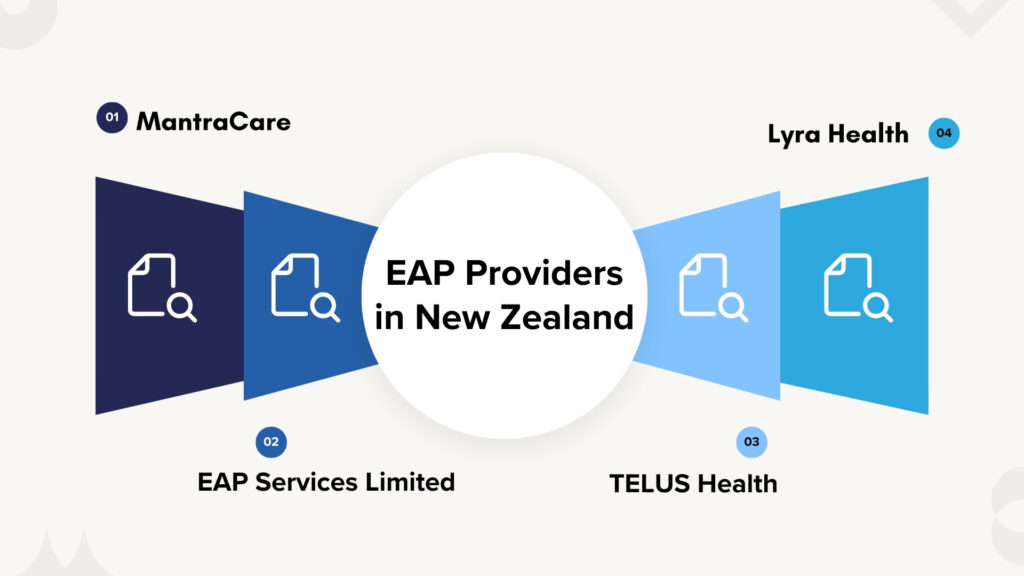
In the EAP landscape in New Zealand, you will find traditional local EAPs, as well as global EAPs that have the capabilities to support the complexity and diversity of the workplace. Below is a brief overview of the five EAPs providers in New Zealand in 2026, what they do, how they differ, and who they are best suited for.
1. MantraCare
MantraCare is a comprehensive, digital-first EAP that is built for the nature of today’s modern, distributed workplace. It offers therapy, coaching, and preventative well-being programs that are available 24/7. This is a great option for companies that want an affordable, scalable, and configurable EAP option with access to services in all locations.
| Offering | Access | Best For |
| Therapy, Coaching, Wellness | 24/7 App + Web | Start-ups to Enterprises |
2. EAP Services Limited
EAP Services Limited has been one of the longest-serving EAPs in New Zealand, with a focus on ensuring that their clients receive local expertise and a trusted network of counsellors. This EAP has a primary focus on ensuring that their clients receive culturally appropriate and confidential support through face-to-face and phone support; thus, making them suitable for organizations that prefer locally based expertise.
| Offering | Access | Best For |
| Counselling, crisis support, workplace wellbeing | Phone + in-person + limited digital | NZ-based organizations |
3. TELUS Health
TELUS Health provides a globally connected employee assistance program and digital healthcare system, which is an amazing solution for the complex, global workforce environment in which businesses operate. This EAP, further, has sophisticated technology and services located all over the world, enabling businesses to provide a holistic solution to the workforce no matter where they are in the world.
| Offering | Access | Best For |
| Integrated wellbeing, EAP, digital health tools | App + web + global support | Multinational companies |
4. Lyra Health
Lyra Health stands out for its high-quality, evidence-based mental health care and fast access to therapists. Its digital-first platform is designed for speed, convenience, and measurable outcomes, making it especially appealing to tech-driven and innovation-focused workplaces.
| Offering | Access | Best For |
| Therapy, coaching, evidence-based care | Digital-first platform | Tech-driven enterprises |
Reviewing EAP offerings in countries such as the United Kingdom and the United States can add useful perspective when narrowing down your options.
Key Characteristics to Look For in an EAP Provider
Choosing the right Employee Assistance Program (EAP) provider is critical to ensuring meaningful employee engagement and measurable outcomes. Here are the key characteristics to evaluate:
1. Confidentiality, Accessibility, Multi-Channel Support – An EAP should give an assurance of confidentiality, facilitate access to support services anytime (24/7) through a multitude of access points, e.g., phone, apps, videos, etc.
2. Qualified Professionals and Speedy Response – Employees should be able to access services from licensed, culturally diverse professionals, as well as access services quickly, within 24-72 hours.
3. Comprehensive and Customizable Services – A comprehensive, flexible EAP will provide mental health, financial, legal, and work-life resources, granting scalability & customization for any unique organizational needs.
4. Insight, Compliance, and Easy Setup – Choose an EAP that provides GDPR-compliant systems; actionable (anonymous) data analytics; and ease of onboarding with little administrative work required.
Conclusion
The key to choosing the most effective EAP provider in New Zealand lies in striking the perfect balance between accessibility, quality, and scalability. The most effective EAP provider will be one which has access to the most modern knowledge database, as well as an understanding of the local landscape, in order to cater to the modern workforce.
By focusing on the confidentiality of services available through their EAP provider, the range of services offered, and how easily employees can access such services; employers will increase the likelihood that employees will use their EAPs and that using the service will enhance employee long-term engagement and productivity while assisting in developing a healthier workplace culture.
To broaden your perspective, you might also review EAP solutions in markets such as Singapore, India, and Belgium.
Frequently Asked Questions
Most EAP providers offer support within 24–72 hours. Many also provide 24/7 helplines for immediate assistance.
Yes, most EAPs offer remote access through phone, video, and apps. In-person sessions are often available as an additional option.
EAP pricing varies based on provider and services offered. It is typically structured as a per-employee yearly cost or subscription plan.
Yes, EAPs help reduce stress and absenteeism, leading to better focus and performance. They also improve employee engagement and retention.
Look for confidentiality, accessibility, qualified professionals, and scalable services. A good provider should align with your organization’s size and needs.