
It started as an ordinary Monday in a busy XYZ fintech office. A high-performing team lead – someone her manager would have described as “unshakeable” – did not show up. No call, no message. By midday, HR learned she had been quietly falling apart for months. The company had health insurance. On paper, they were doing everything right.
They were not.
That story is playing out in offices across Nigeria right now – in the gleaming towers of Victoria Island, in the open-plan newsrooms of Yaba, in the government ministries of Abuja, and in the trading floors of Port Harcourt. And it is pushing a generation of Nigerian HR leaders to ask a harder question than “what benefits do we offer?” The question they are asking now is: do those benefits actually reach people when it matters?
A Market That Can No Longer Afford to Stand Still
Corporate health and wellness in Nigeria has moved well past the era of a quarterly medical check and a laminated gym membership flyer on the notice board. In 2026, it is a genuine workforce management strategy – one shaped by binding new legislation, measurable mental health costs, and a workforce that is increasingly willing to leave employers whose benefits don’t match their reality.
The numbers are hard to ignore. A study by TechCabal, WellaHealth, and WhirlSpot Media found that 93% of Nigerian employees value comprehensive health insurance, and roughly a third would consider leaving an employer if coverage is inadequate.
“With change propelled by AI and changing workforce expectations, HR teams need to strengthen employee skills and talent strategies to stay ahead of evolving business needs,” says Annie Rosencrans, Director of People and Culture at HR platform HiBob. “Advancing organizational sustainability through inclusion initiatives, employee wellbeing and the responsible use of technology will be critical.”
For employers, the urgency is compounded by legislation that has fundamentally changed the game. The NHIA Act 2022 marks a significant shift in Nigeria’s healthcare and employment framework, transitioning from a voluntary to a mandatory health insurance model. It mandates employers with five or more staff to enrol them in NHIA-approved health insurance plans, covering employees, one spouse, and up to four children under 18, with penalties for non-compliance.
This guide helps HR leaders, founders, and decision-makers evaluate corporate wellness providers in Nigeria by understanding what credible wellness programs actually deliver, what compliance and mental health standards matter in 2026, and how to choose solutions employees will genuinely use.
Want to compare employee mental health strategies in South Africa and Zimbabwe? Explore the top corporate wellness providers now.
What Is a Corporate Wellness Provider?
Think of a serious corporate wellness provider less like a gym membership and more like an infrastructure investment. The best ones build systems that operate across three distinct layers.
- Preventive Health covers periodic screenings, biometric health risk appraisals, ergonomic assessments, onsite wellness camps, and occupational health advisory services.
- Clinical and Curative Support encompasses HMO-linked medical coverage, specialist referrals, physiotherapy, and chronic disease management.
- Lifestyle and Mental Wellness includes EAPs, psychological counselling, financial wellbeing coaching, stress and burnout management, nutrition guidance, fitness initiatives, and manager training programs.
“The organizations that are ahead of the curve,” as one XYZ fintech-based HR director at a multinational bank put it, “are not the ones that added a meditation app. They are the ones who changed what a line manager does when someone comes to them distressed.”
Why Corporate Wellness Is Now a Strategic Priority in Nigeria
Before shortlisting any of the corporate wellness providers in Nigeria, it is worth understanding the three forces shaping demand in 2026.
1. Mental health is a proven business expense.
A Deloitte study found that 17% of finance and insurance employees experience burnout, leading to increased absenteeism and decreased productivity. In Nigeria’s banking and fintech sectors, HR leaders are beginning to put actual figures to what unaddressed mental health is costing them in sick days, performance losses, and expensive replacement hires.
2. Burnout data is unambiguous and worsening.
Ninety per cent of employees experienced burnout last year, and most now see wellbeing as interconnected. For Nigerian employers, this has become a workforce and business continuity challenge.
3. The Nigerian workforce is voting with its feet.
Employees now value wellbeing as much as salary and expect support across mental, physical, emotional, and financial health. In a competitive talent market, strong wellness programmes help employers attract and retain top talent.
4. The ROI case is no longer deniable.
Eighty-two per cent of CEOs report positive ROI from wellness programmes, while the WHO estimates a USD 4 return for every USD 1 invested in mental health support.
5. The regulatory climate is tightening.
Following the Presidential directive of September 2025, all entities participating in public procurement must present a valid NHIA-issued Health Insurance Certificate as a condition of eligibility. HR leaders who treat compliance as a ceiling are increasingly uncovered – legally, commercially, and in the labour market.
Top Corporate Wellness Providers in Nigeria in 2026
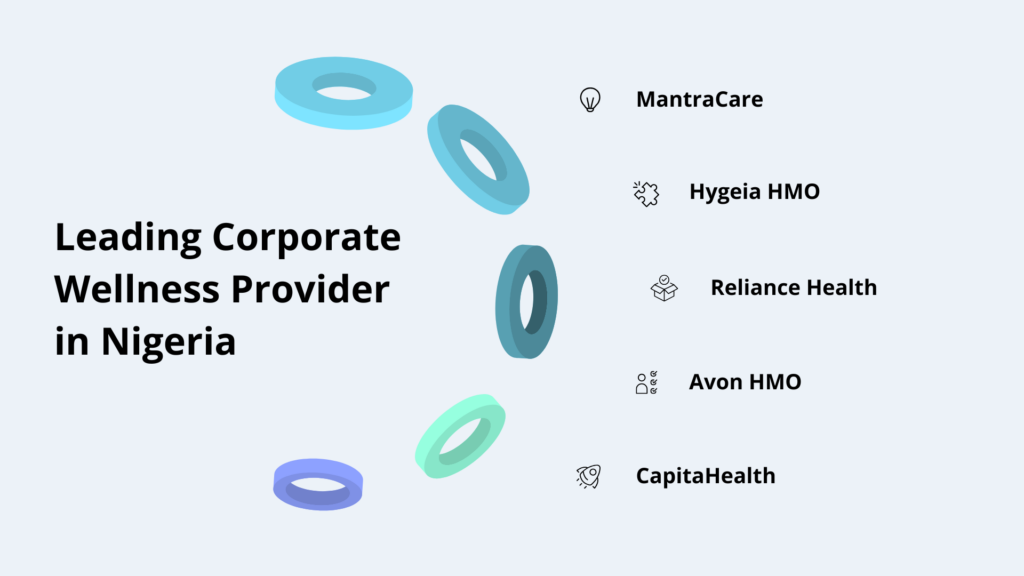
Nigeria’s corporate wellness market combines a statutory health insurance layer with an expanding ecosystem of digital platforms, EAP providers, and specialist wellness companies. The providers below represent the leading options serving Nigerian employers across this full spectrum.
| Corporate Wellness Provider | Best For | Unique Strength |
| MantraCare | Organizations seeking a global wellness platform with a strong mental health and chronic disease focus | AI-powered EAP and holistic wellness platform serving 500+ companies across 30+ countries with multilingual support |
| Hygeia HMO | Mid-to-large enterprises requiring comprehensive medical coverage with preventive wellness built in | Nigeria’s most extensive hospital network at 2,000+ facilities; 30+ years of managed healthcare experience |
| Reliance Health | Employers prioritising digital-first, tech-forward employee health management | Mobile-first platform with 3,800+ partner hospitals, telemedicine, wellness programs, and transparent pricing |
| Avon HMO | Employers want medical coverage with integrated wellness and health education | Comprehensive plans combining fitness initiatives, chronic disease management, and preventive health screenings |
| CapitaHealth | Purpose-driven organizations wanting performance-based, evidence-backed wellness solutions | Nigerian-native platform combining clinical expertise with health intelligence technology, tailored for local workforce needs |
1. Mantra Care
- Headquarters: New Delhi, India (operating globally, including Nigeria)
- Core Focus: AI-powered employee mental health, EAP, and holistic wellness platform
Picture an HR manager at a Nigerian multinational trying to support a team scattered across Lagos, Abuja, Kano, and three other countries. She needs a mental health platform that works across languages, understands burnout as a daily professional experience, and can handle a therapy request at 10 PM when a team member in a different time zone finally has a quiet moment. That is the gap Mantra Care is built to fill.
A global employee wellness platform operating across 30+ countries and serving over 500 companies, Mantra Care, one of the leading corporate wellness providers in Nigeria, brings AI-powered EAP support, individual therapy, stress management, chronic disease programs, and financial and legal coaching under one roof. For Nigerian employers managing distributed, internationally facing, or multilingual workforces, the delivery model is built for the scale and complexity the market increasingly demands.
Key services: EAP, individual therapy and psychological counselling, stress and burnout management, chronic disease management (diabetes, hypertension), yoga and fitness coaching, financial and legal wellbeing support, manager effectiveness training, and organizational wellness assessments.
2. Hygeia HMO
- Headquarters: Lagos, Nigeria (nationwide)
- Core Focus: Comprehensive managed healthcare and preventive health for individuals, families, and corporate groups
A head of HR at a Nigerian manufacturing company once described her previous HMO this way: “The network looked impressive on paper. But when my employee needed a specialist in Ibadan, no one on the list was actually available.” Hygeia HMO has spent over 30 years building a network that holds up under real-world pressure.
With over 30 years of experience, Hygeia offers one of Nigeria’s widest hospital networks, with strong coverage for maternity, chronic conditions, and specialist care – backed by long-standing partnerships with top hospitals and clinics nationwide. For large and mid-sized Nigerian employers who need health coverage that can be trusted from Lagos to Kano, Hygeia remains the gold standard for clinical reliability.
Key services: Group health insurance plans, outpatient and inpatient medical care, specialist consultations, maternity and neonatal coverage, chronic disease management, dental and optical care, preventive health screenings, virtual consultations, and telemedicine.
3. Reliance Health
- Headquarters: Lagos, Nigeria (operating across Nigeria and Africa)
- Core Focus: Technology-driven corporate health insurance and employee wellness platform
“Our employees are 28 on average,” an HR lead at a Lagos fintech told a panel at a recent industry conference. “They manage their entire lives through their phones. If your health insurance doesn’t work the same way, they don’t trust it.” Reliance Health has disrupted the Nigerian HMO market with its technology-driven approach and user-friendly mobile app, combining traditional HMO services with telemedicine and modern healthcare delivery.
Reliance’s hospital network spans over 3,800 partner facilities nationwide, giving employees access to quality healthcare wherever they are, with plans including inpatient and outpatient care, specialist consultations, preventive services, wellness programs, and 24/7 telemedicine. For employers in fintech, tech, media, and professional services – the sectors defining Nigeria’s fastest-growing talent pools – Reliance’s model is the most natural fit.
Key services: Corporate health insurance, outpatient and inpatient care, specialist consultations, preventive services, mental health support, wellness programs, 24/7 telemedicine, pharmacy services, and transparent custom pricing for SMEs and enterprises.
4. Avon HMO
- Headquarters: Lagos, Nigeria (nationwide, registered as a national HMO since 2012)
- Core Focus: Comprehensive health plans with integrated wellness programs and health education
Another of the best corporate wellness providers in Nigeria is Avon HMO. Most HMOs in Nigeria are built to respond to illness. Avon HMO is built to reduce it. What sets Avon apart is the wellness component: health screenings, fitness programs, and chronic disease management built into coverage. For corporate clients, this wellness focus can help with employee productivity and preventive care, potentially reducing long-term healthcare costs.
With a network of over 2,000 hospitals and particularly strong urban coverage, Avon works well for employers in sectors with significant physical and occupational health risks – manufacturing, logistics, FMCG, and construction – where reactive healthcare is never quite enough.
Key services: Corporate group health insurance, outpatient and inpatient care, maternity and neonatal coverage, health screenings, fitness and wellness programs, chronic disease management, health education initiatives, and personalised employee benefits coordination.
5. CapitaHealth
- Headquarters: Nigeria (nationwide)
- Core Focus: Performance-based, evidence-driven employee wellness programs for Nigerian organizations
There is a version of corporate wellness designed for London or New York and adapted, awkwardly, for Lagos. And then there is CapitaHealth. A Nigerian provider of employee wellness programs specially designed to optimise health and peak performance, CapitaHealth believes that when wellness is connected with purpose, it provides a platform for peak performance – an essential ingredient for high productivity.
The company works with clients to generate detailed health profiles from employee risk appraisals, then designs programs customisable to the specific needs of different teams and organizations. In a country as geographically, culturally, and economically diverse as Nigeria, that local rigour is the difference between a wellness program employees trust and one they quietly ignore.
Key services: Health risk appraisals, wellness program design, lifestyle coaching across stress, nutrition, sleep and movement, preventive health assessments, workforce health intelligence, and customised corporate wellness consultancy.
Extended Provider List Worth Evaluating
| Corporate Wellness Provider | Headquartered | Core Focus | Best For |
| AXA Mansard HMO | Lagos | International-standard group health insurance with tiered plans | Multinationals, large corporates, and employees requiring international medical evacuation cover |
| Bastion Health | Lagos | Digital-first HMO with strong SME and fertility benefit options | SMEs wanting affordable, tech-enabled health plans with maternity and wellness built in |
| Premium Well Pro | Nigeria | EAP-focused mental health and lifestyle coaching | Organizations wanting confidential counselling and psychological skills training as a standalone offering |
| OneWellness (OneHealthNG) | Nigeria | Preventive wellness platform with personalised health records and digital challenges | Employers building health culture through engagement-driven, gamified wellness programs |
Looking at global employee wellbeing trends? Compare the top corporate wellness providers across the United Kingdom and the United States.
How to Choose the Right Corporate Wellness Provider in Nigeria
Selecting the right one amongst the corporate wellness providers in Nigeria is one of the most consequential decisions an HR leader will make in 2026. Here is a structured approach.
Step 1 – Understand your statutory obligations before adding anything discretionary.
The NHIA ensures financial access to healthcare for all Nigerians. Employers pay 10%, and employees pay 5% of salary as contributions, with coverage extending to the employee, their spouse, and up to four biological children. Wellness programs beyond this baseline are discretionary – but NHIA compliance itself is legally mandated and actively enforced.
Step 2 – Map your workforce before briefing any provider.
A fintech startup in Lagos Island and an agribusiness operation in Kano have fundamentally different health risk profiles, access needs, and cultural relationships with mental health support. Map your workforce by sector, age distribution, location, work model, and languages spoken before approaching any vendor. Nigeria’s geographic and demographic diversity is a real implementation variable – the best providers account for it, the weakest ignore it.
Step 3 – Evaluate the mental health infrastructure specifically.
Mental health is the primary driver of wellness spend and the primary source of absenteeism cost in the Nigerian corporate market in 2026. Ask every provider directly: what happens when an employee is in acute distress? Is access confidential? What is the pathway from a self-guided digital tool to a one-to-one session with a counsellor to a clinical referral? The answer reveals whether the platform is a genuine clinical model or a well-designed information leaflet.
Step 4 – Verify geographic reach, not just network size.
A 3,000-hospital network means nothing if none of those hospitals is near where your employees actually live and work. Confirm that any provider’s facilities and digital tools function reliably in the cities and states where your workforce is concentrated. Telemedicine is not a luxury in Nigeria’s context – it is often the only realistic path to consistent care outside major urban centres.
Step 5 – Demand evidence of engagement, not just coverage.
Well-being leader organizations are nearly twice as likely to measure employee engagement when assessing wellbeing – they rely on hard data to inform strategy rather than assumptions. Ask every provider for real utilization rates, not sales projections. A benefit nobody uses is not an asset – it is a cost.
Conclusion
“The most forward-thinking organizations understand this – “A healthy workforce isn’t a cost centre. It’s the most valuable asset a company has.”
That is the shift happening in Nigeria’s best-run organizations right now. Not “how little can we spend on benefits?” but “what does our workforce actually need, and which providers can genuinely deliver it?”
Mantra Care brings a globally proven, AI-powered wellness platform to Nigerian employers seeking comprehensive mental health, physical wellbeing, and chronic disease support under one roof. Hygeia HMO brings the deepest clinical infrastructure in the Nigerian market, with a hospital network and service range that is unmatched for employers seeking comprehensive, reliable coverage at scale.
Reliance Health represents the most credible digital-first wellness provider option for Nigerian employers – tech-forward, accessible, transparent, and trusted by growing companies. Avon HMO is the right choice for organizations that want preventive wellness genuinely integrated into their health coverage. And CapitaHealth offers the most locally grounded and performance-oriented wellness approach available.
The Monday morning that changed everything for that XYZ fintech team lead should be the last time it catches an employer by surprise. The corporate wellness providers in Nigeria, the platforms, and the legislation are all in place. What remains is the decision to take it seriously.
Searching for workplace mental health solutions across Asia? See how employers in Malaysia, New Zealand, and Australia approach workforce wellbeing.
Frequently Asked Questions
Yes. Under the NHIA Act 2022, Nigerian employers with five or more employees must provide NHIA-approved health insurance through a licensed HMO. NHIA compliance is also now required for government procurement eligibility.
No. An EAP mainly provides psychological, financial, and personal counselling, while a full wellness program also includes medical coverage, preventive care, fitness, chronic disease management, and mental health support.
The WHO estimates a USD 4 return for every USD 1 invested in mental health support. In Nigeria, proactive wellness programs can reduce absenteeism, turnover, and rising talent replacement costs.
Bastion Health, Reliance Health, and Mantra Care all offer flexible, affordable models accessible to smaller organizations. For NHIA compliance, any accredited HMO fulfils the statutory requirement – the differentiator for SMEs is choosing one whose digital tools and pricing structure remain practical at smaller team sizes.
Employers that fail to enrol employees under the NHIA Act 2022 face legal penalties. NHIA compliance is also now required for government procurement eligibility, creating direct commercial risks for non-compliant businesses.