
Employee health benefits in Norway have evolved significantly over the past few years. In 2026, corporate wellness is no longer viewed as an optional HR initiative – it has become a strategic investment directly linked to employee retention, productivity, workforce resilience, and employer branding.
Norwegian employers are increasingly recognising that strong employee wellbeing programs reduce absenteeism, improve engagement, and support long-term organizational performance. While Norway already operates one of the world’s strongest public healthcare systems, employees now expect employers to provide additional support around mental wellbeing, preventive healthcare, ergonomic safety, fitness, and work-life balance.
According to OECD and European workplace health reports, mental health-related absences and stress-related productivity losses continue to rise across Nordic countries, including Norway. Hybrid work environments, digital fatigue, and growing workforce expectations have accelerated the demand for structured employee wellbeing programs.
This guide is designed for HR leaders, founders, and business decision-makers evaluating the best corporate wellness providers in Norway for employee health benefits in 2026.
Explore the top corporate wellness providers in Sweden and Denmark for employee wellbeing and preventive healthcare.
What is a Corporate Wellness Provider?
A corporate wellness provider is a company that helps employers design, implement, and manage employee health and wellbeing programs. These providers support organizations in improving workforce health, reducing absenteeism, increasing productivity, and strengthening employee retention through structured wellness initiatives.
In practice, most providers in Norway operate across three major categories:
- Preventive Health – Health screenings, occupational health services, annual health checks, vaccination programs, and health risk assessments.
- Mental Health & Emotional Wellbeing – Employee Assistance programs (EAPs), therapy access, stress management, burnout prevention, counselling support, and mindfulness programs.
- Lifestyle & Physical Wellness – Fitness memberships, ergonomic assessments, physiotherapy, nutrition coaching, wellness challenges, sleep support, and chronic condition management.
Modern corporate wellness providers increasingly combine digital health platforms, telemedicine, wearable integrations, AI-powered analytics, and preventive care into one connected wellbeing ecosystem. Rather than offering isolated benefits, employers now seek integrated wellness strategies that deliver measurable improvements in employee engagement, health outcomes, and organizational performance.
Why Corporate Wellness Providers Matter in Norway in 2026
“The future of workforce health in Norway is increasingly preventive, digital, and employee-centric. Organizations investing early in wellbeing infrastructure are building healthier and more resilient teams.”
Mental health challenges are becoming one of the leading causes of long-term employee absence in Norway. Stress, anxiety, depression, and burnout continue to affect employees across industries – particularly within technology, healthcare, logistics, and professional services sectors.
Norwegian employers are now prioritizing early intervention programs, counselling access, stress management, and preventive mental wellbeing initiatives to reduce absenteeism and improve workforce resilience.
Wellness providers offering fast therapy access, EAP support, and digital mental health tools are becoming essential partners for employers.
2. Musculoskeletal disorders remain a major workforce issue.
Musculoskeletal disorders (MSK) continue to contribute heavily to sick leave and productivity loss in Norway. Remote work ergonomics, repetitive strain injuries, and physically demanding industries all contribute to increasing MSK-related health concerns.
Employers are investing more heavily in providers offering ergonomic assessments, physiotherapy support, digital MSK programs, workplace movement initiatives, and injury prevention strategies.
This is particularly important across logistics, manufacturing, construction, energy, and healthcare sectors.
3. Employee expectations around wellbeing have changed.
Norwegian employees increasingly expect employers to support wellbeing beyond traditional salary and insurance benefits.
Wellbeing programs now influence recruitment outcomes, employee retention, employer branding, productivity levels, employee satisfaction, and workplace engagement.
Companies with stronger wellness programs are increasingly viewed as more attractive employers in competitive labour markets.
4. Hybrid work has reshaped workforce wellbeing.
Hybrid and remote work models have created new workforce health risks across Norway.
Common concerns now include loneliness and social isolation, burnout and digital fatigue, sedentary behaviour, poor work-life boundaries, sleep disruption, and reduced physical activity.
Corporate wellness providers now help organizations support distributed teams through virtual wellness programs, digital fitness support, teletherapy, and mobile-first engagement platforms.
Top Corporate Wellness Providers in Norway in 2026
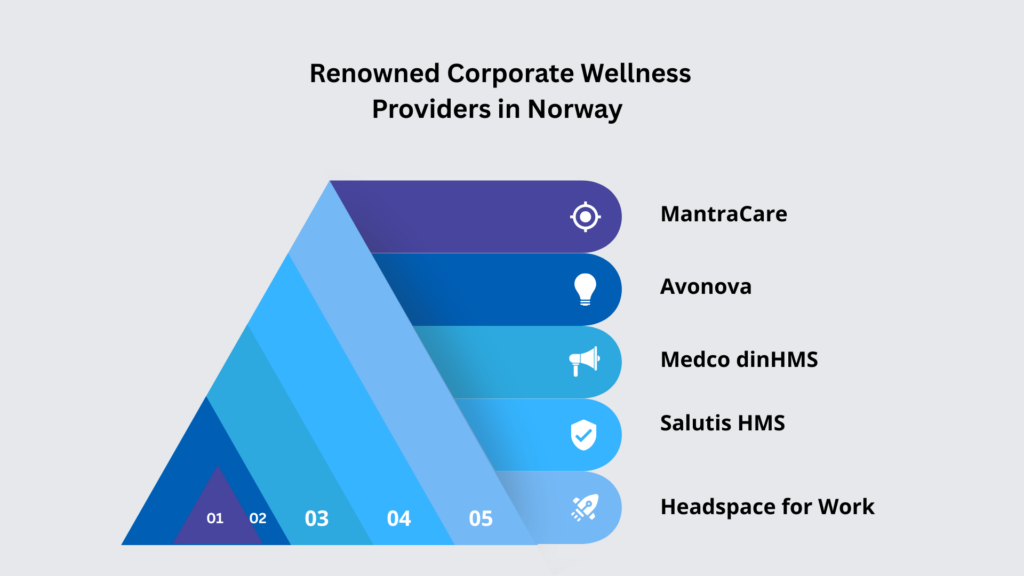
The comparison table below provides a quick overview of the leading corporate wellness providers operating in Norway.
| Corporate Wellness Provider | Best For | Unique Strength |
| MantraCare | Mid-Size to Large Enterprises | Holistic AI-Driven Employee Wellbeing Platform |
| Avonova | Occupational Health & Workplace Safety | Strong Clinical and Compliance Infrastructure |
| Medco dinHMS | Offshore & Industrial Employers | Norway’s largest independently owned OHS with 25+ years of specialist experience |
| Salutis HMS | SMEs & Regional Employers | Approved BHT with clinical health services and one of Norway’s largest training portfolios |
| Headspace for Work | Remote & Hybrid Workforces | Clinically Validated Mental Wellness Support |
1. MantraCare
- Headquarters: Global Operations
- Core Focus: Holistic employee wellbeing and preventive healthcare
MantraCare has become one of the leading global corporate wellness providers supporting employers across Europe, including Norway. The platform combines mental health support, preventive healthcare, fitness programmes, chronic disease management, and digital wellbeing tools into a unified employee wellness ecosystem – consolidating what most organisations manage through separate vendors into a single, AI-driven platform that connects employees to the right care at the right time.
What makes MantraCare particularly relevant in the Norwegian market is its ability to serve workforces that do not sit neatly in one place. A hybrid team split between an Oslo headquarters and regional operations in Stavanger or Bergen, a multinational with Norwegian employees spread across time zones, or a growing tech company scaling headcount faster than its HR infrastructure can keep pace – MantraCare is built for exactly these environments. Its 20-plus language support, GDPR-compliant data infrastructure, and mobile-first delivery ensure that wellness access does not depend on where an employee works or what device they use.
Key services: MantraCare provides Employee Assistance programs (EAPs), 24/7 counselling support, preventive health checkups, telemedicine and therapy sessions, fitness and wellness programs, chronic condition management, nutrition coaching, wellness analytics dashboards, and HR reporting and engagement tools.
2. Avonova
- Headquarters: Norway
- Core Focus: Occupational health and workplace wellbeing
Avonova is one of Norway’s most established occupational health and corporate wellbeing providers, supporting employers with workplace safety, preventive healthcare, rehabilitation, ergonomics, and compliance-focused health services across a wide range of industries. The company plays a particularly important role for Norwegian organisations operating in physically demanding and highly regulated sectors where workforce health directly impacts productivity, safety, and operational continuity.
Avonova has extensive experience working with industrial, manufacturing, healthcare, logistics, construction, offshore, and energy companies throughout Norway. Its strength lies in combining clinical occupational health expertise with practical workplace risk management and long-term employee wellbeing support.
Key services: Avonova offers occupational health services, workplace ergonomic assessments, health screenings, organizational psychology support, sick leave prevention initiatives, vaccination programs, rehabilitation support, and physiotherapy and workplace health consulting.
3. Medco dinHMS
- Headquarters: Stavanger, Norway (offices in Oslo, Bergen, Trondheim, Kristiansand, Hammerfest, and 22 locations nationwide)
- Core Focus: Occupational health services and workplace safety for Norwegian employers
Medco dinHMS BHT AS is one of the leading privately held occupational health providers in Norway, having serviced some of the largest companies on the west coast of Norway for more than 25 years – with services ranging from risk-assessed health screenings for risk-exposed groups to health certificates for offshore workers, seamen, airline personnel, divers, and drivers, alongside drug and alcohol screening, audiometry, spirometry, and laboratory testing.
Norway’s third-largest occupational health service, Medco dinHMS, is the largest OHS that is both led and owned from Norway, with 160 employees delivering services to tens of thousands of customers throughout the country, and recognised as offering the best HSE training in Norway, now also available virtually.
Key services: Risk-assessed health screenings, health certificates (offshore, maritime, aviation, diving), drug and alcohol screening, audiometry and spirometry, laboratory services, HSE advisory and risk assessment, workplace safety inspections, AKAN alcohol program, annual HSE reporting, and nationwide delivery across 22 locations.
4. Salutis HMS
- Headquarters: Innlandet, Norway (also operating in Vestland and Oslo/Viken regions)
- Core Focus: Approved occupational health service with one of Norway’s largest corporate training portfolios
Salutis HMS is an approved occupational health service (BHT) and major training provider, consisting of nearly 30 employees located in Innlandet, Viken, and Vestland, delivering services across the entire country to over 1,500 organizations – with most staff holding healthcare qualifications, including doctors, nurses, physiotherapists, and ergotherapists, alongside specialists in leadership, organizational development, and psychosocial work environments.
The primary goal is to help organizations create healthy and safe working conditions – delivering approximately 400 courses per year of high quality, offering both open and company-internal formats, alongside bespoke course programs – to increase employee competence, knowledge, and insight within health, environment, and safety, reducing sick leave, dissatisfaction, and health problems across client organizations.
Key services: Approved occupational health service (BHT), health risk assessments, occupational medicine and health monitoring, physiotherapy and ergotherapy, psychosocial work environment surveys, workplace safety consultancy, leadership and organizational development training, open and company-internal health and safety courses, and nationwide delivery.
5. Headspace for Work
- Headquarters: Los Angeles, USA
- Core Focus: Mental wellbeing and mindfulness
Headspace for Work remains one of the world’s most recognised digital mental wellness platforms, widely adopted by employers seeking scalable support for stress management, mindfulness, sleep improvement, focus, and employee resilience. As hybrid and remote work continue to reshape workplace wellbeing expectations in Norway, employers increasingly use the platform to provide accessible and preventive mental health support across distributed teams.
The platform is particularly effective for organisations looking to normalise mental wellbeing support through easy-to-use, mobile-first experiences that employees can access independently and confidentially. Its structured content library helps employees manage everyday stress, improve sleep quality, strengthen focus, and build healthier mental wellbeing habits over time.
Key services: Headspace for Work provides guided meditation programs, sleep improvement content, burnout prevention support, stress management tools, mindfulness exercises, employee resilience programs, HR wellbeing dashboards, and multilingual digital content.
Extended List of Corporate Wellness Providers in Norway in 2026
| Corporate Wellness Provider | Headquartered | Core Focus | Best For |
| Momentor | Norway | Digital leadership coaching and employee development platform | Norwegian employers investing in manager capability as a burnout prevention strategy |
| YouWell | Norway | Digital employee wellness and preventive health platform | SMEs and hybrid workforces seeking a Norwegian-native digital health and wellbeing solution |
| Falck Healthcare Norway | Copenhagen / Oslo | Nationwide occupational healthcare, prevention, and rehabilitation | Large employers across oil and gas, healthcare, logistics, and the public sector need Scandinavian-scale coverage |
Global organizations are increasingly investing in employee wellbeing, preventive healthcare, and workplace mental health. Explore how employers across Germany, Finland, and the Netherlands are approaching corporate wellness in 2026.
How to Choose the Best Corporate Wellness Provider
Choosing the right corporate wellness provider in Norway requires more than comparing feature lists. The best provider is the one that aligns with your workforce demographics, organizational goals, industry risks, and long-term wellbeing priorities.
Step 1 – Assess your workforce health profile.
Before evaluating providers, identify the key health challenges affecting your workforce. These may include stress and burnout, mental health concerns, musculoskeletal disorders, sedentary lifestyles, poor engagement, rising absenteeism, sleep issues, chronic disease risk, or workplace injuries.
A remote-first technology company in Oslo will have very different wellbeing needs from a manufacturing, logistics, construction, or energy employer operating across multiple Norwegian regions. Understanding the actual workforce problem is the foundation of effective provider selection.
Step 2 – Define your primary objective.
Different wellness providers specialise in different outcomes. Some organizations focus on reducing absenteeism and healthcare costs, while others prioritize improving employee engagement, retention, mental wellbeing, productivity, or workforce resilience. Clearly defining your primary business objective helps narrow the provider landscape and prevents organizations from investing in broad programs that fail to solve their most pressing workforce challenges.
Step 3 – Prioritize digital accessibility and inclusion.
Employees increasingly expect wellness programs to be flexible, digital, and easy to access. Assess whether the provider offers mobile-first platforms, multilingual support, remote workforce access, wearable integrations, HRMS compatibility, telehealth capabilities, and GDPR-compliant data protection. Participation rates improve significantly when employees can access services seamlessly across devices, locations, and working arrangements.
Step 4 – Evaluate mental health infrastructure carefully.
Mental health support should extend beyond simple wellness content or meditation apps. Strong providers now offer structured Employee Assistance programs (EAPs), licensed therapists, crisis escalation pathways, preventive mental wellbeing programs, manager training, burnout prevention support, and confidential counselling services. Fast and stigma-free access to professional care is becoming one of the most important differentiators in corporate wellness.
Step 5 – Verify clinical and local support networks.
For preventive healthcare and occupational health services, provider reach matters. Ensure the provider can support employees across Norway, not only in Oslo and larger cities. This becomes especially important for employers managing field workers, industrial teams, frontline staff, or geographically distributed operations. Local clinical partnerships, occupational health coverage, and reliable referral pathways are critical for long-term program effectiveness.
Step 6 – Run a pilot before full implementation.
Many organizations now begin with a structured pilot program before committing to a full rollout. Track measurable indicators such as participation rates, employee engagement, utilization levels, absenteeism trends, satisfaction scores, and wellbeing outcomes during the pilot phase. Strong providers are usually comfortable demonstrating measurable value before entering long-term enterprise agreements.
Conclusion
The corporate wellness landscape in Norway in 2026 is being shaped by rising mental health concerns, hybrid work transformation, growing employee expectations, and increasing employer focus on preventive healthcare.
Employers are increasingly viewing wellbeing as a long-term strategic investment rather than a short-term employee perk. The providers in this guide each bring distinct and complementary strengths. MantraCare offers holistic AI-driven wellbeing support with the highest EAP engagement rates in the Norwegian market. Avonova leads in occupational health compliance and clinical infrastructure across all major Norwegian sectors. Headspace for Work delivers clinically validated mindfulness and mental resilience tools for distributed and hybrid workforces. Medco dinHMS brings 25 years of specialist occupational health expertise for Norway’s most physically demanding industries — offshore, maritime, logistics, and construction. Salutis HMS combines approved BHT service delivery with one of Norway’s largest corporate health training portfolios, addressing the upstream causes of sick leave rather than only managing its consequences. The right provider depends on your workforce profile, industry risk, and long-term wellbeing priorities.
Companies that invest early in preventive employee wellbeing infrastructure are building healthier, more productive, and more resilient organizations – and in Norway’s competitive talent market, that investment is increasingly what distinguishes employers employees choose to stay with.
See how organisations in Spain, Mexico, and the UAE are investing in mental health and preventive employee wellness.
Frequently Asked Questions
Pricing varies by provider, workforce size, and scope of services. Approved occupational health services are typically priced on a per-employee retainer basis, while digital platforms like MantraCare and Headspace for Work offer per-user monthly pricing. Most providers offer customised enterprise quotes based on headcount and required service depth.
Yes, and adoption is accelerating. Corporate wellness programs are increasingly standard across technology, finance, oil and gas, logistics, healthcare, and multinational organizations operating in Norway. Mental health support and preventive wellbeing initiatives are now considered essential employee benefits rather than optional extras in most competitive sectors.
Yes. Norwegian law requires employers in certain industries and risk categories to engage an approved occupational health service (bedriftshelsetjeneste). Providers like Medco, DinHMS, and Salutis HMS hold this approval — meaning they satisfy the statutory requirement while also delivering broader wellness and training support that goes beyond minimum compliance.
An EAP focuses on counselling support. A full wellness program goes further — covering preventive care, fitness, nutrition, chronic disease management, and mental wellbeing in one integrated model. Most modern providers include EAPs as one component within a broader wellbeing ecosystem.
Technology, oil and gas, healthcare, logistics, manufacturing, professional services, and financial services lead investment in employee wellbeing. These sectors face the highest competition for talent and the greatest exposure to burnout, musculoskeletal disorders, and stress-related absenteeism – making structured wellness investment a direct operational and commercial priority.