
“To keep the body in good health is a duty… otherwise we shall not be able to keep the mind strong and clear.” – Buddha
Italy is not a nation short on passion for work. But passion, left without support structures, has a cost. According to the OECD Better Life Index, approximately 58% of Italians between the ages of 15 and 64 are employed – below the OECD average of 66% – yet those who are working are navigating rising pressures in a labour market that has been reshaping itself through structural reform and economic recovery. Meanwhile, significant amendments to Italy’s Consolidated Act on Health and Safety in the Workplace were approved by the Italian Parliament in December 2024, signalling a clear regulatory shift toward greater employer accountability for psychosocial risk. This is not a workforce that is being left alone to manage its challenges. It is increasingly requiring employers to step up with structured, measurable, and meaningful wellbeing investment.
The Italian corporate wellness market is projected to grow at a compound annual growth rate (CAGR) of 6% from 2024 to 2029, driven by a growing emphasis on employee wellbeing and the adoption of comprehensive wellness programs. For business owners, HR leaders, and decision-makers navigating Italy’s competitive talent market, the strategic case for workforce wellbeing has never been clearer – or the consequences of inaction more quantifiable.
This guide is built for those evaluating their options in 2026: who the credible providers are, what they actually deliver, and how to identify the right partner for a workforce navigating the real pressures of modern Italian working life.
Curious about corporate wellness in Southern Europe? Explore providers in Spain, Greece, and Norway.
What Is a Corporate Wellness Provider?
A corporate wellness provider partners with an employer to design and deliver a structured health and wellbeing program for their workforce. In practice, this goes far beyond a company-sponsored away day or a discounted gym membership – it means building a sustained, measurable system that addresses the full spectrum of employee health across multiple interconnected dimensions.
Effective employee wellness in Italy in 2026 takes a genuinely holistic approach, addressing mental health, physical health, financial wellbeing, and social health in tandem – because these dimensions do not exist in isolation. An employee managing chronic stress, economic anxiety, and poor sleep simultaneously is not experiencing a single, addressable problem. They are experiencing interconnected pressures that require integrated support.
Most providers operate across three service levels.
- Preventive health includes health risk assessments, biometric screenings, occupational physician engagement, ergonomic evaluations, and workplace health audits. This is the diagnostic foundation – identifying what a workforce is genuinely dealing with before problems manifest as absenteeism, presenteeism, or sustained underperformance.
- Clinical and curative support includes telemedicine, GP access, specialist referrals, physiotherapy, chronic condition management, and rehabilitation. This tier keeps employees with existing health conditions functional and supported within the workplace, reducing prolonged absence cycles.
- Lifestyle and mental wellness include Employee Assistance Programs (EAPs), psychological counselling, fitness and nutrition programs, stress management workshops, smoking cessation support, and financial coaching. This is the layer employees encounter in their daily working lives – and the one that most directly shapes engagement, retention, and organizational culture.
In Italy, employer health and safety is governed by Legislative Decree No. 81/2008 (TUSL), requiring all companies to maintain a Risk Assessment Document, including work-related stress evaluation. Recent December 2024 amendments emphasize psychological health, making structured workplace wellbeing an urgent compliance priority.
Why Corporate Wellness Has Become Urgent in Italy
Italy’s workforce is navigating a convergence of rising workplace stress, post-pandemic mental health pressures, and escalating employee expectations – making structured wellbeing investment a growing strategic priority in 2026.
EU-OSHA data shows that 29% of European workers experience work-related stress, depression, or anxiety, with time pressure and poor communication at work remaining major risk factors. Italy is not exempt from this reality – and the country’s national preventive health plan has progressively acknowledged the inseparable link between mental health and broader physical wellbeing.
Article 28 of Legislative Decree 81/2008 mandates that all Italian employers include work-related stress in their risk assessment frameworks. The 2024 amendments have added renewed urgency to this, with increased scrutiny on psychological health protections.
3. The cost of inaction is well-documented.
Depression and anxiety collectively account for an estimated 12 billion lost working days globally each year, at a cost of roughly US$1 trillion in lost productivity. Stress-related absences also tend to last significantly longer than injury-related ones – making psychosocial risk the most expensive risk category for employers who fail to address it proactively.
4. The ROI of wellness investment is compelling.
Research consistently shows that for every €1 spent on employee mental wellbeing, companies see a return of €4 to €5. Reduced absenteeism, stronger retention, and measurable improvements in engagement compound those financial returns at scale.
Top Corporate Wellness Providers in Italy in 2026
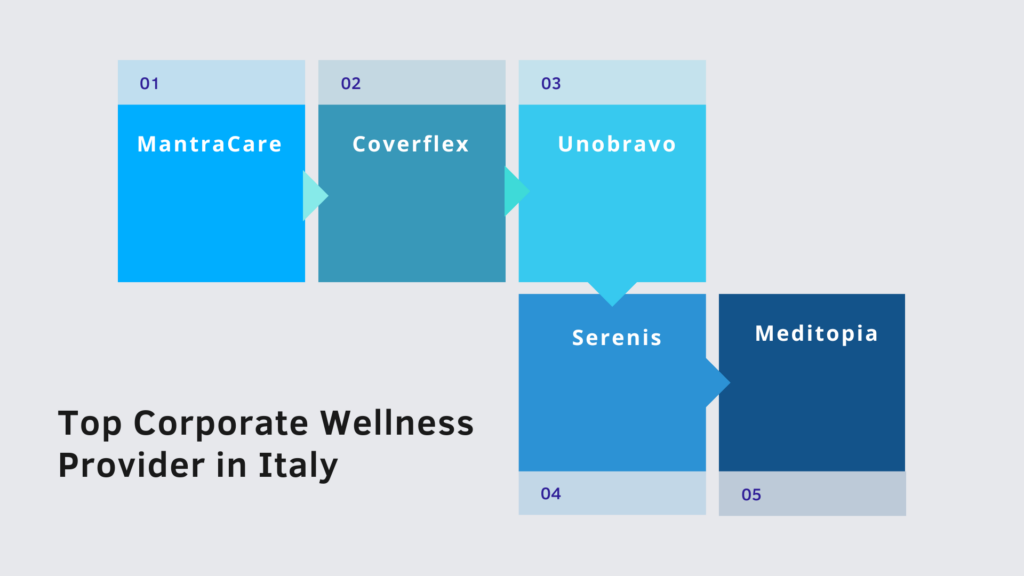
Italy’s corporate wellness market has matured significantly as organizations – from multinationals headquartered in Milan to mid-sized domestic employers across Turin, Rome, and Bologna – increasingly prioritize employee mental health, preventive care, and productivity. The providers below represent the leading corporate wellness companies in Italy, offering services spanning EAPs, digital mental health platforms, flexible benefits management, clinical psychology access, and holistic wellbeing.
| Corporate Wellness Provider | Best For | Unique Strength |
| MantraCare | All Business Sizes | AI-powered multilingual digital wellness platform with broad EAP and holistic health coverage |
| Coverflex | SMEs to Large Enterprises | All-in-one digital benefits platform covering meal vouchers, health insurance, and tax-efficient perks |
| Unobravo | Mental Health-First Employers | Italy’s leading online psychology platform with 9,500+ certified therapists |
| Serenis | Multidisciplinary Health | Italy-born digital health centre integrating psychotherapy, psychiatry, nutrition, and coaching |
| Meditopia | Mindfulness & Preventive Wellness | Globally recognised mental wellness platform with deep Italian localisation and 40M+ users |
1. MantraCare Italy
- Headquarters: Global (with Italian operations and GDPR-compliant data infrastructure)
- Core Focus: AI-powered holistic digital wellness platform
MantraCare Italy offers a comprehensive digital workplace wellness platform. It covers mental health (EAP), telehealth, musculoskeletal care, chronic condition management, women’s health, fitness, and nutrition. All services are accessible through a single, AI-guided interface that connects employees to the right care at the right time. MantraCare has operated in Italy for more than 10 years, with presence in major cities including Milan, Rome, Turin, Naples, Bologna, and Florence. It serves companies ranging from SMEs with 50 employees to large enterprises with over 10,000 staff.
MantraCare is highly effective for Italy’s diverse workforce because it delivers content in 100+ languages, culturally adapted rather than just translated. Italian-speaking licensed psychologists, psychiatrists, and counsellors are available, ensuring care reflects the local context. For multinational employers across Italy and beyond, MantraCare provides locally relevant support within a globally scalable platform, reducing the complexity of managing multiple vendors.
Key services: EAP, psychological counselling, chronic condition reversal (diabetes and hypertension), corporate yoga and fitness, nutrition coaching, physiotherapy, women’s health programs, health risk assessments, telemedicine, multilingual delivery, and real-time HR analytics dashboards.
2. Coverflex
- Headquarters: Lisbon, Portugal (with Italian operations via EatsReady acquisition)
- Core Focus: Digital-first employee benefits and compensation management platform
Coverflex entered the Italian market by acquiring EatsReady, a leading digital-only meal voucher platform. It became one of just ten companies authorised to operate in Italy’s buoni pasto market. Italy was identified as a high-priority expansion target. The market is profitable for Edenred but suffers from limited flexibility and digitalisation in benefits management.
Coverflex’s Compensation OS platform lets any company design and personalize compensation offers. It aggregates health insurance, meal allowances, fringe benefits, and discounts into a single digital experience. Coverflex operates in a global employee benefits market estimated at €200 billion, with Europe making up over 40%. Historically, employee engagement with benefits packages has been below 20%. Coverflex is designed to improve this. It reduces HR administrative burden and provides employees a personalized, tax-efficient experience through a dedicated Visa card.
Key services: Digital meal vouchers (buoni pasto), health insurance, fringe benefits management, flexible compensation design, employee discounts platform, Compensation OS technology, and tax-efficient benefits structuring.
3. Unobravo
- Headquarters: Naples, Italy
- Core Focus: Online psychological support and therapy access at scale
Founded in 2019 by clinical psychologist Danila De Stefano, Unobravo is one of Italy’s most widely used digital mental health platforms. De Stefano continues to lead the organization. It is the only European company invited to participate in an American Psychiatric Association documentary on innovative psychological support. The platform has over 9,500 certified psychologists and psychotherapists. More than 260,000 people have been supported to date. Unobravo has scaled access to psychological care in Italy, where cost and geography have historically been barriers. 51% of Italians cite affordability as an obstacle to mental health support.
In corporate settings, Unobravo functions as a clinically rigorous therapy access benefit. The organization directs every resource and decision toward achieving high-quality mental health outcomes. The platform has an internal team of over 100 professionals. They focus exclusively on therapist selection, continuous training, and clinical supervision. This model is validated by the Università Cattolica. Their research found that 81% of clinical professionals on the platform say Unobravo expanded their ability to reach patients they could not otherwise access. Sessions are available via video call, with in-person therapy available in Milan.
Key services: Online psychotherapy, psychological counselling, corporate mental health benefits, therapist matching, clinical supervision, and in-person therapy (Milan).
4. Serenis
- Headquarters: Milan, Italy
- Core Focus: Multidisciplinary digital health centre integrating mental and physical wellbeing
Serenis was founded in 2021 by Silvia Wang and Daniele Francescon. It has quickly become one of Italy’s most ambitious digital health companies. In 2024, it reported €25 million in revenue and aims for €40–50 million in 2025. Unlike single-discipline mental health platforms, Serenis functions as a digital medical centre. It integrates online psychotherapy, psychiatric evaluation, nutritional guidance, coaching, and clinical medicine under one roof. This multidisciplinary model allows patients to address mental and physical health in a single care environment. It offers a structural advantage for employees managing interconnected health challenges.
Serenis includes corporate wellbeing programs as part of its offering. The platform provides tools to measure the impact of services across the workforce. Sessions are accessible via video from any location. In-person options are available in Milan, Rome, Turin, and other major Italian cities. An integrated online journal supports continuity of care between sessions. The platform has recently expanded into general medicine. This expansion signals a more comprehensive approach to employee health. Employers can now build tangible benefits programs around it.
Key services: Online psychotherapy, psychiatric evaluation, couples therapy, nutritional counselling, coaching, personal medicine, corporate wellbeing programs, and in-person therapy (multiple Italian cities).
5. Meditopia
- Headquarters: Global (with strong Italian market presence)
- Core Focus: Science-based digital mindfulness, mental wellness, and EAP platform
Meditopia has over 40 million users worldwide. The platform is recognised for its localised, culturally adapted content. It holds a strong position in Italy’s corporate wellness market. Meditopia offers a mobile-first mental wellness platform. It supports preventive self-guided tools and structured 1-to-1 expert care. Content is available in 13 languages, including Italian. The platform integrates guided meditations, sleep tools, and psychoeducational programs. It also provides 1-to-1 therapy sessions, coaching, manager wellbeing training, and corporate challenges. All features are available in a single accessible experience.
HR teams can use a scalable digital solution with Meditopia. Employees access it day-to-day, not only in crises. The platform combines on-demand content with live expert support. It tackles low EAP utilization caused by stigma and friction. Meditopia reduces stress and boosts positive emotional outcomes within eight weeks. Employee engagement reaches 42%. It is one of the most effective wellness deployments for Italian employers of any size.
Key services: Guided meditation and mindfulness, 1-to-1 therapy and coaching, sleep and stress programs, manager wellbeing training, corporate wellness challenges, EAP, multilingual content library, and gym and fitness access through WellnessPass.
Extended Provider List Worth Evaluating in Italy
| Corporate Wellness Provider | Headquartered | Core Focus | Best For |
| Mindwork | Milan, Italy | Workplace psychological wellbeing and coaching | Companies seeking Italian-native psychosocial support with multilingual capacity |
| LifeGate Way | Milan, Italy | Sustainability-aligned corporate wellness and community | Employers building ESG-integrated wellbeing strategies |
| One on One | Italy / International | Wellness space design and corporate program management | Companies building or managing physical wellness facilities and structured corporate programs |
Interested in international wellness models? See insights from the USA, UK, New Zealand, and Canada.
How to Choose the Right Corporate Wellness Provider in Italy
Choosing the right wellness partner in Italy requires balancing legal obligations, workforce characteristics, budget realities, and measurable outcomes.
Step 1 – Assess your workforce risks.
Identify the most significant challenges your workforce is navigating – across roles, locations, work patterns, and employee demographics – before selecting any provider. Stress and psychosocial risk assessment data, absenteeism records, and engagement survey results are the right starting points.
Step 2 – Verify legal compliance.
Ensure the provider supports Italy’s Legislative Decree 81/2008 requirements, including the mandatory assessment of work-related stress and the broader risk evaluation framework. Providers who embed compliance within their service model – rather than treating it as a separate concern – offer the strongest foundation.
Step 3 – Evaluate mental health depth.
Choose providers offering structured mental health pathways that range from self-guided tools and preventive content through to licensed clinical counselling and psychiatric support. Mental health access – not just mental health content – is what drives meaningful outcomes.
Step 4 – Review physical and holistic wellbeing services.
Assess whether the provider covers physiotherapy, nutrition, chronic condition management, and ergonomic health. Programs that address both physical and mental health deliver stronger results because the organization actively integrates these dimensions rather than treating them separately.
Step 5 – Demand measurable outcomes.
Request verifiable data on EAP utilization, employee satisfaction, absenteeism reduction, and engagement improvement. Providers who cannot demonstrate outcomes with real numbers are not partners worth considering for serious workforce investment.
Step 6 – Run a structured pilot.
Begin with a three- to six-month pilot before committing to a long-term contract. Track employee engagement, utilization rates, and qualitative feedback to evaluate whether the program is genuinely reaching the people it is designed to support.
Conclusion
Italy’s corporate wellness market is growing with purpose as employers respond to rising workplace stress, tightening regulatory obligations around psychosocial risk, and employees who are increasingly clear about what meaningful support looks like.
MantraCare Italy provides an AI-powered multilingual platform combining EAP, telehealth, chronic care, and HR analytics in a single scalable architecture. Coverflex brings a fully digital benefits management model that modernises how Italian companies handle meal vouchers, health insurance, and tax-efficient perks. Unobravo offers the deepest specialist access to clinical psychology in the Italian market, built around quality outcomes rather than volume. Serenis functions as a multidisciplinary digital health centre, integrating mental health, psychiatry, nutrition, and coaching for employees who need more than a single-domain solution. And Meditopia delivers science-backed mindfulness and mental wellness with genuine daily engagement, at a scale that works across teams of any size.
The right provider is not the one that looks most impressive on paper. It is the one that employees will actually turn to – with genuinely accessible support, transparent outcomes, and solutions designed around the realities of Italian working life in 2026.
Want a broader perspective? Check corporate wellness in the Netherlands, South Africa, Switzerland, and the UAE.
Frequently Asked Questions
Costs vary by provider, scope, and company size. Digital platforms can start at a few euros per employee per month, while comprehensive programs are typically priced by headcount and service tier. Most employers report strong long-term ROI through reduced absenteeism and improved retention.
No. An EAP provides confidential counselling and referral support. A full corporate wellness program goes further – covering preventive health, physiotherapy, fitness, nutrition, and chronic condition management for a genuinely holistic approach.
Research shows a return of €4 to €5 for every €1 invested in employee mental wellbeing, with further gains from reduced absenteeism, lower healthcare costs, and stronger engagement over time.
Partially. Legislative Decree 81/2008 requires all Italian employers to assess work-related stress as part of their risk evaluation framework. Broader programs remain voluntary – though the December 2024 parliamentary amendments signal a clear regulatory push toward greater employer accountability for psychological health.
MantraCare and Meditopia offer scalable digital solutions with flexible pricing suited to smaller teams. Coverflex serves SMEs seeking to consolidate benefits management digitally. Unobravo and Serenis provide session-based corporate packages that fit smaller budgets.