
“Take care of your body. It’s the only place you have to live.” – Jim Rohn
Brazil works hard. But it’s paying a steep price. Nearly 500,000 Brazilian employees took mental health-related sick leave in 2024 – the highest number in at least a decade. That figure jumped 68% from 2023 alone. Anxiety disorders accounted for nearly 141,500 of those cases. And burnout? Brazil is the second country in the world with the most cases, with 30% of workers showing signs of the condition according to the International Stress Management Association in Brazil (ISMA-BR).
This isn’t a future risk. It’s a present-day crisis. And it’s reshaping how Brazilian employers think about health benefits.
The Brazilian corporate wellness market reached USD 1.53 billion in 2024 and is projected to reach USD 2.58 billion by 2033, growing at a CAGR of 6.00%. Employers are no longer treating wellness programs as a nice-to-have perk. They’re treating them as a business-critical investment.
For HR leaders, executives, and decision-makers evaluating their options in 2026, this guide identifies the most credible corporate wellness providers in Brazil, explains what they actually deliver, and helps you choose the right partner for a workforce under real pressure.
Learn how employers in Norway, Sweden, and Finland approach employee wellness and mental health programs.
What Is a Corporate Wellness Provider?
A corporate wellness provider partners with an employer to design and deliver a structured health and wellbeing program for their workforce. It goes far beyond an annual health check or a subsidized gym membership. Done right, it creates a sustained, measurable system that addresses the full spectrum of employee health.
Most providers operate across three service levels.
- Preventive health includes health risk assessments, biometric screenings, ergonomic evaluations, and workplace health audits. This is the diagnostic foundation. It surfaces what a workforce is dealing with before those challenges escalate into absenteeism, presenteeism, or high turnover.
- Clinical and curative support covers telemedicine, GP access, specialist referrals, physiotherapy, chronic disease management, and rehabilitation. This tier keeps employees with existing conditions supported and functional – rather than cycling through extended leave.
- Lifestyle and mental wellness include Employee Assistance Programs (EAPs), psychological counseling, stress management workshops, fitness and nutrition programs, smoking cessation, and financial coaching. This is the layer employees interact with daily. It shapes engagement, loyalty, and culture more than any other.
In Brazil, employer wellness obligations are governed by the CLT and Regulatory Standard NR‑1. In August 2024, Ordinance No. 1,419/2024 amended NR‑1 to include psychosocial risks in all Occupational Risk Management Programs (PGR), enforced from May 26, 2026.
Employers must now identify, assess, and prevent stress, burnout, harassment, excessive workloads, and dysfunctional organizational culture. Law 14,831/2024 introduced certification for companies promoting workplace mental health. Leading wellness providers in Brazil either ensure full PGR compliance or integrate psychosocial risk management into their core offerings.
The Significance of Corporate Wellness in Brazil
Brazil’s workforce is facing a mental and physical health crisis. The data is alarming. And the legal environment is tightening fast.
1. Mental health sick leave hit a decade-long high in 2024.
Nearly 500,000 Brazilian employees took mental health-related leave in 2024 – a 68% jump from the previous year. Anxiety disorders, depression, and burnout are the driving forces.
2. Brazil ranks second globally for burnout.
According to ISMA-BR, 30% of Brazilian workers suffer from burnout, placing Brazil second only to Japan in worldwide burnout rates. The financial and operational costs for employers are enormous.
3. NR-1 enforcement begins May 2026.
Brazil’s updated NR-1 now requires all employers to formally include psychosocial risk management in their Occupational Risk Management Program. Non-compliant companies face labor inspections and direct legal liability. The deadline is now in force.
4. The ROI of wellness investment is well established.
Companies with structured wellness programs consistently report lower absenteeism, reduced healthcare costs, and higher employee retention. Wellhub data shows companies using structured wellness platforms reduce annual employee healthcare costs by up to 35% and see a 40% improvement in employee retention.
Top Corporate Wellness Providers in Brazil in 2026
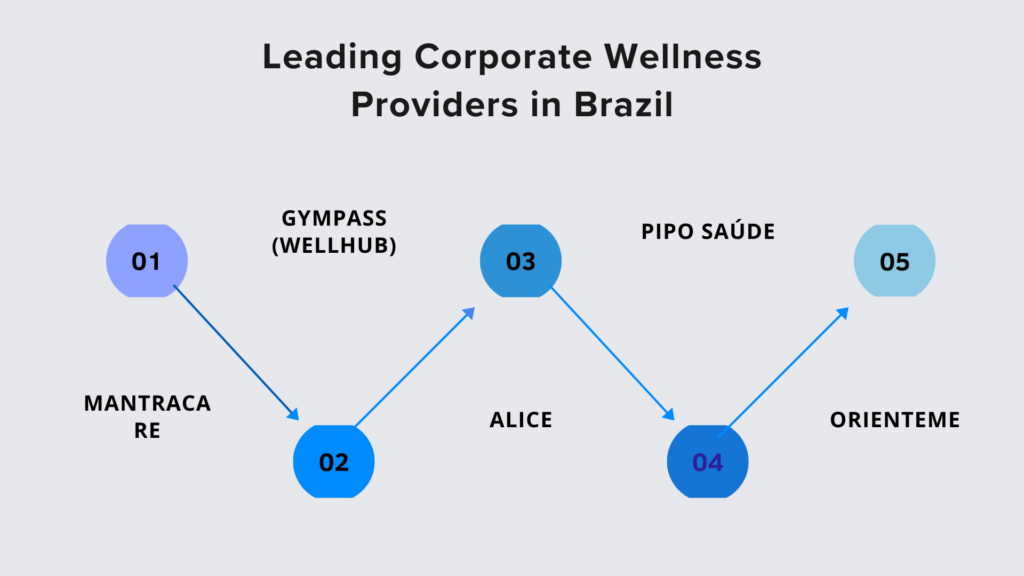
Brazil’s corporate wellness market has evolved rapidly. From Brazilian-born global platforms to specialized digital health insurers, occupational health specialists, and holistic EAP providers, employers now have genuine options. The providers below represent the leading corporate wellness companies in Brazil – covering EAPs, health insurance, digital benefits, physical fitness, and mental health.
| Corporate Wellness Provider | Best For | Unique Strength |
| MantraCare | All Business Sizes | AI-powered multilingual wellness platform with the highest EAP engagement rates in Brazil |
| Gympass (Wellhub) | All Sizes – Physical & Holistic Wellness | Brazilian-born global leader in corporate wellness, connecting employees to gyms, apps, therapy, and nutrition |
| Alice | Tech-Forward & Growing Brazilian Businesses | Brazil’s first primary care-driven health insurer, named the second most innovative company in Latin America (Fast Company, 2024) |
| Pipo Saúde | HR Teams Managing Health Benefits | Digital broker that centralizes and simplifies all corporate health benefits in one data-driven platform |
| OrienteMe | Corporate Mental, Nutritional & Physical Health | Integrated corporate health platform covering occupational psychology, nutrition, and physical wellness |
1. MantraCare Brazil
- Headquarters: Global (with Brazilian operations in Portuguese, fully LGPD-compliant)
- Core Focus: AI-powered holistic digital wellness platform
MantraCare Brazil, one of the renowned corporate wellness providers in Brazil, delivers a comprehensive workplace wellness platform covering mental health (EAP), telehealth, musculoskeletal care, chronic condition management, diabetes, obesity, and fitness – all in one place. AI-driven guidance connects employees to the right care at the right time. MantraCare has served Brazil for 10-plus years, with a presence across major cities including São Paulo, Rio de Janeiro, Belo Horizonte, Brasília, Curitiba, and Manaus. It is trusted by over 500 companies across Brazil and delivers 5 to 7 times higher sign-up rates compared to other EAPs, driven by additional offerings including meditation, yoga, and physiotherapy.
Key services: EAP, psychological counseling, chronic condition management (diabetes and hypertension), corporate yoga and fitness, nutrition coaching, physiotherapy, women’s health programs, health risk assessments, telemedicine, financial and legal counseling, Brazilian Portuguese delivery, and HR analytics dashboards.
2. Gympass (Wellhub)
- Headquarters: New York, USA (founded in Brazil in 2012; operating in 14 countries)
- Core Focus: Corporate wellness platform – fitness, mindfulness, therapy, nutrition, and sleep
Wellhub – formerly Gympass – was born in Brazil and went global. Founded in 2012 by Cesar Carvalho in São Paulo, the company created an entirely new business model by being the first to introduce corporations as payers for employees’ wellness benefits. It quickly scaled a three-sided marketplace of gyms, corporations, and employees in Brazil’s highly fragmented market of more than 35,000 gyms. Since then, Wellhub has exported its model to 14 countries and grown into the world’s leading corporate wellness platform.
Key services: Gym and fitness studio network access, personal training, mindfulness and meditation apps, online therapy access, nutrition coaching, sleep programs, wellness seminars and webinars, employer analytics dashboard, and flexible subscription plans.
3. Alice
- Headquarters: São Paulo, Brazil
- Core Focus: Primary care-driven digital health insurance for companies
Alice is not just another health insurer. It’s a fundamental rethinking of what corporate healthcare can look like. Alice is Brazil’s first primary care-driven health insurance plan. Founded in 2019, the company built an end-to-end healthcare system from the ground up – combining technology and data, proprietary primary care, and value-based agreements with health providers. The result is personalized, data-driven longitudinal care that improves clinical outcomes at lower cost. In 2024, Fast Company named Alice the second most innovative company in Latin America – a recognition of how meaningfully different its model is from traditional plano de saúde options.
Key services: Primary care-driven health insurance plan, 24/7 health team access via app, integrated care coordination, hospital and specialist network access, preventive care programs, telemedicine, electronic health records (EHR), real-time health data tracking, and company HR analytics.
4. Pipo Saúde
- Headquarters: São Paulo, Brazil
- Core Focus: Digital health benefits broker and management platform
For many Brazilian companies, health benefits are the second-largest corporate expense – exceeded only by payroll. But most are still buying those benefits through traditional brokers who don’t add strategic value. Pipo Saúde, another one among the leading corporate wellness providers in Brazil, was built to change that. Founded in 2019 by Manoela Ribas Mitchell, Vinicius Correa, and Thiago Torres, Pipo is a digital broker that sells and manages healthcare benefits for companies – from health insurance and dental plans to mental health and fitness, all centralized in one platform. Pipo has raised $31 million in total funding from Thrive Capital, Kaszek, and Monashees, and now covers over 100,000 lives across more than 130 companies.
Key services: Health plan and dental plan brokerage, mental health and wellness benefits management, automated employee enrollment and offboarding, 24/7 health team support, real-time claims and utilization analytics, benefit benchmarking, health risk assessments, teleconsultation, and HR advisory services.
5. OrienteMe
- Headquarters: São Paulo, Brazil
- Core Focus: Integrated corporate health platform – occupational psychology, nutrition, and physical wellness
OrienteMe is a corporate health platform that maps the mental, nutritional, and physical health of each employee – and connects them with the right professional based on their specific profile. Founded in 2017, OrienteMe was built specifically for the corporate sector. Its goal is to reduce turnover, improve psychological safety, manage occupational diseases, and support team development through an integrated suite of digital wellness services. The platform offers online consultations with psychologists, nutritionists, and physical exercise specialists – tracking progress in real time through a corporate dashboard that HR teams can monitor and act on.
Key services: Online occupational psychology consultations, nutritional guidance, physical exercise orientation, corporate health mapping, real-time progress tracking dashboard, psychosocial risk assessment, turnover reduction programs, psychological safety support, and occupational disease management.
Extended Provider List Worth Evaluating
| Corporate Wellness Provider | Headquartered | Core Focus | Best For |
| TelavitaSão | São Paulo, Brazil | Integrated mental health care – online therapy, psychiatry, and emotional health programs | Companies seeking psychiatrist access alongside psychologist support for higher-acuity cases |
| BenCorp | Brazil | Corporate health management, preventive care, and occupational health consulting | Employers focused on data-driven health risk management and long-term population health programs |
| Zenklub (now Conexa) | São Paulo, Brazil | Online therapy, coaching, and development programs for employees | HR teams seeking a scalable digital mental health and coaching platform with a strong Brazilian heritage |
See how multinational employers manage employee wellbeing in the USA, UK, and Canada.
How to Choose the Right Corporate Wellness Provider in Brazil
Choosing the right wellness partner in Brazil requires balancing NR-1 compliance, workforce characteristics, budget reality, and measurable outcomes. Here is a practical six-step framework.
Step 1 – Assess your workforce risks.
Start with data. Identify the most pressing challenges across your workforce – sectors, locations, work patterns, and demographics – before approaching any provider. What is actually driving absenteeism and turnover in your organization?
Step 2 – Verify legal compliance.
Ensure the provider supports your obligations under NR-1, including psychosocial risk identification, documentation in the PGR, and preventive action planning. Enforcement begins May 26, 2026. Companies that haven’t prepared face labor inspections and direct legal liability.
Step 3 – Evaluate mental health support depth.
Look for structured mental health pathways. Digital self-guided tools matter. But so does access to licensed psychologists, psychiatrists where needed, crisis support, and clinical referral. Brazil’s public health system (SUS) has wait times for psychologists that often exceed three to six months – your employees can’t wait.
Step 4 – Review physical wellbeing services.
Check whether the provider covers ergonomic assessment, physiotherapy, rehabilitation, physical activity access, and nutritional support. These dimensions drive long-term physical capacity and reduce occupational injury costs.
Step 5 – Ask for measurable outcomes.
Request verified data. Absenteeism reduction, EAP utilization rates, employee satisfaction scores, and ROI metrics from comparable client organizations in Brazil. Engagement numbers matter as much as the service catalog.
Step 6 – Run a pilot program.
Start with a three- to six-month pilot before committing to a full rollout. Evaluate actual employee uptake, utilization, and whether the provider’s model is genuinely accessible to your workforce – across regions, languages, and income levels.
Conclusion
Brazil’s corporate wellness market is expanding with urgency. Employers are responding to a mounting mental health crisis, new and enforceable legal obligations, and a workforce that increasingly expects meaningful wellbeing support as part of the employment relationship.
MantraCare Brazil delivers an AI-powered, Portuguese-language wellness platform combining EAP, telehealth, and chronic care with strong engagement rates and real-time HR analytics. Wellhub – born in Brazil and now global – connects employees to the widest fitness and wellness network in the country, with proven results in retention and healthcare cost reduction. Alice is reinventing corporate health insurance through a primary care-driven model that prioritizes prevention, data, and daily engagement. Pipo Saúde gives HR teams the tools to manage all health benefits in one place – with the data and expert advisory support to make smarter decisions. And OrienteMe brings an occupationally-oriented approach to corporate health – mapping mental, nutritional, and physical wellbeing across the workforce and surfacing actionable insights in real time.
The right provider isn’t the one that looks best on paper. It’s the one your employees will actually use – with accessible, Portuguese-language support, measurable outcomes, and solutions built for the realities of Brazilian working life in 2026.
Explore how SMEs and large enterprises in Greece, Poland, and Italy maximize ROI from wellness investments.
Frequently Asked Questions
Brazil ranks second worldwide for burnout, with 30% of workers affected according to ISMA-BR. Nearly 500,000 employees took mental health-related sick leave in 2024 – a 68% jump from the year before. Employer-led mental health support is no longer optional. It is operationally essential.
An EAP provides short-term counselling and referral support. A primary care-driven plan like Alice delivers longitudinal medical care, specialist access, chronic disease management, and hospital coverage. The strongest Brazilian wellness strategies include addressing different points on the employee health spectrum.
A gym subsidy gives access to one facility. Wellhub connects employees to thousands of gyms, studios, and digital wellness apps covering fitness, therapy, mindfulness, nutrition, and sleep – through a single employer-sponsored subscription that removes cost, convenience, and variety as barriers.
Yes. Providers like MantraCare and OrienteMe offer psychosocial risk assessment tools and workforce health mapping that generate the compliance data NR-1 requires. This removes the administrative burden of managing PGR documentation separately from the wellness programme.
Portuguese-language delivery at every level is non-negotiable. Geographic reach beyond São Paulo and Rio matters – employees in Manaus, Recife, and Curitiba need equal access. Mobile-first platforms and regional clinical partnerships determine whether a programme reaches the full workforce or only part of it.