

The debate about employee benefits in the Philippines has changed course. A basic HMO card and an annual physical exam used to be enough. In 2026, that baseline is not just insufficient – it may leave your organisation legally exposed and your workforce quietly disengaging.
The corporate wellness market in the Philippines was valued at USD 1,413 million in 2024 and is expected to be valued at USD 2,407.58 million by 2033, growing at a 6.10% CAGR. There are three forces at play here: a measurable mental health crisis on the balance sheet, the increasing prevalence of non-communicable diseases among working-age Filipinos, and a legal obligation, not a privilege, to be well.
This guide is for HR leaders, business owners and people managers who want to select the best corporate wellness provider in the Philippines for their company in 2026.
The demand for scalable employee wellbeing programs continues to rise across Malaysia and Singapore. Learn which providers are shaping the region.
Who is a Corporate Wellness Provider?
A corporate wellness provider is a business that co-creates health and wellbeing solutions with employers that are beyond the statutory requirements. For the Philippines, it covers PhilHealth, SSS, access to HMO, and Labour Code leaves.
The ideal providers have three categories:
- Preventive Health (medical checks, biometric screening, health risk checks)
- Curative and Chronic care (telemedicine, specialist access, disease management programs
- Mental Health and Lifestyle Support (staff counselling and other counselling services, stress management sessions, fitness and nutrition coaching, and EAPs).
The most capable platforms integrate all three in a single system, giving HR teams a unified view of workforce health.
Why Corporate Wellness Matters in the Philippines in 2026
With 87% of Filipino workers saying they have been impacted by work-related mental health issues and a loss in productivity of PHP 68.9 billion annually in play, the question is, “When will HR invest in employee wellbeing – and how soon should the answer be now?
1. The mental health crisis is severe – and expensive
In the Philippines, 87% of workers feel at least one negative measurable effect related to poor mental health at work, compared to 76% workers worldwide. Half of the Filipino workforce experiences more than four of these consequences, including fatigue, trouble sleeping, stress and anxiety, loss of interest, and difficulty concentrating.
The economic impact is huge. Data shared at the National Mental Health Summit 2025 showed that 77% of Filipino employees screened reported symptoms of depression, and poor mental health drains an estimated PHP 68.9 billion annually from the Philippine workforce productivity.
Retention risk is equally grave. 68% of Filipino employees are considering leaving their jobs or switching careers, while 85% are considering stepping back from work. Burnout affected 33% of workers in the past year — well above the global average of 20% — yet only 22% of those who experienced burnout sought professional help.
2. Chronic disease is taking a toll on the workforce
Non-communicable diseases (NCDs) cause a substantial burden in the Philippines. Employers are investing in wellness programs in order to improve productivity, decrease absenteeism, and cut back on healthcare costs; the link between expenditure on healthcare and corporate performance is clear. Conditions like hypertension, diabetes, and heart disease — if unmanaged at the employer level – drive up healthcare costs and absenteeism over time.
3. Compliance is no longer negotiable
In the Philippines, workplace mental health is now a matter of law, based on the Mental Health Act (RA No. 11036), DOLE mandates and established principles of workplace safety and non-discrimination. Employers should have and/or institute mental health policies, make reasonable accommodations, and offer benefits to help employees with mental health problems.
DOLE Department Order No. 208-20 makes it mandatory for all private sector workplaces and establishments to formulate a Mental Health Workplace Policy and Program. Financial penalties as per RA 11058 are imposed for non-compliance. In addition, in 2024, PhilHealth coverage was expanded by making it compulsory for all workers in the labor force.
Top Corporate Wellness Providers in the Philippines in 2026
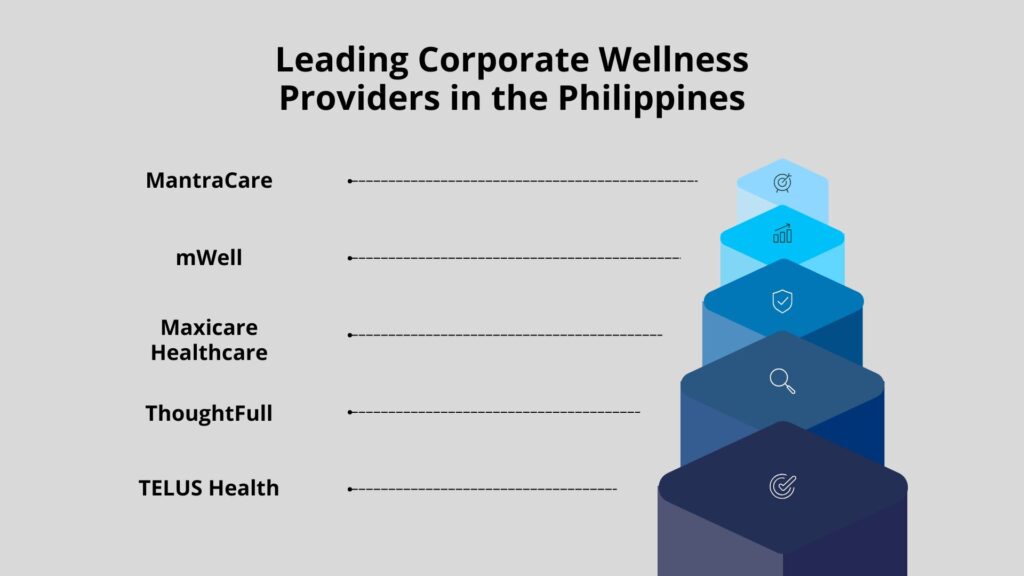
Choosing the appropriate one amongst the best corporate wellness providers in the Philippines for your organization is the key. The comparison is mentioned below –
| Corporate Wellness Provider | Best For | Unique Strength |
| MantraCare | Mid-Size to Large Enterprises | AI-driven holistic platform across mental, physical and preventive care |
| mWell | All Enterprise Sizes | Philippines-native platform with AI scoreboard and KonsultaMD integration |
| Maxicare Healthcare | Large Enterprises and SMEs | Largest hospital network in PH with integrated mental health and telemedicine |
| ThoughtFull | Organizations with a Culture-First HR approach | Text-based coaching, ISO 27001-certified, Southeast Asia-native |
| TELUS Health | Multinational Employers | Global EAP infrastructure with multilingual reach and local data compliance |
1. MantraCare
- Headquarters: Global, with Philippines operations
- Core focus: Holistic, AI-driven employee wellbeing
Having been here for more than a decade, MantraCare is one of the most established global corporate wellness programs in the country, serving more than 80,000 workers nationwide. Its hallmark is wide-rangingness. The one app covers 80+ languages, including mental health counselling, physiotherapy, chronic disease management, nutrition counselling, yoga instruction, meditation and women’s health programs – essential for Philippine employers with remote workforces on Luzon, the Visayas, and Mindanao.
MantraCare integrates AI across every speciality – mental health, musculoskeletal care, nutrition, and chronic disease – to deliver personalised care while reducing healthcare costs through dynamic pricing and smart provider matching. Gamification, daily group-based live sessions, and self-care content encourage more than half (40%+) of employees to interact with the platform.
Key services: EAP counselling, AI-powered chronic disease programs (diabetes, hypertension, PCOS), physiotherapy, fitness and nutrition, manager training, HR dashboard with ROI reporting, HIPAA- and SOC 2-compliant.
2. mWell (Metro Pacific Health Tech Corporation)
- Headquarters: Manila, Philippines
- Core focus: Integrated digital health ecosystem for the Filipino workforce
In recent years, mWell has been the most notable wellness provider amongst the group of the best corporate wellness providers in the Philippines. It is the digital arm of Metro Pacific Investments Corp. (MPIC) and is created with institutional credibility and the clinical infrastructure of one of the country’s biggest conglomerates.
mWell launched Wellness@Work in May 2025 – a suite of customisable corporate wellness programs that provide HR stakeholders with a dashboard to manage all aspects of employee wellness in one place. The heart of it is the Corporate Scoreboard, a first-of-its-kind monitoring system that provides HR teams with real-time data on employee participation, health patterns, and wellness results. It includes monitoring of the AI-powered mWellness Score, which tracks physical activity, and the Mind Health Score, which measures emotional wellbeing and stress levels.
Key services: AI-powered Corporate Scoreboard, 24/7 teleconsultations, fitness and nutrition programs, mWellness Wearables, pharmacy and diagnostics access, Wellness Credits system, turnkey deployment with no additional IT investment.
3. Maxicare Healthcare Corporation
- Headquarters: Manila, Philippines
- Core focus: Comprehensive HMO with integrated wellness and mental health programs
Established in 1987, Maxicare is among the biggest and most reliable Health Maintenance Organizations in the Philippines. Maxicare was the first Philippine HMO to offer a Specialised Care Program for Mental Health – covering psychiatrist consultations and teleconsult access through their Primary Care Clinics. Its network extends to more than 1500 certified hospitals and clinics across the country and makes more than 20000 doctors and specialists available.
With a single provider that combines HMO medical plans with wellness messaging, Maxicare provides one of the most comprehensive offerings available in the market. A key strength for Philippine Companies with employees spread out around the country is its territorial reach. The Maxicare Video Consult app offers 24/7 teleconsult, while corporate plans feature preventive care exams and dental, optical, and wellness coverage for certain levels.
Key services: Inpatient and outpatient HMO coverage, Specialised Care Program for Mental Health, 24/7 teleconsultation, annual physical exams, preventive diagnostics, dental and optical benefits, SME and enterprise plan customisation.
4. ThoughtFull
- Headquarters: Singapore (Philippines operations)
- Core focus: Scalable mental wellbeing and organisational culture
ThoughtFull is an early adopter of the text-based mental health coaching model in Asia – a clinically enabled and culturally adept intervention in a region where mental health stigma exists and is well-researched. The messaging-based format lowers the barrier to entry, making it more likely that employees who would never call a helpline will quietly begin using the service.
It has been ISO 27001 certified, adheres to relevant data privacy laws and is provided in 28+ languages. It is a stepped-care system, combining prevention, early intervention, growth coaching and crisis support in one system. Organisational analytics enable HR leaders to track wellbeing trends, run pulse surveys, and demonstrate program ROI – while maintaining individual employee confidentiality.
Key services: Text-based and video counselling, mental health coaching, wellbeing assessments, manager training, culture analytics, pulse surveys, crisis and critical incident support, ISO 27001-certified.
5. TELUS Health
- Headquarters: Global, with Philippines and Southeast Asia operations
- Core focus: Global EAP infrastructure for multinational and large enterprise employers
One of the world’s most well-known Employee Assistance Program (EAP) providers is TELUS Health (formerly LifeWorks). For Filipino companies implementing benefit structures at regional levels in Asia Pacific, it offers the most operationally logical option – a single vendor relationship and consistent mental health and EAP service delivery in various countries across Asia-Pacific.
It comes with a whole array of built-in tools such as 24/7 counselling access, legal and financial advisory support (in pertinent duties, since money stress is a known factor that causes mental health issues in Filipino workers), manager support line, and critical incident response. The platform will comply with the requirements of the Philippine Data Privacy Act while adhering to international Data Governance.
Key services: 24/7 EAP counselling in multiple languages, including Filipino, legal and financial advisory, digital mental health tools, manager support line, critical incident response, and regional DPA-aligned data governance.
Extended List of Providers Worth Evaluating
| Corporate Wellness Providers | Headquartered | Core Focus | Best For |
| HoliFit | Manila, Philippines | Corporate fitness, health assessments, and employee engagement | Organisations prioritising physical wellness and engagement |
| Sprout Solutions | Mandaluyong, Philippines | HR platform with integrated wellness and DOLE D.O. 208 compliance tools | Companies seeking HR-wellness integration in one local platform |
| Medicard Philippines | Manila, Philippines | Flexible HMO plans for SMEs and enterprises | Companies seeking an affordable, flexible HMO with strong outpatient coverage |
| Intellicare (Asalus Corporation) | Manila, Philippines | Holistic HMO with preventive care and wellness programs | Enterprises seeking a comprehensive HMO with digital health and SME options |
Employers in the USA, Canada, and the United Kingdom are transforming workforce wellbeing through digital health and mental health support. Explore the global leaders in corporate wellness.
How to Choose the Right Provider in the Philippines
Choosing the right corporate wellness provider is not a procurement decision – it is a people decision.
Step 1 – Understand your legal obligations.
Every Philippine employer must comply with RA 11036 and DOLE D.O. 208-20, which mandate a formal Mental Health Workplace Policy and Program. Any provider you evaluate should actively support these requirements.
Step 2 – Confirm Data Privacy Act compliance.
Employee health data is sensitive personal information under Philippine law. Employers must seek informed consent, establish a lawful purpose for collection, and implement reasonable security measures. A Data Processing Agreement must be executed with any wellness provider before implementation.
Step 3 – Assess local language and cultural competency.
Platforms with licensed Filipino counsellors, Filipino-language content, and local customer support consistently achieve higher employee engagement. Ask providers for their Philippines-specific utilisation data — not global averages.
Step 4 – Map complementarity with existing benefits.
The best provider for your organisation closes the gaps in your current benefits structure without duplicating what already exists. If you have comprehensive HMO coverage, you likely need mental health and EAP support more than another curative health layer.
Step 5 – Validate mental health infrastructure depth.
In 2026, the credible minimum is a stepped-care model: digital self-help tools, access to licensed counsellors, referral pathways to clinical psychologists and psychiatrists, and a tested crisis protocol. Verify that counsellors hold current PRC licences – not just a convincing website.
Conclusion
The Philippines labor force is at a turning point. Employers are now getting the message that the cost of doing nothing in mental health is equal to – or higher than – the cost of investing in mental health.
These providers on this list represent the best options available in the Philippines in 2026, with some having a certain strength in terms of clinical coverage, local cultural understanding, digital infrastructure or geographic coverage. No single provider is right for every organisation. It will depend on the type of workforce you have, existing benefits packages, compliance requirements and the level of commitment your leadership are prepared to give to employee wellbeing as a business priority.
Start with compliance. Build from there. Be sure to find a provider that treats your employees like you would like your business treated: with care, accountability, and a long-term strategy.
Belgium and the Netherlands are focusing more on workforce resilience and sustainable employee engagement. Discover the platforms employers rely on most.
Frequently Asked Questions
All employers in the private sector are required to have a Mental Health Workplace Policy and Program under RA 11036 and DOLE D.O. 208-20. Offences subject to PHP 40,000 daily penalties until they are made compliant.
Employers are required to act in accordance with several conditions: to obtain employees’ informed consent before collecting or processing related health information; to establish a legitimate, lawful purpose for collection; and to take reasonable security precautions. All practitioners who manage personal health information are included.
The platform offers modular pricing, multilingual support, and scalable coverage for SMEs that do not require enterprise-level commitments. MantraCare also integrates wellness compliance with HR functions, while Medicard SME plans and Intellicare’s Locale program support growing consumer-focused businesses.
Monitor absenteeism, program utilisation and employee well-being scores from a minimum 12-month baseline(pulse surveys and healthcare claims records). Workplaces with structured wellness policies report improvements as great as 15% in the score for employee engagement and a 10–12% reduction in absenteeism.
Shift-based workforces need 24/7 teleconsultation, accessible mental health support, and stress management for high-pressure environments. Platforms like mWell, MantraCare, and ThoughtFull are well-suited for BPO, customer support, and operations teams.