

Corporate wellness in NZ is no longer about the trendy fruit bowl, discounted gym membership, and break room stress poster. In 2026, it is a genuine workforce management strategy – one that reflects the measurable challenges New Zealand employers are now legally and practically required to address.
The Australia and New Zealand corporate wellness market was valued at USD 1.4 billion in 2022 and is projected to reach USD 2.15 billion by 2030. Stress management is the fastest-growing segment, reflecting rising workplace pressure and pushing more New Zealand employers to invest in structured employee wellness programs.
This guide helps HR leaders and business owners choose the right wellness provider for New Zealand employees in 2026.
Looking for burnout prevention and EAP solutions across Asia-Pacific? See how employers in Australia are responding.
What Is A Corporate Wellness Provider?
A corporate wellness provider works for an employer to create, implement and assess a program of health and wellbeing for their workforce. The best providers develop systems that are better than what is required by law: They design physical, mental, and preventive systems that are sustainable and measurable.
Most serious vendors are organized into three tiers of service.
- Preventive Health includes health risk assessment, biometric screening, workplace ergonomic assessment, onsite health assessment, flu vaccines and skin screening.
- Clinical support includes physiotherapy, occupational health, rehabilitation, GP referrals, and chronic disease management.
- Lifestyle and mental wellness services include EAPs, counselling, resilience training, financial wellness, nutrition support, fitness programs, and manager training.
In New Zealand, especially, access to mental health support is on a greater scale, happening through the employer, not the public system. It’s not until an employer understands this context that they are investing in wellness rather than simply stacking up a structure that benefits people.
Why Corporate Wellness Is Now A Strategic Priority in New Zealand
Before shortlisting any provider, it is worth understanding the forces shaping demand in 2026.
1. Mental health is not a business aspiration; it is a proven business cost.
In the 2024 Workplace Wellbeing survey released by EMA and nib New Zealand, results showed that four out of five workers noticed a negative impact of the uncertain economic climate, and 50% of those workers reported it harmed their mental health. The business consequences are absenteeism, presenteeism, turnover, and the slower erosion of team culture that never shows up cleanly in a single data point.
2. Employees are demanding more from their employers.
A 2024 Workplace Wellbeing survey found that 72% of Kiwi workers considered wellbeing programmes and EAP support important when evaluating employers. Wellness policies are no longer viewed as a competitor differentiator. For a growing segment of the New Zealand workforce, their absence is a reason to leave.
3. Cultural responsiveness is unique to New Zealand.
Many New Zealand workplaces are culturally diverse, and Western-only wellness models often fail to support Māori and Pasifika employees effectively. Providers that integrate te ao Māori approaches, te reo content, and whānau-centred wellbeing deliver better engagement and outcomes. This is not a nice-to-have feature – it is essential for effective workforce support.
Top Corporate Wellness Providers in New Zealand in 2026
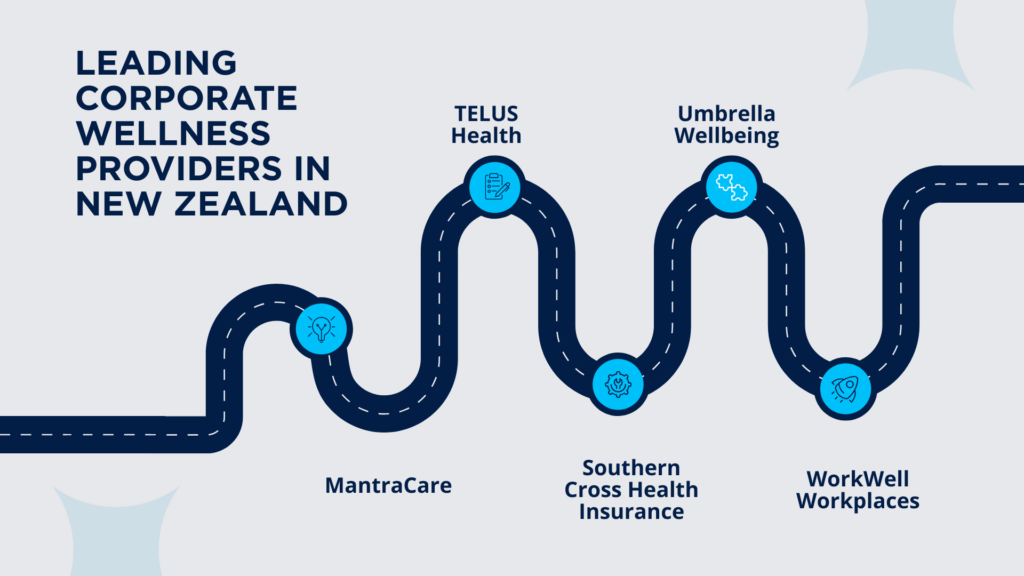
New Zealand’s corporate wellness market combines globally recognised digital platforms with deeply local expertise – from EAPs purpose-built for Kiwi workplaces to health insurers with decades of national presence. The corporate wellness providers in New Zealand below represent the leading companies serving employers across this spectrum.
| Corporate Wellness Provider | Best For | Unique Strength |
| MantraCare | All Business Sizes | AI-powered holistic wellness platform with 10+ years in New Zealand and 80+ language support |
| TELUS Health | Mid-to-Large Organizations | Global EAP leader with a dedicated New Zealand clinical team and Rongoā Māori integration |
| Southern Cross Health Insurance | Employers Prioritising Health Insurance Integration | New Zealand’s largest health insurer with embedded wellness tools and the country’s most comprehensive workforce health research |
| Umbrella Wellbeing (Geneva Wellbeing) | Organizations Seeking Psychologist-Led Wellbeing | New Zealand’s most clinically rigorous native workplace mental health provider |
| WorkWellWorkplaces | Beginning Their Wellness Journey | Free, government-supported accreditation program with a 15-year track record |
1. MantraCare
- Headquarters: Auckland, New Zealand (nationwide)
- Core Focus: AI-powered holistic employee wellness platform
MantraCare has been one of the top corporate wellness providers in New Zealand for over a decade. The company consolidates EAP, fitness, physiotherapy, nutrition, and chronic disease support into a single platform, eliminating the need for multiple disconnected vendors. Employers also get one unified app and HR analytics dashboard for workforce wellbeing management.
The platform uses AI-driven routing to connect employees with the right care pathway automatically, making support easier to access for employees who may not seek help on their own.
Key services: EAP, psychological counselling, chronic condition reversal for diabetes and hypertension, corporate fitness and yoga, nutrition coaching, physical therapy, women’s health programs, health risk assessments, telemedicine, and HR analytics dashboards.
2. TELUS Health
- Headquarters: Auckland, New Zealand (global operations)
- Core Focus: Global EAP and total wellbeing platform with dedicated New Zealand clinical delivery
TELUS Health combines global clinical infrastructure with strong local delivery in New Zealand, allowing employers to access both international expertise and local cultural understanding. They can access both.
TELUS Health stands out in New Zealand through its integration of Rongoā Māori, supporting physical, mental, spiritual, and family wellbeing together. This culturally responsive approach can significantly improve EAP engagement among Māori employees.
Key services: EAP, 24/7 crisis counselling, digital cognitive behavioural therapy, face-to-face therapy, financial and legal work-life services, manager hotline, critical incident support, Rongoā Māori support, and HR strategy portal with engagement analytics.
3. Southern Cross Health Insurance
- Headquarters: Auckland, New Zealand (nationwide, not-for-profit)
- Core Focus: Workplace health insurance with integrated wellness tools and the country’s most comprehensive workforce health research
Southern Cross is not primarily a wellness provider – it is New Zealand’s largest health insurer. Understanding this distinction is important for HR leaders evaluating it, because it shapes what the organization does exceptionally well and where its natural limits are.
The Workplace Wellness study, published with BusinessNZ, covers over 170,000 employees and is New Zealand’s largest workforce wellbeing survey. It tracks absence rates, stress drivers, wellness outcomes, and long-term workplace trends.
Employers already using Southern Cross health cover can access the BeingWellPlus platform for wellbeing resources, webinars, and support without a separate procurement process.
Key services: Group health insurance, BeingWellPlus workplace wellbeing hub, Raise mental health sessions, workplace wellness webinars, Healthy Futures Business Edition research, and the annual Workplace Wellness benchmark report.
4. Umbrella Wellbeing (Geneva Wellbeing)
- Headquarters: Auckland and Wellington, New Zealand (nationwide)
- Core Focus: Psychologist-led workplace mental health, EAP, and organizational wellbeing
Umbrella Wellbeing is in the process of becoming Geneva Wellbeing – an integrated brand bringing together mental health, physical wellness, workplace support, and specialist rehabilitation services under one roof. For organizations that have previously tried digital-first wellness platforms and found them insufficiently grounded in actual clinical expertise, this transition makes Geneva Wellbeing the most credible locally-headquartered option in the New Zealand market.
The critical differentiator is that Umbrella’s EAP is delivered by clinical psychologists, registered psychologists, psychotherapists, and counsellors – not by a triage model that routes employees to a general helpline. Umbrella’s Wellbeing Assessment, benchmarked against normative data from over 6,000 New Zealand employees, gives employers a genuine evidence base for understanding where their workforce sits relative to the national picture – a level of local specificity that no imported global platform can provide.
Key services: Enhanced EAP delivered by registered psychologists, wellbeing assessment and organizational strategy consulting, psychologist-led resilience and mental health workshops, manager and leadership training, psychological safety consulting, eLearning, and workforce wellbeing reporting.
5. WorkWell
- Headquarters: Nationwide (free government-supported program)
- Core Focus: Structured workplace wellbeing accreditation framework for organizations of all sizes
WorkWell deserves more serious attention from New Zealand employers than it typically receives in commercial wellness conversations, precisely because it is free. For the tens of thousands of New Zealand SMEs for whom a comprehensive wellness program is the right next step but a large procurement commitment is not yet realistic, WorkWell provides a structured, evidence-based framework that has guided workplaces across multiple industries for over 15 years.
The accreditation process is logical and step-by-step, covering the full range of components that constitute a credible workplace wellbeing program. The Kick Start pathway makes even first steps accessible for organizations not yet ready for full accreditation.
Key services: Workplace wellbeing accreditation framework, Kick Start flexible non-accredited option, evidence-based program design guidance, industry-specific support, and access to expert wellbeing resources and tools.
Extended Provider List Worth Evaluating
| Corporate Wellness Provider | Headquartered | Core Focus | Best For |
| EAP Services | New Zealand | Long-established local EAP with a trusted national counsellor network | Employers seeking a dedicated domestic EAP with deep community roots |
| Active+ | Auckland, New Zealand | Organizations in physical or high-injury industries need integrated return-to-work support | Organizations in physical or high-injury industries needing integrated return-to-work support |
| Clearhead | Auckland, New Zealand | Digital psychosocial risk monitoring and WorkSafe HSWA compliance tools | HR teams wanting real-time, structured psychosocial hazard tracking |
Interested in how organizations in the USA and the UK are improving retention and employee engagement? Discover the top wellness solutions globally.
How To Choose The Right Corporate Wellness Provider in New Zealand
Selecting the right corporate wellness partner is one of the most consequential decisions an HR leader will make in 2026. The New Zealand market offers strong wellness solutions across different budgets, but choosing the wrong provider can become both costly and highly visible to employees. Here is a structured approach.
Step 1 – Understand your legal obligations before adding anything discretionary.
Under the Health and Safety at Work Act 2015, New Zealand employers must manage psychosocial risks at work – this is a legal obligation, not a wellbeing aspiration. NZ has published formal guidance requiring psychosocial hazards to be identified and managed like any other workplace hazard. Before evaluating any provider on features or price, understand what your organization is actually required to do. A wellness program built on top of an unmanaged psychosocial risk environment does not fulfil your legal duty – it masks it.
Step 2 – Before approaching any vendor, map your workforce.
Assess your workforce by industry, age group, location, work model, and cultural diversity. For employers with significant Māori or Pasifika teams, culturally responsive mental health support is essential for real programme engagement.
Step 3 – Evaluate the mental health infrastructure, specifically, not just the product brochure.
New Zealand’s public mental health system faces well-documented capacity constraints – long wait times, regional gaps, and funding pressures that mean many employees have no realistic pathway to professional support outside what their employer provides. Ask every provider directly how they handle an employee in acute distress – ask whether support is genuinely confidential – ask what the pathway looks like from self-guided digital content to one-to-one counselling to clinical referral. A weak or vague answer tells you whether the platform is a real stepped-care model or a polished helpline.
Step 4 – Assess data privacy and compliance with New Zealand’s Privacy Act 2020.
The Privacy Act 2020 requires organisations to securely collect, store, use, and disclose employee health data. Employers should clearly define what information remains confidential, what data they can access, and how providers protect employee identities in reporting. Providers who blur this line do not just create legal exposure – they destroy the employee trust on which any wellness program depends.
Step 5 – Demand evidence of actual engagement, not coverage statistics.
Proactively offering a wellness program and having employees meaningfully engage with it are very different things. Ask every provider for utilization data – how the program reaches employees who would not proactively seek support, specifically about stigma-reduction strategies in the communication approach. The most sophisticated and expensive wellness platform in the market delivers zero value if the employees who need it most never open the app.
Conclusion
New Zealand’s corporate wellness market is evolving rapidly due to stronger mental health obligations, rising employee expectations, and the growing cost of poor workforce wellbeing.
MantraCare offers an AI-powered platform that unifies multiple wellness services for distributed and multicultural teams. TELUS Health combines global clinical expertise with strong local responsiveness in New Zealand. Southern Cross Health Insurance combines wellness tools with workforce health insights, while Umbrella Wellbeing delivers psychologist-led wellbeing support. WorkWell provides a practical and accessible starting point for New Zealand SMEs building structured wellness programs.
The right provider among the corporate wellness providers in New Zealand is not the one with the most polished sales deck or the most familiar brand. It is the one your employees will actually engage with – in the moments that matter, through channels they trust, and in a way that reflects the real cultural and social fabric of your workforce. In Aotearoa’s current landscape, getting that right has never mattered more.
Searching for workplace mental health solutions in Europe? See how employers in Finland and Switzerland approach employee wellbeing.
Frequently Asked Questions
Not in their modern form, but New Zealand employers must still manage psychosocial risks under the Health and Safety at Work Act 2015. WorkSafe NZ can investigate, issue notices, and prosecute non-compliant employers, making structured wellness programs an important compliance and risk management tool.
No. An EAP mainly provides psychological, legal, and financial counselling, while a full wellness program also covers preventive care, physical health, nutrition, and chronic disease management. Many New Zealand employers mistakenly treat an EAP alone as a complete wellness strategy.
The median annual absence cost per employee in New Zealand is $1,319, with a total economic impact of $4.17 billion. Early intervention programs that combine manager training, digital mental health tools, and professional support consistently improve absenteeism, productivity, and retention.
WorkWell offers a free accreditation framework for organizations of all sizes. MantraCare and TELUS Health provide flexible per-employee pricing suitable for smaller teams. For many SMBs, a strong EAP with 24/7 digital access and local counsellor support is the most practical starting point.
It is not optional. Low EAP utilization among Māori employees often reflects program design failures rather than a lack of demand. Providers that integrate te ao Māori and bicultural approaches improve engagement and strengthen workforce trust.