

Thailand’s corporate wellness market is no longer a peripheral benefit – it is a business imperative. The market reached USD 443.72 million in 2024 and is projected to climb to USD 757.34 million by 2033, growing at a CAGR of 6.12%. That trajectory is not driven by trend-chasing. It is driven by a workforce under measurable strain and employers who are finally connecting the dots between employee health and bottom-line performance.
For HR leaders, business owners, and decision-makers evaluating their options in 2026, this guide cuts through the noise: who the credible providers are, what they actually deliver, and how to choose the right partner for the real complexity of the Thai workforce.
Businesses in Indonesia and Hong Kong are investing more heavily in preventive healthcare and workforce resilience. Compare the leading wellness platforms in both countries.
What Is a Corporate Wellness Provider?
A corporate wellness provider works collaboratively with an employer to design and deliver a structured health and wellness program for their workforce. In practice, this means going well beyond a free gym membership or an annual health check – it means building a sustained, measurable system that supports employees across every dimension of their health.
Effective employee wellness in Thailand takes a genuinely holistic approach in 2026, addressing mental health, physical health, financial wellbeing, and social health in tandem – because these dimensions do not operate in isolation. An employee managing undiagnosed hypertension while under financial stress is not a mental health problem or a physical health problem. They are both, and they need to be treated as both.
Most providers operate across three service levels:
- Preventive health includes health risk assessments, biometric screenings, annual medical check-ups, wellness days, and occupational health audits. This is the diagnostic foundation – understanding what the workforce is actually dealing with before problems become costs.
- Clinical and curative support includes telemedicine, GP referrals, access to specialists, chronic disease management, and pharmacy benefits. This tier keeps employees with existing health conditions functioning and supported within the workplace.
- Lifestyle and mental wellness include Employee Assistance Programs (EAPs), psychological counselling, fitness programs, nutrition coaching, financial advisory, stress management workshops, and legal support. This is the layer employees feel in their daily experience and the one that most directly shapes engagement, retention, and culture.
In Thailand, health risk assessment has emerged as the critical starting point for most corporate wellness efforts – giving organizations a factual picture of their workforce health profile before deciding where to invest.
Why Corporate Wellness Has Become Essential in Thailand
Before creating a provider shortlist, it is worth understanding what the data actually says.
- Mental health is a quantifiable business problem. Thailand’s Department of Mental Health reported that between 2020 and 2024, over 8% of Thais experienced high levels of stress, and nearly 10% were at risk of depression. The Excellence Centre for Depressive Disorder estimated that in 2024, more than 1.3 million Thais aged 15 and above were living with depression – a condition that does not stay at home when someone clocks in for work.
- The cardiometabolic burden is quietly eroding productivity. Around 20% of Thailand’s population has hypertension, but only half are aware of it, and just 30% of those are receiving treatment. Diabetes, obesity, and chronic stress layer on top of that. Employees who are managing undiagnosed or poorly managed conditions are not performing at capacity – they are simply showing up.
- Burnout is the silent cost multiplier. Across Southeast Asia, a 2024 regional assessment found burnout prevalence at 62.9% among full-time workers. McKinsey research indicates Asian employees report higher burnout than the global average, largely due to long working hours, presenteeism culture, and hierarchical workplace structures – all familiar features of the Thai corporate environment. Burned-out employees are 63% more likely to take a sick day and 23% more likely to visit an emergency room, and teams with high burnout show 18 to 20% lower productivity.
- The ROI case is settled. Well-designed, well-measured wellness programs return between THB 3 and THB 6 for every THB 1 spent, through reductions in absenteeism, lower healthcare claims, and higher retention. Thailand’s own data confirms that employee wellness programs have resulted in an average absenteeism rate reduction of 21%. The question in 2026 is not whether to invest. It is which partner to trust with that investment.
Top Corporate Wellness Providers in Thailand in 2026
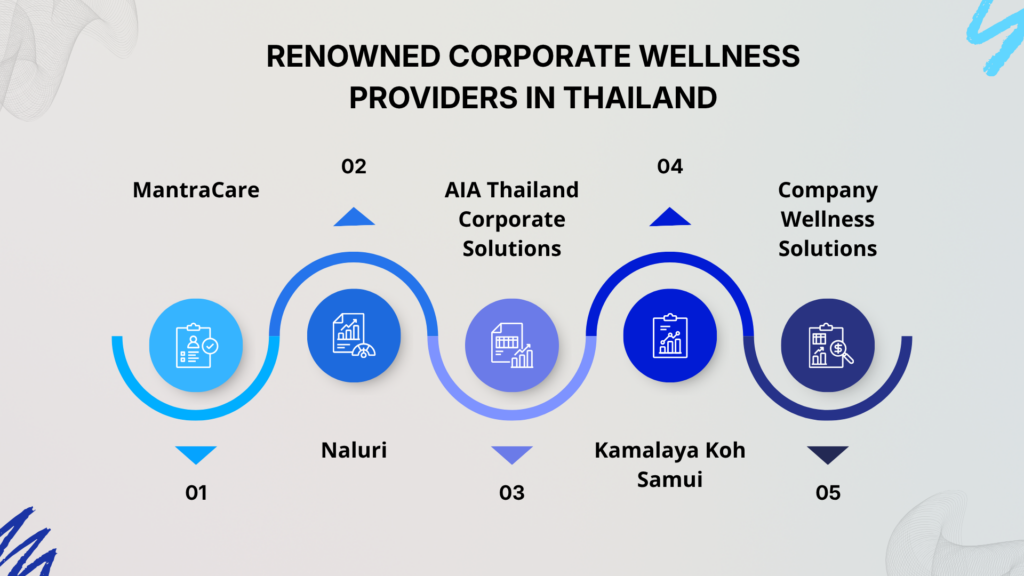
Thailand’s corporate wellness landscape is evolving rapidly as organizations increasingly prioritize employee mental health, preventive healthcare, and workplace productivity. The providers listed below represent some of the leading corporate wellness companies in Thailand, offering services ranging from EAPs and health screenings to fitness, telemedicine, and holistic wellbeing programs.
| Corporate Wellness Provider | Best For | Unique Strength |
| MantraCare | Mid-Size to Large Enterprises | Integrated AI-powered platform across mental, physical & preventive care |
| Naluri | Mid-Size to Large Enterprises | Outcomes-based digital health coaching with SEA clinical depth |
| AIA Thailand Corporate Solutions | Large Enterprises & MNCs | Market-leading group insurance paired with structured wellness activation |
| Kamalaya Koh Samui | Executive & Leadership Teams | Transformative retreat-based wellness for senior cohorts |
| Company Wellness Solutions | All Business Sizes | End-to-end EAP with multilingual, multichannel delivery |
1. MantraCare
- Headquarters: New Delhi (Global, with Thailand coverage)
- Core Focus: Holistic AI-powered employee wellness
MantraCare has been operating in Thailand for over a decade and serves organizations ranging from lean startups to multinational enterprises. What differentiates it in the Thai market is the technology infrastructure: AI-generated health risk assessments, personalized wellness coaching journeys, and an integrated platform that consolidates what most providers force into separate tools and contracts.
The platform addresses the chronic condition burden that sits undetected in Thai workforces – diabetes reversal programs, hypertension management, musculoskeletal care – alongside mental health services and physical wellness. For HR teams that need to demonstrate ROI to leadership, MantraCare’s dashboard provides live reporting on signups, utilization, therapy sessions, engagement rates, and return on investment across offices and departments.
Key services: EAP, psychological counselling, chronic condition reversal (diabetes and hypertension), corporate yoga and fitness, nutrition coaching, physical therapy, women’s health programs, health risk assessments, telemedicine, HR analytics dashboards.
2. Naluri
- Headquarters: Kuala Lumpur (active across Southeast Asia, including Thailand)
- Core Focus: Evidence-based digital health coaching with measurable clinical outcomes
Naluri focuses on measurable health outcomes rather than participation metrics, including reductions in depression, anxiety, chronic disease risks, and absenteeism. In 2025, Mercedes-Benz Thailand partnered with Naluri to launch a personalised employee wellness program covering fitness, nutrition, coaching, and mental health support.
The platform’s Southeast Asia footprint means its clinical frameworks are built for Thai health realities. Workplace wellness interventions in Thailand helped reduce depression, anxiety, and stress levels by 20%, according to Naluri’s research. The company also expanded across Asia after raising Series B funding in 2025.
Key services: EAP, mental health coaching, chronic disease management (cardiometabolic conditions), personalized health plans, multidisciplinary care coaching, organization-level health analytics, cancer and chronic pain support.
3. AIA Thailand Corporate Solutions
- Headquarters: Bangkok
- Core Focus: Group insurance-integrated employee health benefits
AIA Thailand is the market leader in corporate health benefits with 21% market share and nearly 60 years of experience in employee benefits solutions. In the Thai market, its significance cannot be overstated: it is the infrastructure layer that most large Thai employers already use, and its corporate wellness proposition has matured significantly in recent years.
AIA Vitality combines behavioural wellness programs with AIA’s group insurance offerings through wellness days, health screenings, fitness classes, and team health challenges. Organizations with existing AIA employee benefits can add the program as an integrated wellness extension.
Key services: Group health and life insurance, AIA Vitality wellness activation, wellness days, onsite health screenings, fitness classes, mental health check-ups, hybrid working wellness support, and accident insurance.
4. Kamalaya Koh Samui
- Headquarters: Koh Samui, Thailand
- Core Focus: Transformative retreat-based corporate wellness for leadership and executive teams
Kamalaya is in a category of its own. Founded 20 years ago, it has earned over 90 international awards – including 11 in 2025 alone – and welcomes over 30,000 international guests. Its corporate wellness offering is not a day program or a digital platform; it is a tailored group retreat model for organizations that need to address leadership burnout, executive health, team resilience, or cultural reset at depth.
The retreat model is built on integrative medicine: ancient Eastern healing traditions combined with Western clinical frameworks, guided by expert practitioners in stress management, nutrition, sleep, and mental resilience. For companies operating in high-pressure industries – finance, law, manufacturing leadership, executive consulting – Kamalaya addresses the dimension of burnout that an app or a counselling helpline simply cannot reach. Remote and online packages are also available for organizations where in-person stays are not feasible.
Key services: Executive wellness retreats, burnout and stress recovery programs, nutrition and naturopathic consultation, personalized fitness programs, biometric assessment (BIA), brain enhancement programs, and online remote wellness packages.
5. Company Wellness Solutions
- Headquarters: Johannesburg (with Thailand and global reach across 87 countries)
- Core Focus: End-to-end EAP and occupational health
Company Wellness Solutions operates as a turnkey corporate wellness provider, delivering integrated EAP services with multilingual, multichannel access that matters for Thailand’s linguistically diverse workforce. Its app, website, toll-free number, and USSD support ensure employees can access wellness services even without smartphones or stable internet connectivity.
The provider covers up to eight dependents per employee, extending the wellness value beyond the individual and into households – a meaningful differentiator in Thai culture where family health concerns are frequently a driver of workplace stress. Coverage spans mental health, legal advice, financial counselling, fitness support, and nutritional guidance.
Key services: EAP, occupational health management, wellness days, eye and hearing screening, financial and legal counselling, customized workshops, mental health support.
Extended Provider List Worth Evaluating
| Corporate Wellness Providers | Headquartered | Core Focus | Best For |
| Doctor Anywhere Thailand | Bangkok, Nationwide | Telemedicine & digital primary care | Tech companies, remote & hybrid workforces |
| Fitcorp Global Group | Bangkok, Nationwide | Corporate fitness programming | Physical health activation, manufacturing sector |
| The Life Co Int. | Bangkok | Holistic wellness integration | Mid-market enterprises |
Employers in India, the UAE, and South Africa are strengthening workforce resilience through integrated wellness programs. Explore the platforms driving this change.
How to Choose the Right Corporate Wellness Provider in Thailand
Choosing the right corporate wellness provider in Thailand requires more than comparing services or pricing. Employers should evaluate workforce health needs, cultural fit, mental health support, scalability, and the provider’s ability to deliver measurable employee wellbeing outcomes.
Step 1 – Map your workforce before briefing any provider.
A Bangkok fintech team and a manufacturing workforce in Chonburi have virtually nothing in common in terms of wellness needs. Before approaching a vendor, map: age distribution, geographic spread, language demographics, health risk profile, and work structure. The problem definition drives the provider selection, not the other way around.
Step 2 – Get specific about what you are trying to achieve.
Reduce absenteeism? Lower healthcare claims? Address a mental health crisis in a specific department? Improve retention among Gen Z and millennial employees? Different providers are configured for different outcomes. Align provider strengths with your specific top-priority need, not their longest service list.
Step 3 – Demand real accessibility, not just a mobile app.
Mobile-first is necessary but not sufficient in Thailand. For workforces that include front-line workers, factory employees, or staff in Tier-2 cities like Chiang Mai, Khon Kaen, or Hat Yai, check whether the provider supports offline access, Thai-language content, and responsive support outside Bangkok. Digital exclusion from a wellness program is a failure mode, not a feature gap.
Step 4 – Evaluate the mental health infrastructure properly.
Thailand’s mental health burden demands a stepped-care model: self-help tools at the base, confidential helplines, professional counsellors, psychiatric referral pathways, and crisis intervention at the top. Ask every provider to walk you through how an employee in distress moves through their system, and how fast. Gaps in that pathway are not minor – they are the highest-risk failure point in any wellness program.
Step 5 – Push for outcome-based contracts.
Activity-based reporting – sessions delivered, calls answered, events held – is the default metric in the Thai market. Push further. Tie vendors to measurable outcomes: absenteeism reduction, EAP utilization rate, reductions in high-risk health indicators, and employee NPS on the program. Providers that cannot structure an outcomes-based agreement have not been held accountable for results before, and that matters.
Step 6 – Run a structured pilot before committing long-term.
A 3-month pilot with predetermined success metrics protects against the gap between sales pitch and delivery reality. Define success in advance: employee participation rates by department, early utilization data, manager feedback scores, and employee satisfaction with the program. The pilot is the most reliable due diligence tool available.
Conclusion
Thailand’s corporate wellness market is maturing with intent. The combination of rising mental health burden, an undetected cardiometabolic crisis in the workforce, and a generation of professionals who treat wellness benefits as a core part of their employment decision has created a market where inaction is the most expensive option.
The providers in this guide are established operators with credible track records. MantraCare and Naluri offer technology-forward platforms with measurable outcomes. AIA Thailand provides the insurance infrastructure most large corporates already depend on, with a wellness layer built on top. Kamalaya delivers the depth of intervention that digital platforms cannot for executive teams. Company Wellness Solutions offers an accessible, multichannel EAP foundation that works for organizations of every size.
The right provider is not the one with the most impressive brochure. It is the one your employees will actually use, in the language they speak, through channels they can reach, with results that are independently verifiable. In 2026, that bar is higher than it has ever been – and so is the reward for getting it right.
Companies across Sweden, Norway, and Finland are prioritizing workplace mental health and burnout prevention. See which providers are driving long-term workforce wellbeing.
Frequently Asked Questions
The cost of employee wellness programs in Thailand varies depending on the scope of services, workforce size, and delivery model. Basic wellness initiatives are typically more affordable, while comprehensive programs that include healthcare, mental health support, and preventive services require a higher investment.
No. An EAP is a specific component – typically focused on psychological, legal, and financial counselling. A corporate wellness program is broader, covering physical health, preventive care, nutrition, fitness, and mental health in an integrated model. The strongest programs include a robust EAP as one pillar within a wider wellness architecture.
Well-implemented wellness programs generate between THB 3 and THB 6 per THB 1 invested, primarily through reduced absenteeism, lower healthcare claims, and improved retention. Thai market data shows an average 21% reduction in absenteeism from wellness programs. The University of Oxford’s research confirms that companies with strong wellbeing cultures meaningfully outperform those without over 10 years.
Not in their modern comprehensive form. Thailand’s Labour Protection Act and Occupational Safety, Health and Environment Act set baseline workplace safety obligations. Comprehensive wellness programs are not mandated, but the legal and reputational risk of failing to address employee health – particularly mental health – is growing as workforce expectations and ESG reporting standards tighten.
MantraCare, Company Wellness Solutions, and Doctor Anywhere Thailand offer scalable per-employee pricing that does not require large minimum headcounts. For focused mental health support without a full-suite commitment, Naluri is also worth evaluating for smaller organizations.