
When a Mining Company Said Enough – In 2023, the HR director of a mid-sized gold mining operation in Mashonaland faced a problem she couldn’t ignore. Sick-leave claims had spiked. Productivity in two key shifts had dropped by nearly a fifth. Three of her most experienced supervisors had quietly resigned – not for better pay, but because they were exhausted. One cited burnout. Another said the stress had become unmanageable.
She had no wellness program. No EAP. No mental health support. She had a gym subsidy that almost nobody used.
Within eight months of deploying a structured employee wellness program – combining telemedicine, counselling access, and chronic disease management – the company recorded a measurable drop in sick days, higher engagement scores, and a retention rate that had stabilized for the first time in three years. The wellness investment wasn’t a feel-good initiative. It was an operational fix for a documented business problem.
That story is playing out across Zimbabwe’s corporate sector in 2026. And it’s no longer unique to mining.
The Workforce Crisis Driving the Market
Zimbabwe’s economy is rebounding. The World Bank projects 6.6% GDP growth in 2025, supported by recovery in agriculture, iron and steel, and services – outpacing many regional peers in Sub-Saharan Africa. That growth creates opportunity. But it also intensifies the pressure on a workforce that is already strained.
The numbers are sobering. Over 35,900 skilled Zimbabwean workers – predominantly in healthcare – were granted UK work visas in a single year between June 2023 and June 2024. Teachers, engineers, and sector specialists are following the same path. Career prospects, compensation, and social conditions are the top three drivers pushing people out, with career prospects cited by 66% of those who emigrate.
The psychological load compounds the physical one. Across sub-Saharan Africa, workplace burnout has escalated significantly. Globally, two-thirds of employees reported feeling burned out in the past year. Employees experiencing burnout are 63% more likely to take a sick day. Teams with high burnout show 18–20% lower productivity. And turnover intentions double among burned-out staff compared to engaged peers.
In Zimbabwe’s context – where replacing a skilled worker often means competing against better-funded international recruiters – burnout is not just an HR metric. It is an existential business risk.
For HR leaders and business owners evaluating their options in 2026, this guide identifies the credible providers, what they deliver, and how to choose the right partner for Zimbabwe’s specific workforce reality.
Looking beyond Zimbabwe for workplace wellness solutions? Explore leading corporate wellness providers across Nigeria and South Africa and compare employee wellbeing offerings.
What is a Corporate Wellness Provider?
A corporate wellness provider is an organization that partners with an employer to build a structured, sustained health program for their people. That’s different from a gym allowance or an annual health day. It means creating measurable systems that support employees across every dimension of their wellbeing.
In Zimbabwe’s context, truly effective wellness takes a holistic approach. Mental health, physical health, financial wellbeing, and access to clinical care don’t operate in isolation. An employee managing hypertension while navigating financial pressure and occupational stress isn’t one problem – it’s several compounding ones.
Most credible providers operate across three layers.
- Preventive health – health risk assessments, biometric screenings, occupational health audits, and wellness checks. This is the foundation. It identifies what the workforce is actually dealing with before those issues become costs.
- Clinical and curative support – telemedicine, specialist referrals, chronic disease management, and pharmacy access. This keeps employees with existing conditions functional and supported inside the workplace.
- Lifestyle and mental wellness – EAPs, psychological counselling, fitness programs, nutrition coaching, financial advisory, and stress management. This is the layer employees feel every day. It directly shapes engagement, culture, and retention.
In Zimbabwe, mental health support and preventive healthcare have emerged as the priority entry points for corporate wellness investment in 2026. The country’s longstanding pattern of underreporting psychological distress – partly cultural, partly structural – means that visible absence data significantly understates the real burden employers are managing.
The Growing Need For Corporate Wellness in Zimbabwe
Zimbabwe’s corporate wellness market is still developing compared with those of South Africa and Kenya. But the urgency has sharpened considerably in the past two years.
The brain drain is accelerating. Employers who invest in wellness retain staff longer. Those who don’t are losing people to international competitors who offer not just better salaries, but better support. Employee benefits – particularly health coverage and wellbeing programs – are now part of Zimbabwe’s talent retention conversation in a way they weren’t five years ago.
The NCD burden is rising. Diabetes and hypertension alone create measurable productivity loss through absenteeism and presenteeism. Chronic disease and multimorbidity impact the ability of workers to continue working – a pattern observed consistently in Zimbabwean workplace health research. Employers who invest in chronic condition management are protecting output, not just people.
The financial case is becoming clearer. Wellness programs reduce absenteeism. They cut the cost of replacing skilled workers. They lower per-employee healthcare costs over time. For every $1 spent on mental health interventions, organizations typically see $4–5 in return. In 2026, the question for Zimbabwean employers is not whether to invest – it is which partner can deliver results in the specific context of the Zimbabwean workforce.
Top Corporate Wellness Providers in Zimbabwe in 2026
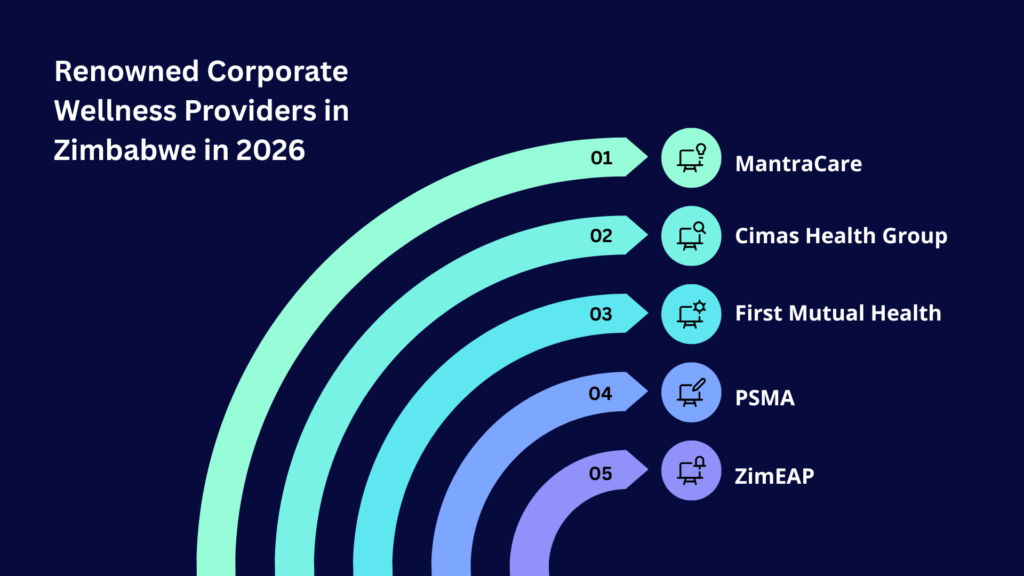
Zimbabwe’s corporate wellness landscape is smaller but growing fast, as organizations in mining, agriculture, finance, and professional services increasingly treat employee health as a strategic input. The providers below represent the credible options for Zimbabwean employers in 2026, covering everything from EAPs and clinical support to digital wellness platforms and comprehensive medical aid.
| Corporate Wellness Provider | Best For | Unique Strength |
| MantraCare Zimbabwe | All Business Sizes | AI-powered holistic wellness platform with 10+ years of Zimbabwean market operations |
| Cimas Health Group | All Corporate Sizes | Zimbabwe’s longest-established medical aid society with the deepest integrated wellness network |
| First Mutual Health | Mid-Size to Large Employers | Innovative biometric and corporate health plans with strong national reach |
| PSMA | Public Sector & Large Corporates | Zimbabwe’s largest medical aid by membership, built for organizational-scale health coverage |
| ZimEAP | All Business Sizes | Zimbabwe’s specialist EAP provider offering counselling, financial, and legal employee support |
1. MantraCare Zimbabwe
- Headquarters: Global (with 10+ years of Zimbabwean market operations)
- Core Focus: AI-powered holistic employee wellness platform
MantraCare is the leading global platform operating in Zimbabwe’s corporate wellness space. It has served 80,000 employees in Zimbabwe and over 30 countries across more than a decade. It delivers 5–7 times higher signup rates than other EAPs operating in Zimbabwe, and 95% of users in Zimbabwe report satisfaction with the program.
The platform’s range is what separates it. Mental health counselling, yoga, physiotherapy, chronic condition reversal for diabetes and hypertension, nutrition coaching, women’s wellness, maternity support, leadership coaching, and telemedicine – all accessible through a single platform, with AI-driven guidance connecting each employee to the right care. MantraCare’s HR dashboard gives employers real-time visibility into engagement, utilisation, therapy sessions, and ROI – a level of reporting transparency that most Zimbabwean market providers don’t offer.
Key services: EAP, psychological counselling, chronic condition reversal (diabetes and hypertension), corporate fitness and yoga, physiotherapy, nutrition coaching, women’s health, maternity and paternity programs, telemedicine, leadership and performance coaching, health risk assessments, and real-time HR analytics.
2. Cimas Health Group
- Headquarters: Harare, Zimbabwe (nationwide operations)
- Core Focus: Integrated medical aid, primary healthcare, and corporate wellness
Cimas has been Zimbabwe’s leading medical aid society since its founding in 1945. Its vision is to be the premier healthcare, lifestyle, and wellness partner for Zimbabwean members. Today, it serves over 230,000 contributing members and positions itself as the preferred provider for individuals, families, and corporations, preferred by corporations and families alike for over 75 years.
For corporate clients, Cimas’s infrastructure is distinctive. It operates medical aid, primary healthcare clinics, laboratory services, pharmacy networks, and its iGo wellness platform – all under one group structure. The iGo platform is the health and wellness arm of Cimas, giving members access to fitness partners, lifestyle rewards, and preventive health activities. Cimas’s corporate social responsibility work includes active chronic condition support, such as a significant donation of insulin pens to the Diabetes Association of Zimbabwe – a reflection of how seriously the group treats NCD management in the Zimbabwean population.
Key services: Medical aid packages (USD and ZWL), iGo wellness and fitness platform, primary care clinic network, laboratory services, pharmacy access, chronic condition support, dental care, international evacuation cover via Healthguard International, telemedicine via Dial-a-Doc, and preventive health screenings.
3. First Mutual Health
- Headquarters: Harare, Zimbabwe (nationwide operations)
- Core Focus: Corporate group health plans with innovative biometric offerings
First Mutual Health is a subsidiary of First Mutual Holdings Limited and one of Zimbabwe’s most active medical aid innovators. It has introduced biometric-linked health plans starting at approximately US$50 per month for basic hospital coverage and health monitoring – a notable product development in a market where affordability is a persistent barrier to corporate wellness coverage.
First Mutual Health has also shown a deliberate commitment to coverage access. Its MicroMed product targets the informal and agricultural workforce – acknowledging that Zimbabwe’s economy is largely informal, and that employer-subsidised plans are increasingly rare. That community-facing orientation matters for corporate clients in sectors like agriculture, mining, and manufacturing, where workforce populations often span formal and informal employment categories.
Key services: Group health insurance, biometric health plans, hospital cover, GP consultations, chronic condition management, MicroMed informal sector plans, specialist referrals, and bundled life and disability benefits.
4. PSMAS (Premier Service Medical Aid Society)
- Headquarters: Harare, Zimbabwe (nationwide operations)
- Core Focus: Large-scale health coverage for public sector and corporate employers
PSMAS is Zimbabwe’s largest medical aid society by membership. Founded in the 1930s to provide health coverage to government employees, it operates over 154 medical service centres across the country through its investment arm – making it the most geographically extensive healthcare network available to Zimbabwean employers.
For large corporates and public sector employers, PSMAS’s scale is its primary advantage. Entry-level plans range from US$10 to US$30 per month, making it the most accessible group health coverage option in the market. Its national footprint reaches employees in secondary cities and rural areas where other medical aid providers have limited presence – a material advantage for employers in agriculture, mining, and infrastructure.
Key services: Group health coverage, nationwide clinic network, specialist referrals, chronic illness support, hospitalisation cover, emergency services, and entry-level affordability at scale.
5. ZimEAP
- Headquarters: Zimbabwe
- Core Focus: Employee Assistance Program delivery for Zimbabwean employers
ZimEAP is one of Zimbabwe’s specialist EAP providers. Its focus is the counselling, financial assistance, and personal support services that sit at the core of any effective employee assistance program. The organization operates with a team of experienced counsellors who support employees through personal and professional challenges – including relationship difficulties, grief, financial stress, substance concerns, and workplace conflict.
For Zimbabwean employers who want dedicated EAP capacity without deploying a full-platform wellness program, ZimEAP provides a credible, locally grounded option. Its counsellors understand the Zimbabwean social context – the financial pressures, family structures, and cultural attitudes toward help-seeking that shape how employees engage with mental health support. That local grounding matters in a market where internationally designed platforms can miss important cultural nuances.
Key services: EAP, psychological counselling, financial assistance, legal referral, work-life balance resources, personal crisis support, and substance concern referral.
Extended Providers Worth Evaluating
| Corporate Wellness Provider | Headquartered | Core Focus | Best For |
| Cigna Global Health Benefits | Global | International health insurance with Zimbabwe market access | MNCs and regional employers need global benefits consistency |
| Wellhub (formerly Gympass) | New York / Global | World’s largest corporate fitness and wellness network | Harare and Bulawayo-based employers prioritizing physical wellness activation |
How do Zimbabwe’s wellness providers compare regionally? See how local corporate wellness companies stack up against providers across emerging markets in the United Kingdom, Canada and India.
How to Choose the Right Provider in Zimbabwe
The right wellness partner for a Harare financial services firm looks very different from the right partner for a tobacco farm in Mashonaland. Here’s how to work through the decision.
Step 1 – Map your workforce.
Assess employees by location, sector, chronic disease risk, language, and economic profile. A mining company with staff across multiple sites needs different solutions than a Harare professional services firm.
Step 2 – Define your primary goal.
Reducing absenteeism, lowering healthcare costs, improving retention, or building a mental health infrastructure – choose a provider based on what your business actually needs, not what’s in fashion.
Step 3 – Confront the stigma problem.
Mental health support is underutilized in Zimbabwean workplaces. Prioritize providers offering anonymous access, self-guided tools, and manager training. If employees don’t trust the platform, they won’t use it.
Step 4 – Evaluate chronic disease capability.
Given the NCD burden in Zimbabwe’s workforce, any serious wellness program must include hypertension and diabetes management – not just counselling and fitness. This is the layer that protects productivity over the long term.
Step 5 – Demand real outcomes data.
Ask every provider for absenteeism reduction figures, EAP utilisation rates, and measurable health improvements from existing clients. Engagement metrics without health outcomes are not evidence.
Step 6 – Pilot before committing.
Run a three-to-six-month structured pilot. Measure uptake, employee feedback, and any early operational impact. In Zimbabwe’s market – where the right fit is highly contextual – a pilot is the only responsible path to long-term investment.
Conclusion
Zimbabwe’s corporate wellness market is emerging from a period of dormancy into genuine strategic relevance. A workforce carrying a rising NCD burden, a documented brain drain pulling 35,900-plus skilled workers out of the country in a single year, and an economy with 6.6% GDP growth projections that will intensify talent competition – all of this has created conditions where inaction on employee wellness is the most expensive option on the table.
Cimas Health Group brings the deepest integrated clinical and wellness infrastructure in the Zimbabwean market. MantraCare delivers AI-powered holistic wellness with a decade of Zimbabwean market operations and measurable ROI. First Mutual Health offers innovative biometric plans and broad accessibility. PSMAS provides the widest geographic reach for large-employer coverage. ZimEAP offers specialist, culturally grounded EAP delivery for employers who need focused mental health support.
The right provider isn’t the one with the most features. It’s the one your employees will actually use – the one that fits their reality, speaks to their challenges, and delivers outcomes that a business can measure. In 2026, that matters more than ever.
Why are organizations prioritizing employee wellbeing? Learn how wellness programs in markets like Indonesia, Malaysia, and Hong Kong improve productivity, engagement, retention, and workforce resilience.
Frequently Asked Questions
Costs vary widely. Entry-level medical aid plans start at US$10–30 per employee per month through PSMAS, while comprehensive plans from Cimas or First Mutual range from US$50–220, depending on coverage tier. Digital EAP platforms like MantraCare start from as little as $2 per employee per month for basic access.
No. An EAP focuses primarily on counselling and referral. A full wellness program also covers preventive health, fitness, chronic condition management, nutrition, and financial wellbeing – a significantly broader scope.
Well-designed programs typically reduce absenteeism, improve retention, and lower per-employee healthcare costs. For every $1 invested in mental health specifically, evidence consistently shows $4–5 in return through productivity and reduced turnover.
Zimbabwe’s Labour Act and occupational health regulations require employers to manage workplace health and safety risks. Comprehensive wellness programs go beyond those minimum requirements – but forward-thinking employers treat them as competitive tools, not compliance boxes.
MantraCare, ZimEAP, and Cimas’s entry-level iGo plans are well-suited for SMBs. First Mutual Health’s MicroMed product also provides affordable access to smaller employer groups and informal-sector-adjacent workforces.