
“He who has health has hope, and he who has hope has everything.” – Arabian Proverb
Japan has long been synonymous with dedication to work. But dedication, without limits, has consequences. In fiscal year 2024, Japan’s Ministry of Health, Labour and Welfare recorded 1,304 recognized cases of overwork-related deaths and health disorders – the highest figure on record. More than 1,000 of those cases involved mental health disorders. That number includes 89 cases of suicide or attempted suicide. The Japanese term for death by overwork, karoshi, is no longer a fringe concept. It is a measurable national health emergency.
Meanwhile, approximately 1 in 10 Japanese workers logs more than 80 hours of overtime per month – the government’s own threshold for elevated karoshi risk. The 2019 Work Style Reform Law capped annual overtime at 720 hours, yet enforcement remains inconsistent. Hidden overtime is widespread. And despite six consecutive years of record-high recognized mental health claims, many employees still suffer in silence – because stigma around mental health remains deeply embedded in Japanese workplace culture.
The Japanese corporate wellness market reached USD 5.0 billion in 2025 and is forecast to grow to USD 7.9 billion by 2034, at a CAGR of 5.25%. That trajectory reflects a workforce – and an employer base – that can no longer treat wellbeing as optional.
For HR leaders, people managers, and business owners evaluating their options in 2026, this guide breaks down who the credible providers are, what they actually deliver, and how to choose the right partner for Japan’s unique workforce challenges.
Curious about wellness programs in neighboring Asia-Pacific countries? Explore corporate wellness in Indonesia, Singapore, and Thailand.
What Is a Corporate Wellness Provider?
A corporate wellness provider works with an employer to design and deliver a structured wellbeing program for their workforce. It goes well beyond annual health checks or a list of gym discounts. It means building a sustained, measurable system that addresses employee health across every dimension – mental, physical, financial, and social – because these dimensions interact and compound.
An employee working 60-hour weeks under harassment, pressure, and financial anxiety is not just tired. They are experiencing overlapping, reinforcing stressors. Effective wellness in Japan must reflect that complexity.
Most providers operate across three service levels.
- Preventive health includes health risk assessments, biometric screenings, occupational physician services, stress check program administration, ergonomic evaluations, and workplace health audits.
- Clinical and curative support includes telemedicine, GP and specialist access, physiotherapy, psychiatric referrals, chronic condition management, and return-to-work rehabilitation.
- Lifestyle and mental wellness include Employee Assistance Programs (EAPs), psychological counseling, stress management workshops, fitness and nutrition programs, smoking cessation, and financial coaching.
In Japan, the primary legal framework is the Industrial Safety and Health Act (ISHA), which requires companies with 50 or more employees to appoint a certified safety and health manager and an industrial physician, and to conduct an annual Stress Check Program for all qualifying workers. Workers who exceed 80 hours of overtime monthly and show signs of fatigue must also be offered a medical consultation. These are legal floors, not ceilings. The strongest wellness providers in Japan either operate as certified occupational health service organizations or embed full compliance support as a standard part of their offering.
Why Corporate Wellness Has Become Urgent in Japan
Japan’s workforce is navigating a crisis with deep roots – and 2026 is the year employers can no longer look away.
1. Karoshi and mental health disorders are at record highs.
In FY2024, the Ministry of Health, Labour and Welfare recognized 1,055 work-related mental health disorders – the first time this figure has crossed 1,000. It is nearly triple the number recognized just 15 years ago. Suicide and attempted suicide account for 89 of those cases.
2. Overwork remains structurally embedded.
More than 10% of Japanese male workers in their 30s and 40s work over 60 hours per week. Work-related stress, job insecurity, and power harassment (pawa hara) remain leading drivers of mental health deterioration. Cultural norms that equate long hours with loyalty continue to create silent suffering.
3. Mental health stigma suppresses help-seeking.
Many Japanese employees choose not to disclose stress or psychological distress to their employers – fearing career consequences. This makes accessible, confidential, and structured support not a luxury but a functional necessity.
4. The ROI is clear and quantifiable.
For every $1 invested in employee mental wellbeing, companies consistently see $4–$5 in return, driven by reduced absenteeism, lower healthcare costs, and stronger retention. In a country already navigating a shrinking labor pool due to demographic decline, retaining experienced workers is a strategic imperative.
Top Corporate Wellness Providers in Japan in 2026
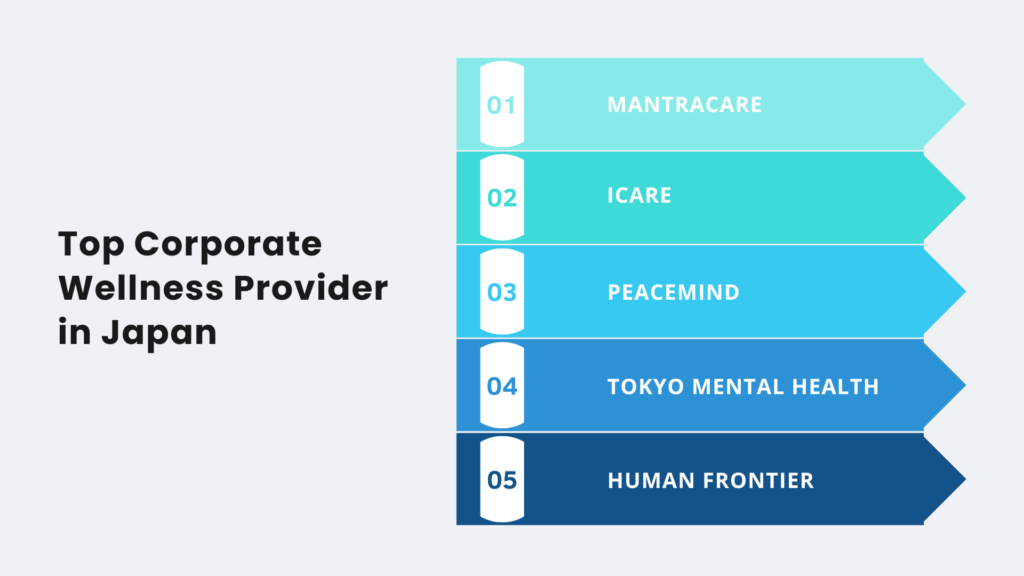
Japan’s corporate wellness landscape has grown considerably as organizations – from global multinationals in Tokyo to domestic mid-sized enterprises across Osaka, Nagoya, and Yokohama – increasingly prioritize structured employee health management.
The providers below represent the leading corporate wellness companies in Japan, offering services spanning AI-powered digital platforms, occupational health compliance, deep-rooted EAP expertise, bilingual clinical support, and nationwide counselor networks.
| Corporate Wellness Provider | Best For | Unique Strength |
| MantraCare | All Business Sizes | AI-powered multilingual platform with full-spectrum EAP, telehealth, and chronic care |
| iCARE | Compliance-Driven Health Management | Japan-native platform (Carely) built for occupational health data, stress checks, and HR integration |
| PEACEMIND | Large Enterprises & Compliance-Heavy Rollouts | Japan’s pioneer EAP provider since 1998, with 1,400+ corporate clients and global partner networks |
| Tokyo Mental Health | Bilingual & International Workforces | Interdisciplinary clinical team offering bilingual EAP, psychiatry, and crisis intervention in Tokyo |
| Human Frontier | Return-to-Work & Domestic Employers | Nationwide counselor network with deep expertise in leave management and relapse prevention |
1. MantraCare Japan
- Headquarters: Global (with Japanese operations and GDPR-compliant data infrastructure)
- Core Focus: AI-powered holistic digital wellness platform
MantraCare Japan delivers one of the most comprehensive corporate wellness providers in Japan. Its services cover mental health (EAP), telehealth, musculoskeletal care, chronic condition management, women’s health, corporate fitness, yoga, and nutrition – all under one AI-guided system that connects employees to the right support at the right time. The platform has been active in Japan for over 10 years, serving companies across Tokyo, Osaka, Nagoya, Fukuoka, and beyond, ranging from SMEs to enterprises with 10,000+ employees.
What makes MantraCare particularly effective in Japan’s increasingly diverse workforce is its delivery in 100+ languages – with content that is culturally adapted, not simply machine-translated. Japanese-speaking licensed psychologists and counselors are available through the platform, alongside English-speaking support for international employees and expats – a critical feature for multinational employers in Japan’s major commercial centers.
Key services: EAP, psychological counseling, chronic condition reversal (diabetes and hypertension), corporate yoga and fitness, nutrition coaching, physiotherapy, women’s health programs, health risk assessments, telemedicine, multilingual delivery, and real-time HR analytics dashboards.
2. iCARE (Carely)
- Headquarters: Tokyo, Japan (acquired by OMRON, September 2025)
- Core Focus: Digital occupational health management platform
Founded in 2011 by occupational physician and psychotherapist Yota Yamada, iCARE has built the leading Japan-native platform for corporate health management. Its flagship product, Carely, digitizes what has historically been a paper-heavy, fragmented process – managing health checkup data, stress check results, occupational physician consultations, and leave and return-to-work workflows – within a single, security-certified cloud environment. Carely is widely used by HR and occupational health teams that need to manage legally mandated health programs efficiently and securely.
In September 2025, OMRON Corporation completed its acquisition of iCARE. That partnership brings together OMRON’s leadership in healthcare devices and biometric monitoring with iCARE’s deep occupational health data infrastructure. New services combining both companies’ capabilities are expected by fiscal 2026. For employers navigating Japan’s Industrial Safety and Health Act obligations – stress checks, industrial physician records, leave management – Carely represents the most purpose-built compliance platform available in the market.
Key services: Health checkup management, stress check program administration, occupational physician consultation records, leave and return-to-work management, HR-occupational health information integration, and health data analytics.
3. PEACEMIND
- Headquarters: Tokyo, Japan (now a subsidiary of TANABE CONSULTING GROUP)
- Core Focus: Pioneer EAP and organizational mental health services
Founded in 1998, PEACEMIND is amongst the original corporate wellness providers in Japan, and after 27 years, it remains one of the country’s most deeply embedded workplace mental health organizations. PEACEMIND supports approximately 1,400 companies, primarily large enterprises, and currently covers roughly 800,000 employees through its network of clinical psychologists, psychiatric social workers, public health nurses, industrial counselors, and certified EAP professionals (CEAP). It is the only private organization in Asia to hold the international quality certification from the University of Occupational and Environmental Health’s Mental Health Service Institution – a distinction that matters for employers who require rigorously accredited clinical governance.
In July 2025, TANABE CONSULTING GROUP acquired the majority shares in PEACEMIND. That integration gives PEACEMIND access to a full management consulting infrastructure – enabling multifaceted interventions that connect employee mental health support with talent strategy, organizational design, and human capital development. For large and complex enterprises dealing with systemic overwork, harassment, or post-restructuring stress, this combination of EAP expertise and management consulting depth is rare in the Japanese market.
Key services: EAP, stress check program (“Workplace and Heart Lively Survey”), organizational analysis and consulting, management and leadership training, harassment prevention programs, leave and return-to-work support, occupational health advisory, and crisis response.
4. Tokyo Mental Health (TMH)
- Headquarters: Tokyo, Japan
- Core Focus: Bilingual clinical mental health services and EAP for international and domestic workforces
Tokyo Mental Health occupies a distinctive position in Japan’s corporate wellness landscape. It is not a technology-first platform. It is a clinically grounded, interdisciplinary mental health provider. TMH is built for organizations navigating high-stress Japanese work culture. It supports a multilingual workforce. TMH offers EAP services in Japanese and English. The team includes psychologists, counselors, therapists, and psychiatrists. They bring direct clinical expertise to corporate wellbeing mandates.
TMH’s EAP package includes mental health concierge services, counseling and consultation, crisis response management, and integrated psychiatric consultation through its affiliation with American Clinic Tokyo. Its proprietary digital assessment tool, Psynary, allows employees to complete stress tests and depression and anxiety screenings independently – in Japanese or English – before a TMH clinician reviews the results and delivers a personalized care recommendation. This approach reduces stigma by giving employees a private, low-barrier first step into support.
Key services: Bilingual EAP (Japanese and English), individual counseling, couples and family therapy, psychological assessment, crisis intervention, Psynary digital screening tool, stress check support, and psychiatric consultation via American Clinic Tokyo partnership.
5. Human Frontier
- Headquarters: Tokyo, Japan (with offices in Osaka and Nagoya; nationwide coverage)
- Core Focus: EAP with specialist expertise in return-to-work and relapse prevention
Human Frontier – now operating as HOKENDOUHJIN-FRONTIER following a merger with HOKENDOHJINSHA – is a long-standing domestic EAP provider with a nationwide network of qualified counselors, each with hands-on experience working within Japanese corporate environments. Its model is built around in-person consistency: the same counselor works with the same employee throughout their case, from initial disclosure through return-to-work and beyond. That continuity of relationship is not common in Japan’s EAP market – and it makes a meaningful difference for employees dealing with complex or recurrent mental health challenges.
Human Frontier’s specialist focus on return-to-work management and relapse prevention is particularly relevant for Japanese employers. Mental health-related absences are costly, often prolonged, and frequently recur without structured reintegration support. Human Frontier’s programs address this systematically – covering not just the individual employee, but also their household members, who, under Japanese occupational health practice, are frequently involved in recovery support.
Key services: EAP, in-person counseling with consistent case counselors, return-to-work and relapse prevention programs, family-inclusive counseling, management and staff training, harassment prevention workshops, and organizational workplace improvement support.
Extended Provider List Worth Evaluating
| Corporate Wellness Provider | Headquartered | Core Focus | Best For |
| Meditopia for Work | Global (strong Japan presence) | Science-based mindfulness, mental wellness, and EAP | Employers prioritizing daily engagement with 41% stress reduction in 8 weeks |
| LebenWell Behavioral Health | Japan | Behavioral health and counseling for international and domestic workforces | Organizations seeking culturally sensitive behavioral health integration |
| Cradle | Japan | Digital mental health support and coaching for workplaces | Growing Japanese companies building preventive mental wellness programs |
Want global insights on employee wellbeing? Check corporate wellness in the USA, India, and Canada.
How to Choose the Right Corporate Wellness Provider in Japan
Selecting the right wellness partner in Japan requires balancing legal compliance, workforce needs, cultural context, and measurable results.
Step 1 – Assess your workforce risks.
Start with data. Review absenteeism records, stress check results, overtime patterns, and engagement survey findings. Understand whether the biggest risks are overwork, harassment, mental health stigma, or something more specific to your industry or workforce demographics.
Step 2 – Verify legal compliance.
Confirm that the provider supports Japan’s Industrial Safety and Health Act obligations – including stress check administration, industrial physician integration, and overtime health consultation requirements. Providers who embed compliance within their service model reduce HR burden significantly.
Step 3 – Evaluate mental health depth and accessibility.
Japan’s mental health stigma problem is real. Choose providers that offer confidential, low-barrier access to support through digital self-assessment tools, anonymous contact options, and counseling in employees’ preferred language. Accessibility drives utilization. Utilization drives outcomes.
Step 4 – Check bilingual and multilingual capacity.
For employers with international teams or expat workforces in Tokyo and Osaka, the ability to deliver psychological support in English – and ideally other languages – determines whether a meaningful portion of the workforce will ever actually use it.
Step 5 – Demand outcome data.
Ask for verified data on EAP utilization rates, stress reduction, absenteeism improvement, and employee satisfaction. Providers who cannot produce outcome evidence are not delivering programs worth investing in.
Step 6 – Pilot before you scale.
Run a three- to six-month structured pilot before committing to a long-term contract. Track engagement, utilization, and qualitative feedback to assess whether the program is reaching the people it is designed to support.
Conclusion
Japan’s corporate wellness market is growing rapidly – driven by a workforce crisis that is no longer deniable and an employer community that is increasingly required to respond, legally and ethically.
MantraCare Japan offers an AI-powered multilingual platform combining EAP, telehealth, chronic care, and HR analytics within one scalable architecture. iCARE provides Japan’s leading occupational health compliance platform, built for stress check management, leave workflows, and HR-physician data integration. PEACEMIND brings 27 years of EAP expertise, a 1,400-company client base, and new management consulting depth following its 2025 acquisition. Tokyo Mental Health bridges the gap between corporate EAP needs and genuine bilingual clinical care, with clear escalation pathways to psychiatric support. And Human Frontier delivers consistent, in-person counseling with a specialist focus on return-to-work and relapse prevention that few domestic providers can match.
The right one to choose from the list of corporate wellness providers in Japan is not the one that looks most comprehensive on a feature list – it is the one that employees will actually use, offering accessible, culturally appropriate, and measurable support for a workforce navigating the real pressures of Japanese working life in 2026.
Looking at diverse approaches worldwide? Learn about corporate wellness in Nigeria, Mexico, Brazil, and Australia.
Frequently Asked Questions
Costs vary by provider and scope. Digital EAPs start from a few hundred yen per employee per month. Comprehensive programs are priced by headcount and service tier. Employers report ROI through reduced absenteeism, lower turnover, and higher productivity.
No. EAPs focus on counseling and referrals. Full wellness programs also cover preventive health, stress check compliance, physiotherapy, chronic condition management, fitness, and nutrition.
Every $1 invested in mental wellbeing typically returns $4–$5 through reduced absenteeism, lower healthcare costs, and stronger retention.
Partially. Companies with 50+ employees must conduct annual Stress Checks, appoint safety managers, and offer medical consultations for high overtime. Broader wellness programs remain voluntary.
MantraCare and Meditopia for Work offer scalable digital solutions. iCARE, Human Frontier, and Tokyo Mental Health provide modular EAPs tailored for smaller teams.